What Are Seamless Pipes?
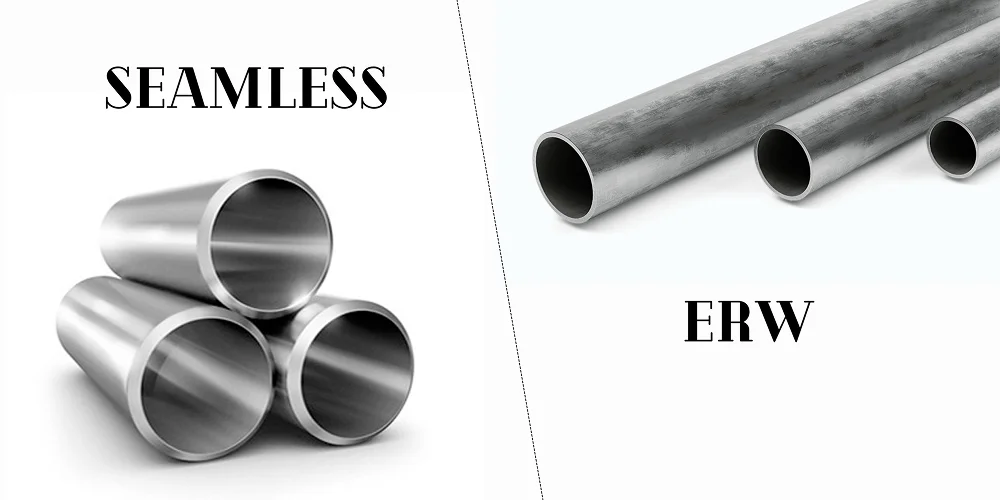
Seamless pipes are designed for high precision, to offer consistent wall thickness & exact dimensions. They are available in sizes ranging from 1/8 inch to 26 inches in outer diameter (OD). Used in industrial applications where high strength and reliability are essential. They are also essential in transporting oil and gas, as well as in air and hydraulic cylinders, bearings, boilers, automobiles & many more. Made from a solid piece of metal, typically a steel billet. Seamless pipes are created by piercing & elongating the material to form a hollow tube.
What is an ERW pipe?
ERW pipes are longitudinally welded & can be manufactured up to 24 inches OD, using strips or coils of steel. ERW pipes are formed through a process involving the pulling of a steel ribbon through a series of rollers & subsequent fusion via an electric charge. They are used in low to medium pressure applications to transfer oil & water. ERW Steel Pipe commonly comes in a range of sizes, from 2 3/8 inches OD to 24 inches OD, with various length options extending over 100 feet. Surface finishes are available in both bare & coated formats. As a leading ERW Stainless Steel Pipes Manufacturer and exporter, we offer top ERW pipes from India. Contact us for detailed product information or custom requirements.ERW Pipe vs Seamless Pipe Manufacturing Process
Understanding the ERW & seamless pipe difference with how they are made. The manufacturing process of seamless pipe vs ERW pipe is different & influences their strength, quality & applications.
Seamless pipes are made from solid round steel billets. These billets are first heated & then pierced using a rotary piercer or extrusion process to create a hollow tube. The pipe is then elongated & rolled to achieve the required thickness and diameter. This method does not involve any welding. They mainly offer superior strength & uniformity.
ERW (electric resistance welded) pipes are designed by cold forming steel sheets into cylindrical shapes. The electric current is applied to generate heat through resistance after edges are met together. This heat fuses the edges together to form a weld without using any filler material. Modern high-frequency ERW techniques ensure a strong & smooth weld to use in medium-pressure applications.
Seamless pipes have slight thickness due to the rolling process, while ERW pipes generally maintain a more uniform thickness because they are made from flat steel strips.
Seamless pipes are ideal for applications that require high strength & pressure resistance. ERW pipes are a more cost-effective solution for standard uses. The right choice depends on your project performance needs & overall budget.
Why use seamless pipes instead of ERW pipes?
Seamless pipes feature a smooth finish with low surface roughness. They are used for applications that need precision & high performance. These pipes are manufactured by drawing solid billets into a tube shape. The overall strength of a seamless pipe matches with the strength of the base material to ensure uniformity & reliability under high pressure.
ERW pipes are made by welding steel sheets or coils along a seam. This material may have high strength & the welded seam is typically the weakest point, which can limit the pipe performance under demanding conditions. Because of this, seamless pipes are often preferred in industries where structural integrity and resistance to pressure are critical.
Why Choose Seamless Pipes for the Oil & Gas Industry?
Seamless pipes offer uniform strength throughout the pipe with no welded joints to reduce the risk of failure under high-pressure conditions. Their precise dimensions & smooth surface ensure secure connections with fittings. It is mainly used for leak-proof operations. ERW pipes may have slight variations in wall thickness & rougher edges to use for high-pressure applications. For critical applications like pipelines & drilling systems, seamless pipes provide the durability, consistency needed to maintain operational integrity to avoid cost.
How to identify Stainless Steel Seamless Pipe or ERW?
To identify whether a stainless steel pipe is seamless or ERW is easy. Just only check the stencil marking on the pipe. If you see ASTM A53 Type S then it’s a seamless pipe. If it is marked as Type E then it’s an ERW (electric resistance welded) pipe. This simple step ensures you select the right pipe for your needs. Seamless pipes are flawless and ERW pipes come with unique manufacturing processes to have high strength. Modern ERW pipes are now highly reliable & perfect for many industrial uses.
At Kalpataru Piping Solutions, we are a leading manufacturer and exporter of ERW stainless steel pipes. We offer a wide variety of pipes with different sizes and shapes designed with ISO and OHSAS-certified materials.
ERW Pipe Thickness Chart and Sizes
| DN | PIPE OUT DIAMETER (OD) | ERW PIPE THICKNESS CHART | |||||||||||||||
| A SERIES | B SERIES | SCH5S | SCH10S | SCH20S | LG | SCH20 | SCH30 | STD | SCH40 | SCH60 | XS | SCH80 | SCH100 | SCH120 | SCH140 | SCH180 | |
| 324050 | 42.448.360.3 | 384557 | 1.61.61.6 | 2.82.82.8 | 3.23.23.6 | — | –3.2 | — | — | 3.63.64.0 | — | — | 5.05.05.6 | — | — | — | 6.37.18.8 |
| 658090 | 76.188.9101.6 | 7689- | 2.02.02.0 | 3.03.03.0 | 3.64.04.0 | — | 4.54.54.5 | — | — | 5.05.65.6 | — | — | 7.18.08.0 | — | — | — | 10.011.012.5 |
| 100125150 | 114.3139.7168.3 | 108133159 | 2.02.92.9 | 3.03.43.4 | 4.05.05.0 | — | 5.05.05.6 | — | — | 5.96.37.1 | — | — | 8.810.011.0 | — | 11.012.514.2 | — | 14.216.017.5 |
| 200250300 | 219.1273.0323.9 | 219273325 | 2.93.64.0 | 4.04.04.5 | 6.36.36.3 | — | 6.36.36.3 | 7.18.08.8 | — | 8.08.810.0 | 10.012.514.2 | — | 12.516.017.5 | 16.017.522.2 | 17.522.225.0 | 20.025.028.0 | 22.228.032.0 |
| 350400450500550600 | 355.6406.4457.0508.0559610 | 377426478529-630 | 4.04.04.05.05.05.6 | 5.05.05.05.65.66.3 | — | 8.08.08.08.08.08.0 | 8.08.08.010.0– | 10.010.011.012.5– | 10.010.010.010.010.010.0 | 11.012.514.216.0-17.5 | 16.017.520.020.0– | 13.013.013.013.013.013.0 | 20.022.225.028.030.032.0 | 25.828.530.032.0– | 28.030.036.040.0– | 32.036.040.045.0– | 36.040.045.050.0– |
ASME B36.19 seamless pipe sizes
| NPS(DN) | ID | ODIN(MM) | WTIN(MM) | WEIGHTLB/FT(KG/M) |
| 1/8(6) | 5S | 0.405(10.3) | *1 | … |
| 1/8(6) | 10S | 0.405(10.3) | 0.049(1.24)*1 | 0.19(0.28) |
| 1/8(6) | 40S | 0.405(10.3) | 0.068(1.73) | 0.24(0.37) |
| 1/8(6) | 80S | 0.405(10.3) | 0.095(2.41) | 0.31(0.47) |
| 1/4(8) | 5S | 0.54(13.7) | *1 | … |
| 1/4(8) | 10S | 0.54(13.7) | 0.065(1.65)*1 | 0.33(0.49) |
| 1/4(8) | 40S | 0.54(13.7) | 0.088(2.24) | 0.43(0.63) |
| 1/4(8) | 80S | 0.54(13.7) | 0.119(3.02) | 0.54(0.8) |
| 3/8(10) | 5S | 0.675(17.1) | *1 | … |
| 3/8(10) | 10S | 0.675(17.1) | 0.065(1.65)*1 | 0.42(0.63) |
| 3/8(10) | 40S | 0.675(17.1) | 0.091(2.31) | 0.57(0.84) |
| 3/8(10) | 80S | 0.675(17.1) | 0.126(3.2) | 0.74(1.1) |
| 1/2(15) | 5S | 0.84(21.3) | 0.065(1.65)*1 | 0.54(0.8) |
| 1/2(15) | 10S | 0.84(21.3) | 0.083(2.11)*1 | 0.67(1.0) |
| 1/2(15) | 40S | 0.84(21.3) | 0.109(2.77) | 0.85(1.27) |
| 1/2(15) | 80S | 0.84(21.3) | 0.147(3.73) | 1.09(1.62) |
| 3/4(20) | 5S | 1.05(26.7) | 0.065(1.65)*1 | 0.68(1.02) |
| 3/4(20) | 10S | 1.05(26.7) | 0.083(2.11)*1 | 0.86(1.28) |
| 3/4(20) | 40S | 1.05(26.7) | 0.113(2.87) | 1.13(1.69) |
| 3/4(20) | 80S | 1.05(26.7) | 0.154(3.91) | 1.48(2.2) |
| 1(25) | 5S | 1.315(33.4) | 0.065(1.65)*1 | 0.87(1.29) |
| 1(25) | 10S | 1.315(33.4) | 0.109(2.77)*1 | 1.41(2.09) |
| 1(25) | 40S | 1.315(33.4) | 0.133(3.38) | 1.68(2.5) |
| 1(25) | 80S | 1.315(33.4) | 0.179(4.55) | 2.17(3.24) |
| 1¼(32) | 5S | 1.66(42.2) | 0.065(1.65)*1 | 1.11(1.65) |
| 1¼(32) | 10S | 1.66(42.2) | 0.109(2.77)*1 | 1.81(2.69) |
| 1¼(32) | 40S | 1.66(42.2) | 0.14(3.56) | 2.27(3.39) |
| 1¼(32) | 80S | 1.66(42.2) | 0.191(4.85) | 3.0(4.47) |
| 1½(40) | 5S | 1.9(48.3) | 0.065(1.65)*1 | 1.28(1.9) |
| 1½(40) | 10S | 1.9(48.3) | 0.109(2.77)*1 | 2.09(3.11) |
| 1½(40) | 40S | 1.9(48.3) | 0.145(3.68) | 2.72(4.05) |
| 1½(40) | 80S | 1.9(48.3) | 0.2(5.08) | 3.63(5.41) |
| 2(50) | 5S | 2.375(60.3) | 0.065(1.65)*1 | 1.61(2.39) |
| 2(50) | 10S | 2.375(60.3) | 0.109(2.77)*1 | 2.64(3.93) |
| 2(50) | 40S | 2.375(60.3) | 0.154(3.91) | 3.66(5.44) |
| 2(50) | 80S | 2.375(60.3) | 0.218(5.54) | 5.03(7.48) |
| 2½(65) | 5S | 2.875(73) | 0.083(2.11)*1 | 2.48(3.69) |
| 2½(65) | 10S | 2.875(73) | 0.12(3.05)*1 | 3.53(5.26) |
| 2½(65) | 40S | 2.875(73) | 0.203(5.16) | 5.8(8.63) |
| 2½(65) | 80S | 2.875(73) | 0.276(7.01) | 7.67(11.41) |
| 3(80) | 5S | 3.5(88.9) | 0.083(2.11)*1 | 3.03(4.52) |
| 3(80) | 10S | 3.5(88.9) | 0.12(3.05)*1 | 4.34(6.46) |
| 3(80) | 40S | 3.5(88.9) | 0.216(5.49) | 7.58(11.29) |
| 3(80) | 80S | 3.5(88.9) | 0.3(7.62) | 10.26(15.27) |
| 3½(90) | 5S | 4.0(101.6) | 0.083(2.11)*1 | 3.48(5.18) |
| 3½(90) | 10S | 4.0(101.6) | 0.12(3.05)*1 | 4.98(7.41) |
| 3½(90) | 40S | 4.0(101.6) | 0.226(5.74) | 9.12(13.57) |
| 3½(90) | 80S | 4.0(101.6) | 0.318(8.08) | 12.52(18.64) |
| 4(100) | 5S | 4.5(114.3) | 0.083(2.11)*1 | 3.92(5.84) |
| 4(100) | 10S | 4.5(114.3) | 0.12(3.05)*1 | 5.62(8.37) |
| 4(100) | 40S | 4.5(114.3) | 0.237(6.02) | 10.8(16.08) |
| 4(100) | 80S | 4.5(114.3) | 0.337(8.56) | 15.0(22.32) |
| 5(125) | 5S | 5.563(141.3) | 0.109(2.77)*1 | 6.36(9.46) |
| 5(125) | 10S | 5.563(141.3) | 0.134(3.4)*1 | 7.78(11.56) |
| 5(125) | 40S | 5.563(141.3) | 0.258(6.55) | 14.63(21.77) |
| 5(125) | 80S | 5.563(141.3) | 0.375(9.53) | 20.8(30.97) |
| 6(150) | 5S | 6.625(168.3) | 0.109(2.77)*1 | 7.59(11.31) |
| 6(150) | 10S | 6.625(168.3) | 0.134(3.4)*1 | 9.3(13.83) |
| 6(150) | 40S | 6.625(168.3) | 0.28(7.11) | 18.99(28.26) |
| 6(150) | 80S | 6.625(168.3) | 0.432(10.97) | 28.6(42.56) |
| 8(200) | 5S | 8.625(219.1) | 0.109(2.77)*1 | 9.92(14.78) |
| 8(200) | 10S | 8.625(219.1) | 0.148(3.76)*1 | 13.41(19.97) |
| 8(200) | 40S | 8.625(219.1) | 0.322(8.18) | 28.58(42.55) |
| 8(200) | 80S | 8.625(219.1) | 0.5(12.7) | 43.43(64.64) |
| 10(250) | 5S | 10.75(273) | 0.134(3.4)*1 | 15.21(22.61) |
| 10(250) | 10S | 10.75(273) | 0.165(4.19)*1 | 18.67(27.78) |
| 10(250) | 40S | 10.75(273) | 0.365(9.27) | 40.52(60.29) |
| 10(250) | 80S | 10.75(273) | 0.5(12.7)*2 | 54.79(81.53) |
| 12(300) | 5S | 12.75(323.8) | 0.156(3.96)*1 | 21.0(31.24) |
| 12(300) | 10S | 12.75(323.8) | 0.18(4.57)*1 | 24.19(35.98) |
| 12(300) | 40S | 12.75(323.8) | 0.375(9.53)*2 | 49.61(73.86) |
| 12(300) | 80S | 12.75(323.8) | 0.5(12.7)*2 | 65.48(97.44) |
| 14(350) | 5S | 14.0(355.6) | 0.156(3.96)*1 | 23.09(34.34) |
| 14(350) | 10S | 14.0(355.6) | 0.188(4.78)Notes(1),(2) | 27.76(41.36) |
| 14(350) | 40S | 14.0(355.6) | 0.375(9.53)*2 | 54.62(81.33) |
| 14(350) | 80S | 14.0(355.6) | 0.5(12.7)*2 | 72.16(107.4) |
| 16(400) | 5S | 16.0(406.4) | 0.165(4.19)*1 | 27.93(41.56) |
| 16(400) | 10S | 16.0(406.4) | 0.188(4.78)Notes(1),(2) | 31.78(47.34) |
| 16(400) | 40S | 16.0(406.4) | 0.375(9.53)*2 | 62.64(93.27) |
| 16(400) | 80S | 16.0(406.4) | 0.5(12.7)*2 | 82.85(123.31) |
| 18(450) | 5S | 18.0(457) | 0.165(4.19)*1 | 31.46(46.79) |
| 18(450) | 10S | 18.0(457) | 0.188(4.78)Notes(1),(2) | 35.8(53.31) |
| 18(450) | 40S | 18.0(457) | 0.375(9.53)*2 | 70.65(…) |
| 18(450) | 80S | 18.0(457) | 0.5(12.7)*2 | 93.54(…) |
| 20(500) | 5S | 20.0(508) | 0.188(4.78)*1 | 39.82(59.32) |
| 20(500) | 10S | 20.0(508) | 0.218(5.54)Notes(1),(2) | 46.1(68.65) |
| 20(500) | 40S | 20.0(508) | 0.375(9.53)*2 | 78.67(117.15) |
| 20(500) | 80S | 20.0(508) | 0.5(12.7)*2 | 104.23(155.13) |
| 22(550) | 5S | 22.0(559) | 0.188(4.78)*1 | 43.84(65.33) |
| 22(550) | 10S | 22.0(559) | 0.218(5.54)Notes(1),(2) | 50.76(75.62) |
| 22(550) | 40S | 22.0(559) | … | … |
| 22(550) | 80S | 22.0(559) | … | … |
| 24(600) | 5S | 24.0(610) | 0.218(5.54)*1 | 55.42(82.58) |
| 24(600) | 10S | 24.0(610) | 0.25(6.35)*1 | 63.47(94.53) |
| 24(600) | 40S | 24.0(610) | 0.375(9.53)*2 | 94.71(141.12) |
| 24(600) | 80S | 24.0(610) | 0.5(12.7)*2 | 125.61(187.07) |
| 30(750) | 5S | 30.0(762) | 0.25(6.35)*1 | 79.51(118.34) |
| 30(750) | 10S | 30.0(762) | 0.312(7.92)*1 | 99.02(147.29) |
| 30(750) | 40S | 30.0(762) | … | … |
| 30(750) | 80S | 30.0(762) | … | … |
ERW Pipe vs Seamless Cost
The cost difference between seamless & ERW pipes arises from their manufacturing processes. Seamless pipes with no weld seam are perfect for high-pressure applications due to their consistent strength & uniform structure. ERW pipes are more cost-effective for less pressure conditions because they are easier to produce & use less material. Seamless pipes have higher cost because they are used in high-pressure & temperature applications. ERW pipes are more affordable to use in applications where extreme pressure resistance is not required.
Frequently Asked Questions on ERW Pipe vs Seamless Pipe
Which is better, seamless or ERW pipe?
Seamless pipes are typically considered better for high-pressure applications. Since these pipes don’t have a weld seam to have a uniform structure with no weak points to provide superior strength & pressure resistance. ERW pipes have a welded seam to use in high corrosive environments.