Stainless steel pipe fittings are crucial components that connect one or more pipes, facilitating in-line branching and directional changes. These fittings are typically available in three main types: butt-weld, threaded/screwed, and socket weld. In this blog, we will focus on socket weld fittings, exploring their types, advantages, disadvantages, and applications.
What Is Socket Weld Fittings?
Socket weld fittings are used to join pipes, valves, or flanges by inserting the pipe into a recessed portion of the fitting. The connection is secured with a fillet weld, creating a robust, leak-proof joint ideal for high-pressure applications. Socket weld pipe fittings follow ASTM and ASME B16.11 standards, which dictate tolerances, pressure, and temperature ratings, ensuring durability and performance.
Types of Socket Weld Fittings
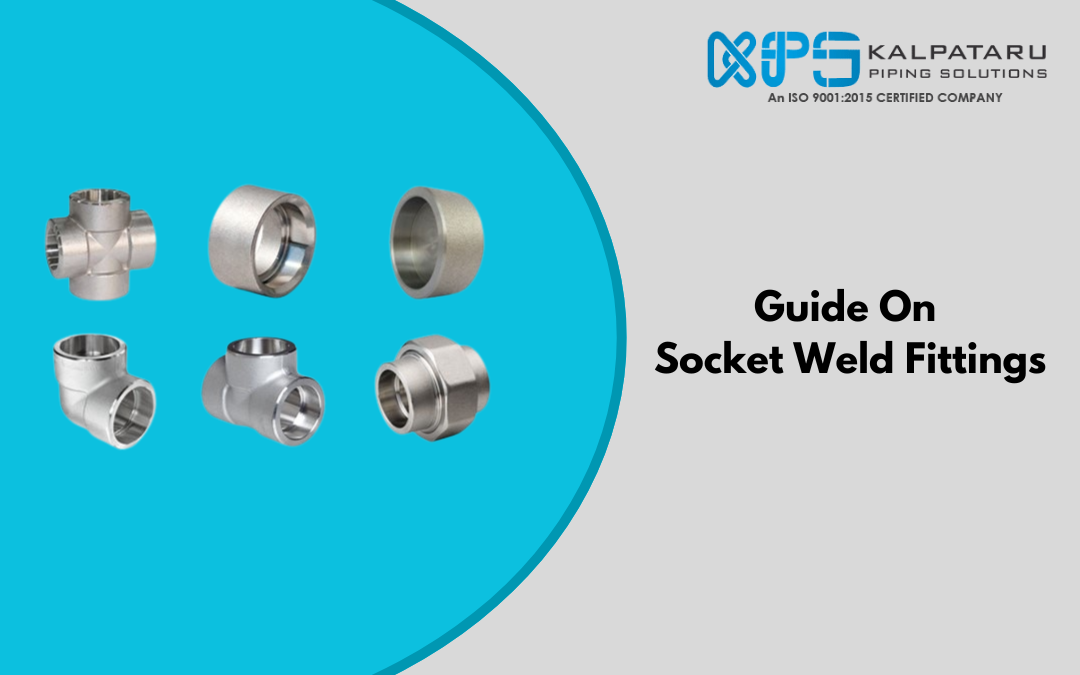
Socket weld fittings are essential components in piping systems, providing robust and leak-proof connections for various industrial applications. Here, we explore different types of socket weld fittings, their functions, and where they are commonly used.
1. Full Coupling : A socket weld full coupling, also known as a socket weld coupler, is a fitting used to connect two pipes or a pipe and a nipple.
2. Half Coupling: A half coupling is a fitting inserted into the end of a run pipe, providing a female threaded end connection. These are often used in conjunction with another half-coupling.
3. Reducing Coupling : Reducing couplings are used to connect two pipes with different outer diameters, allowing for a seamless transition between varying pipe sizes.
4. Reducer Insert : Reducer inserts provide a cost-effective and efficient method for pipeline reductions, ensuring compliance with MSS SP-79 standards.
5. Socket Weld Union : A socket weld union is a screwed connection consisting of three interwoven components. It has two internal threads and a center that, when rotated, draws the ends together.
6. Socket Weld Elbow : Socket weld elbows are used in piping systems with high working pressures and temperatures, where the pipe walls are thick. The pipe is inserted into the socket, and fillet welds are made on both sides of the joint.
7. Socket Weld Tee (Straight and Reducing) : Socket weld tees are specialized fittings used to create a 90-degree branch off the main pipe. They connect to pipes of the same diameter forming the head of the tee, with openings for additional pipe connections.
8. Socket Weld Cross : A socket weld cross allows for the creation of a 90-degree branch from the main pipe run, similar to a tee but with four connections.
9. Socket Weld Cap : Socket weld caps are end caps used to seal the ends of pipes. They are cap-shaped and provide a secure closure for the pipeline.
Advantages of Socket Weld Fittings
- Easy Alignment: The socket ensures proper alignment, eliminating the need for tack welds.
- Leakage Reduction: Lower risk of leakage compared to threaded fittings.
- No Bore Contamination: Weld metal does not flow into the pipe bore.
- Cost-Effective Installation: Cheaper to install than butt weld fittings due to fewer machining and dimensional requirements.
Disadvantages of Socket Weld Fittings
- Ensure a 1.6mm gap between the socket shoulder and the pipe for proper welding.
- Internal crevices and expansion gaps can promote corrosion, making socket weld fittings less suitable for radioactive or corrosive applications.
- These fittings are unsuitable for ultra-high pressure in food industries due to incomplete penetration and hard-to-clean crevices.
Uses of Socket Weld Fittings
- High Pressure Handling: Ideal for industrial uses due to their ability to handle high pressure.
- Leak-Free Connections: Provides strong, leak-proof joints, crucial for pipelines transporting flammable or hazardous chemicals.
- Performance Standards: Meets strict ASME and ASTM standards for tolerances, pressure, temperature ratings, dimensions, materials, and markings.
- Material Variety: Available in alloy steel, carbon steel, and stainless steel, suitable for various fittings like couplings, reducers, tees, elbows, and flanges.
- Wide Application: Versatile use across different industries due to the variety of materials and fitting types.
Butt Weld Vs Socket Weld
Socket weld (SW) fittings follow the ASME B16.11 standard, which specifies that a pipe is inserted into the recessed area of the fitting. Both the fitting and the pipe must be square cut, with no need for additional preparation or beveled ends beyond cleaning the external surfaces. This streamlined approach simplifies both installation and welding processes.
In contrast, butt weld (BW) fittings are governed by the ASME B16.9 standard. These fittings are welded directly onto the ends of the pipes, and their thickness matches that of the pipes. Unlike socket weld fittings, butt weld fittings require the ends to be beveled, which adds an extra step to the preparation process.
Understanding the difference between socket weld and butt weld is crucial for selecting the appropriate fitting type for your project.
Read more : Difference Between Socket Weld and Buttweld
Conclusion
In conclusion, socket weld fittings are vital for creating reliable, high-pressure connections in piping systems. Their ease of use, durability, and versatility make them an excellent choice for various industrial applications. For optimal performance and longevity, choosing high-quality stainless socket weld fittings is essential.
FAQS
What are the advantages of using socket weld fittings?
Socket weld fittings are perfect for small pipes carrying flammable or toxic materials, and handle steam pressures up to 600 psi, providing strong connections, high flow, and minimal leakage.
What is the difference between socket weld and butt weld fittings?
Socket weld fittings insert a pipe into a recessed fitting and secure it with fillet welds, while butt weld fittings require beveling the pipe ends and welding them directly.
What is the maximum pipe size for socket weld fittings?
Socket weld fittings are typically used for pipes up to 4 inches in diameter.
What materials are used for socket weld fittings?
Socket weld fittings are commonly made from alloy steel, carbon steel, and stainless steel to suit various applications and ensure durability.