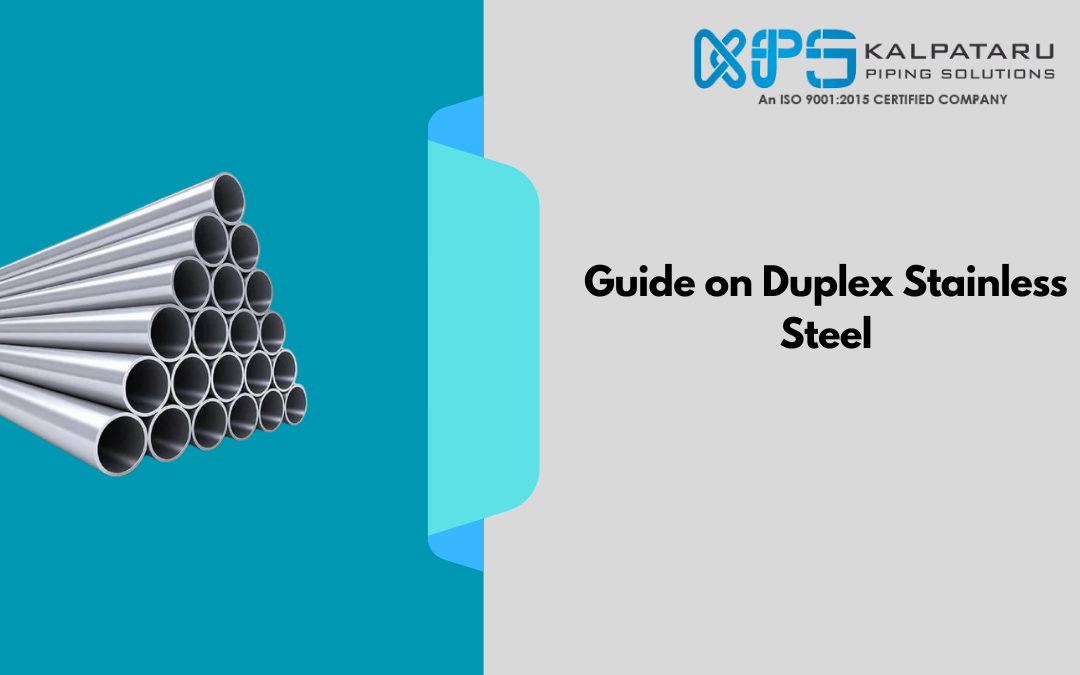
Duplex stainless steel material can contain an equal combination of both austenite and ferrite substances. This type of material has its unique microstructure offering higher strength & great corrosion resistance. In this blog, let’s explore its benefits, offering grades & applications.
Understanding Duplex Stainless Steel
Duplex stainless steel material can be designed by combining the high strength of ferritic stainless steel with the superior corrosion resistance of austenitic stainless steel. Typically these materials consist of 40 to 60% ferrite after solution annealing. Higher chromium and molybdenum content provide exceptional resistance to pitting and crevice corrosion, especially in aggressive environments.
Benefits of Duplex Stainless Steel
Stronger & Durable
Duplex stainless steel has a high yield strength that allows manufacturers to use thinner sections, reducing weight while maintaining structural integrity. It is highly durable due to its superior mechanical properties.
Great Corrosion Resistance
It is particularly resistant to chloride stress corrosion cracking, pitting, and crevice corrosion, to resolve the common issues in application to handle aggressive chemicals or salty seawater. The high content of chromium, molybdenum, and nitrogen in duplex stainless steels significantly enhances its ability to resist oxidation and corrosion.
Cost-Effective Solution
Duplex steel is more affordable as it contains less nickel chemical compounds. Since it is cost effective, offers long service life and minimal maintenance requirements.
Versatility in Use
As duplex steel materials are available in multiple forms such as sheets, plates, bars, and pipes, they can be used in a variety of industrial applications.
Chemical Composition of Duplex Steel
- Chromium: With concentrations ranging from 18% to 28%, chromium is essential for creating a passive oxide layer on the steel’s surface. This layer protects the material from oxidation and corrosion.
- Molybdenum: Present in amounts up to 5%, molybdenum significantly improves resistance to pitting and crevice corrosion.
- Nickel: While present in smaller amounts (1.5% to 8%), nickel stabilizes the austenitic phase, improving toughness and ductility.
- Nitrogen: Nitrogen concentrations typically range from 0.08% to 0.50%. It strengthens the material by increasing yield strength and improving resistance to pitting and crevice corrosion.
- Carbon: Duplex stainless steel contains very low levels of carbon (less than 0.04%), which prevents the formation of chromium carbides and ensures excellent resistance to intergranular corrosion, especially in welded sections.
- Manganese: Present in grades like LDX 2101, manganese (around 1.5%) contributes to the strength, toughness, and deoxidizing properties of duplex stainless steel, helping create a defect-free microstructure.
Why Choose Us for Duplex Steel Needs?
As a leading manufacturer, exporter & supplier of duplex stainless steel materials, we offer high quality products with most popular grades needed for various industries at affordable prices & timely delivery.
- Duplex 2205 or Duplex UNS S31803: Known for excellent corrosion resistance with high levels of chromium, molybdenum, and nitrogen. Not ideal for temperatures above 300°C.
- Duplex 2507: Super duplex stainless steel with high molybdenum and chromium content, offering excellent resistance to pitting and crevice corrosion. Suitable for harsh environments but may become brittle at high temperatures.
- Duplex 2101: A lean duplex stainless steel with good corrosion resistance, stronger than stainless steel 304 but not as high as 316. Cost-effective due to lower nickel and molybdenum.
- Duplex 2304: Lean duplex stainless steel offering similar corrosion resistance to 316L with greater strength, used in construction and pulp and paper industries. Can be prone to pitting corrosion in chloride-rich environments.
- Duplex 2760: Super duplex stainless steel providing excellent resistance to pitting, crevice corrosion, and sulfide stress corrosion cracking, though it can become brittle at high temperatures.
Uses of Duplex Stainless Steel
- Duplex stainless steels are widely used across various industries due to their excellent corrosion resistance, high strength, and cost-effectiveness. Key applications include:
- Offshore and Near-Shore Operations: Ideal for oil drilling, desalination, and water treatment.
- Chemical and Liquid Processing: Used in equipment handling corrosive substances.
- Naval Parts and Components: Suitable for marine environments.
- Pollution Control Equipment: Effective in reducing environmental contaminants.
- Pulp and Paper Production: Resists corrosion in harsh chemical environments.
- Construction: Durable for structural applications.
- Hot Water and Brewing Tanks: Resists corrosion and maintains structural integrity in hot, acidic environments.
FAQS
What is the tensile strength of duplex stainless steel?
The tensile strength of duplex stainless steel typically ranges from 550 to 750 MPa (80,000 to 110,000 psi), depending on the specific grade and heat treatment.
How do you weld duplex stainless steel?
Weld duplex stainless steel with suitable filler materials, preheat properly, and perform post-weld heat treatment. Use low heat input to prevent chromium carbide precipitation.
Can duplex stainless steels be used at high temperatures?
Duplex stainless steels are not ideal for temperatures above 300°C (572°F) due to embrittlement. Super duplex or high-temperature alloys are better for such conditions.
Are Duplex Stainless Steels Magnetic?
Yes, duplex stainless steels are magnetic due to their mixed microstructure of austenite and ferrite, which imparts some magnetic properties.