Stainless steel is famous for resisting rust, mainly because of its chromium content. There are different types of stainless steel, including Ferritic, Martensitic, Austenitic, and Duplex. Duplex stainless steel mixes features of both ferritic and austenitic steels, giving it high strength and good resistance to stress and corrosion. It’s ideal for tough conditions and demanding applications.
In contrast, 316 stainless steel is a type of austenitic steel known for its excellent resistance to rust, especially in salty or acidic environments. It’s often used where there’s a lot of exposure to corrosive materials.
Here in this blog we will learn about how Duplex stainless steel and 316 stainless steel are different. Understanding these differences will help you pick the right stainless steel for your needs.
What is Duplex Stainless Steel?
Duplex stainless steel has a unique two-phase structure, mixing ferritic and austenitic grains. When cooled to room temperature, about half of the ferritic grains turn into austenitic grains. During melting, the steel first turns into the ferritic phase. For example, 2205 duplex stainless steel (UNS S32750) has this dual-phase structure, combining both types of stainless steel. This unique structure gives duplex stainless steel a range of advantageous properties, including:
- High Strength: Duplex stainless steel is generally stronger than other types of stainless steel, making it suitable for applications requiring high strength and durability.
- Corrosion Resistance: It offers excellent resistance to chloride stress corrosion cracking and pitting, making it ideal for use in aggressive environments.
- Cost-Effectiveness: Duplex stainless steel often has lower levels of expensive alloying elements like nickel, which can make it more cost-effective compared to austenitic grades.
- Good Toughness: Despite its high strength, duplex stainless steel maintains good toughness and ductility, making it easier to fabricate and weld.
- Heat Resistance: It performs well in high-temperature environments, retaining strength and stability at elevated temperatures.
Duplex stainless steel is often used in chemical processing, oil and gas industries, and marine environments because it’s strong and resistant to rust.
Get in touch with us for more details.
What is 316 Stainless Steel?
316 stainless steel is a type of austenitic stainless steel known for its excellent corrosion resistance and high strength. It is often used in environments where exposure to harsh conditions, such as seawater or acidic chemicals, is common. Here are key characteristics of 316 stainless steel:
- Composition: 316 stainless steel typically contains 16-18% chromium, 10-14% nickel, and 2-3% molybdenum. The addition of molybdenum enhances its resistance to chloride-induced corrosion.
- Corrosion Resistance: It offers superior resistance to corrosion and pitting compared to 304 stainless steel, especially in marine and chemical environments. Its resistance to chloride and high temperatures makes it suitable for applications in chemical processing, marine environments, and more.
- Strength and Toughness: 316 stainless steel has good tensile strength and toughness, which makes it durable and suitable for structural applications.
- Heat Resistance: It maintains its strength and stability at high temperatures, making it suitable for use in elevated temperature environments.
- Fabricability: This grade of stainless steel is easy to machine, weld, and fabricate, which makes it versatile for various applications.
Common uses for 316 stainless steel include marine equipment, chemical processing equipment, medical devices, and components that require high resistance to corrosion and high temperatures.
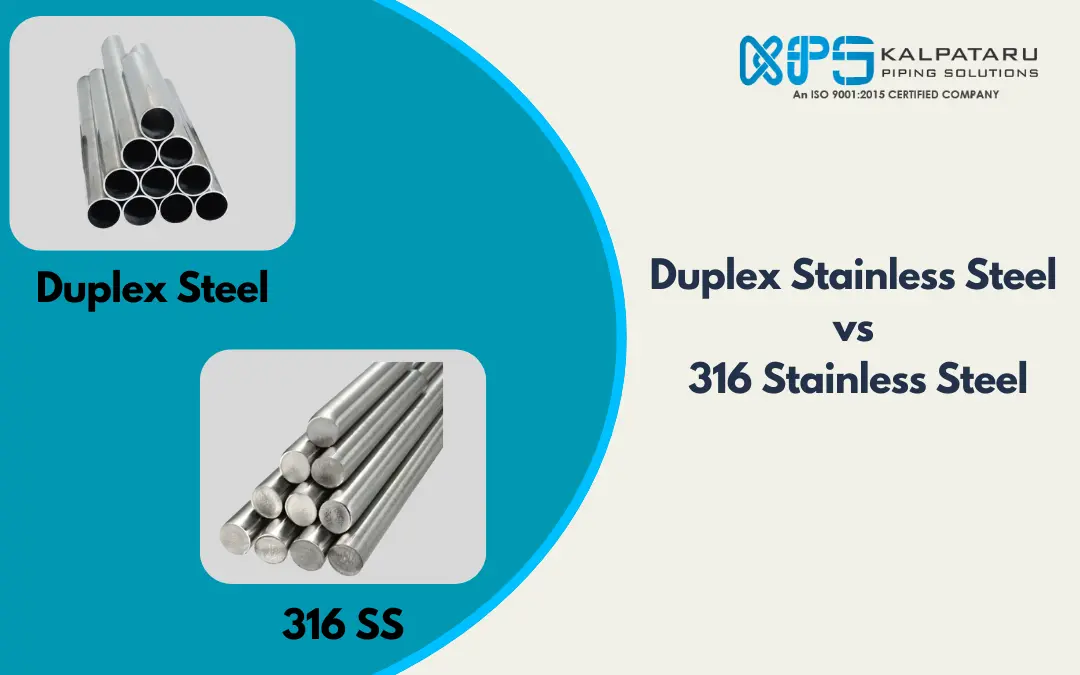
Difference Between Duplex Steel & 316 Stainless Steel
Duplex steel and 316 stainless steel are two distinct materials, each with its own set of qualities and uses. Both are commonly used across various industries, but they excel in different areas due to their unique properties.
Duplex stainless steel is known for its high resistance to corrosion and impressive strength, making it ideal for applications where these features are crucial. It’s widely used in industries such as oil and gas, marine, and chemical processing. Compared to 316 stainless steel, duplex SS generally contains more chromium, molybdenum, and nitrogen, which contributes to its superior strength and corrosion resistance at higher temperatures. Additionally, duplex steel has higher ductility than 316 steel, making it easier to shape into complex forms without cracking.
On the other hand, 316 stainless steel (or 316 SS) is a versatile material that handles high temperatures well and offers strong corrosion resistance. It’s commonly used in the food, medical, aerospace, and various other industries. 316 steel contains 18% chromium and 8% nickel, providing good resistance to rust and corrosion, especially in chloride environments.
In summary, while both 316 stainless steel and duplex stainless steel are austenitic steels, duplex stainless steel is stronger and more resistant to chloride stress corrosion cracking, making it suitable for demanding applications. 316 stainless steel remains a popular choice for its flexibility and performance in a range of environments.
| Material | Duplex Stainless Steel | 316 Stainless Steel |
| Composition | Contains high levels of both austenitic and ferritic stainless steel | Contains only austenitic stainless steel |
| Corrosion Resistance | More resistant to corrosion and cracking due to higher chromium, molybdenum, and nitrogen content | Less resistant to corrosion and cracking due to lower chromium and molybdenum content |
| Strength | Higher yield and tensile strength compared to 316 stainless steel | Lower yield and tensile strength compared to Duplex Stainless Steel |
| Weldability | Can be more difficult to weld due to higher alloy content | Easier to weld compared to Duplex Stainless Steel |
| Cost | Generally more expensive than 316 stainless steel | Generally less expensive compared to Duplex Stainless Steel |
| Applications | Used in industries requiring high strength, corrosion resistance, and toughness, such as oil and gas, chemical processing, and marine engineering | Widely used in various applications, including food processing, medical equipment, and architecture, where high corrosion resistance is not critical |
Advantages Of Duplex Stainless Steel
The key benefits of duplex stainless steel are its high strength and superior corrosion resistance. Additionally, duplex stainless steels are less prone to stress corrosion cracking compared to other stainless steel types.
Disadvantages Of Duplex Steel
The main drawback of duplex stainless steel is its higher cost compared to austenitic and ferritic stainless steels. It is also less commonly available, which can impact procurement and availability.
Conclusion
Both Duplex Stainless Steel and 316 Stainless Steel offer distinct advantages depending on the application. Duplex stainless steel provides superior strength and corrosion resistance but comes at a higher cost. 316 stainless steel, while less resistant to corrosion compared to duplex steel, is cost-effective and highly versatile. Understanding these differences can help in selecting the appropriate material for specific needs in various industries. For more information on stainless steel types and their applications, consult with Kalpataru Piping Solutions.
FAQs
1.Which is better: Duplex 2205 or 316 stainless steel?
When comparing Duplex 2205 and 316 stainless steel, Duplex 2205 generally stands out as the superior choice for demanding applications. Marine-grade Duplex 2205 contains higher levels of Chromium, Nickel, Molybdenum, and Nitrogen compared to 316 stainless steel. This enhanced composition results in a product that is significantly stronger and offers nearly twice the corrosion resistance of marine-grade 316 stainless steel.
2.What is the hardness of duplex stainless steel?
Duplex stainless steel 2205, which features a two-phase ferritic/austenitic structure, offers high strength and exceptional corrosion resistance. In its annealed condition, it has a maximum Brinell hardness of 290, equivalent to Rockwell C31.
3.What is the temperature limit for duplex stainless steel?
For duplex stainless steel, the maximum temperature limit is typically around 250°C, while for super duplex stainless steel, it is generally around 150°C. However, many standards and codes do not differentiate between duplex and super duplex grades, often setting 150°C as the standard maximum temperature.