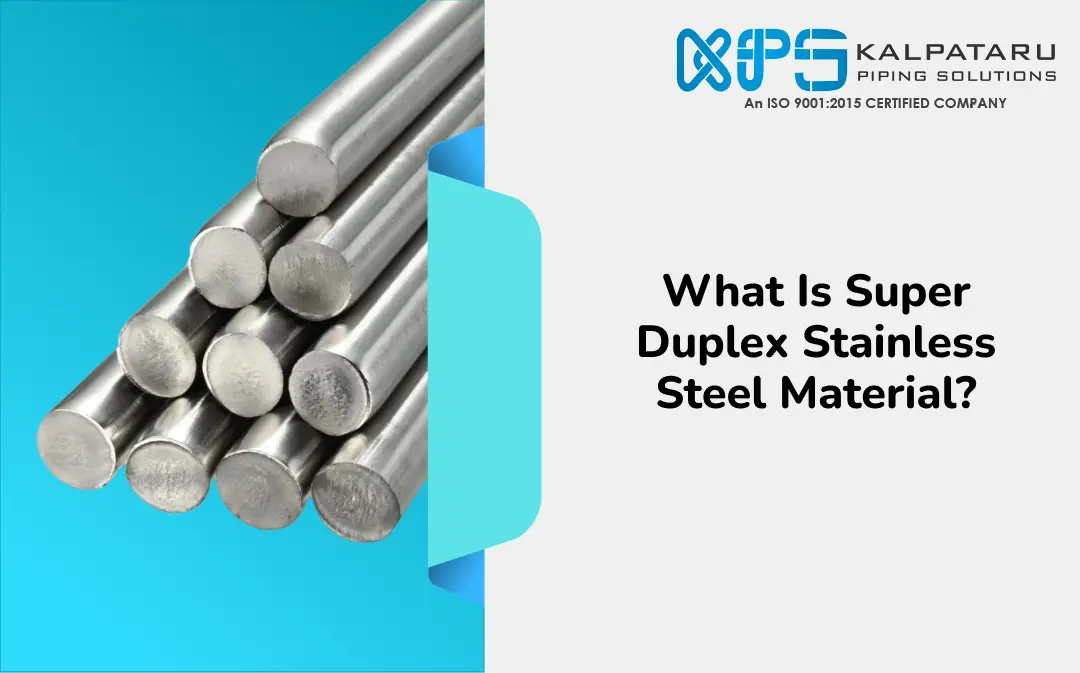
‘Super duplex’ refers to a group of high-performance stainless steels with approximately 25% chromium content. True to its name, this alloy features a microstructure composed of both austenitic and ferritic steel grains. This unique duplex structure gives Super Duplex stainless steels their distinctive physical and mechanical properties.Super duplex stainless steel is a high-performance alloy distinguished by its exceptional strength and corrosion resistance. It features a unique microstructure that combines both austenitic and ferritic stainless steel phases, providing an outstanding balance of mechanical and chemical properties. Typically containing around 25% chromium, super duplex steel excels in resisting corrosion, especially in chloride-rich environments. The addition of molybdenum and nitrogen further enhances its resistance to pitting and stress corrosion cracking. With its high tensile strength and toughness, super duplex stainless steel is ideally suited for demanding applications, including those in the oil and gas industry, chemical processing, and marine environments. Its robust properties make it a preferred choice for high-pressure and high-temperature conditions.
History of Super Duplex Materials
The journey of duplex stainless steel began in Sweden, where it was initially developed for the sulfite paper industry to address corrosion issues caused by chloride-laden cooling waters. While these early duplex alloys represented a significant advancement, they did not fully meet the industry’s demands, leading to further innovation.
The next step in this evolution was the development of super duplex stainless steel. The pioneering alloy in this category, Ferralium 255, was created by Langley Alloys in the 1960s. However, the term “super duplex” itself did not emerge until the 1980s. It was used to describe highly alloyed, high-performance duplex steel with exceptional pitting resistance, determined by a formula of Cr% + 3.3Mo% + 16N% > 40. Over time, various grades of super duplex stainless steel have been developed, including the introduction of Super Duplex F61 in 1969.
Uses of Super Duplex Stainless Steel
Super duplex stainless steel, including grades like Super Duplex 2507 and UNS S32750, is highly valued for its exceptional resistance to acids, acid chlorides, and caustic solutions, making it ideal for aggressive environments in the chemical, petrochemical, pulp, and paper industries. Its superior resistance to stress corrosion cracking and enhanced mechanical properties set it apart from more common austenitic stainless steels, such as the 3xx series, and standard duplex steels like S32205.
Super Duplex material is commonly used in demanding applications, including pumps, valves, fasteners, pipework, and connectors, particularly in the oil and gas, petrochemical, chemical, pulp, and paper industries. Langley Alloys offers an extensive range of super duplex materials, including solid bars up to 16 inches (406.4mm) in diameter, plates up to 3 inches thick, and access to pi
Super-Duplex stainless steels and their characteristics
The term “Super-Duplex” was first used in the 1980’s to denote highly alloyed, high-performance Duplex steel with a pitting resistance equivalent of >40 (based on Cr% + 3.3Mo% + 16N%). With its high level of chromium, Super-Duplex steel provides outstanding resistance to acids, acid chlorides, caustic solutions and other environments in the chemical/petrochemical, pulp and paper industries, often replacing 300 series stainless steel, high nickel super austenitic steels and nickel-based alloys. The chemical composition based on high contents of chromium, nickel and molybdenum improves intergranular and pitting corrosion resistance. Additions of nitrogen promote structural hardening by interstitial solid solution mechanism, which raises the yield strength and ultimate strength values without impairing toughness. Moreover, the two-phase microstructure guarantees higher resistance to pitting and stress corrosion cracking in comparison with conventional stainless steels. From the introduction of its first-generation, Duplex steel has seen a steady increase in popularity. Recently, the production of high strength, corrosion resistant super-duplex coil has been implemented in the marine and chemical industries, architecture and mast riggings, wire lines, lifting and pulley equipment and well service strands. In fact, development of wire processing techniques has enabled the production of steel wires down to 1mm in diameter.Welding Super Duplex Stainless Steels
Welding duplex and super duplex stainless steels presents unique challenges compared to conventional austenitic alloys. The heat-affected zone (HAZ) of these steels can experience issues such as reduced toughness, post-weld cracking, and diminished corrosion resistance. To address these problems, skilled welders are needed to perform welding using techniques like SAW, TIG, and MIG. Additionally, proper post-welding processing is crucial to maintain the material’s integrity.Corrosion Resistance of Super Duplex Stainless Steels
The enhanced corrosion resistance of duplex and super duplex stainless steels is due to their alloy composition, which includes chromium, nickel, molybdenum, nitrogen, and tungsten. These elements significantly improve resistance to pitting, with resistance values reaching as high as 45. These alloys are also suitable for use at elevated temperatures without suffering from oxidation corrosion and exhibit superior resistance to various alkaline, acidic, and neutral solutions.Cutting Speed for Super Duplex Stainless Steels
Machining duplex and super duplex stainless steels requires careful consideration due to their tendency to work harden. Given their high strength and low thermal conductivity, it is essential to use robust, rigid machinery along with high-performance cutting inserts. Machining these alloys also necessitates the use of ample coolant to manage heat effectively. Employing the correct speeds and feeds will ensure efficient and effective machining of duplex and super duplex stainless steels.Conclusion
Super duplex stainless steels offer exceptional strength, corrosion resistance, and durability, making them ideal for demanding applications in industries like oil and gas, chemical processing, and marine environments. Their unique microstructure provides superior performance compared to traditional materials, despite the challenges in welding and machining. As technology advances, super duplex steels will continue to be a top choice for high-pressure and harsh environment applications.
Kalpataru Piping Solutions provides a comprehensive range of super duplex materials, ensuring access to high-quality products for even the most challenging needs.
FAQ
Difference Between Duplex and Super Duplex Stainless Steels
The key difference between duplex and super duplex stainless steels lies in their chromium content. Duplex stainless steels typically contain around 22% chromium, while super duplex stainless steels are alloyed with approximately 25% chromium. This increased chromium content in super duplex steels enhances their resistance to pitting corrosion, offering superior protection in harsh environments compared to standard duplex stainless steels.
What is the ASTM grade for super duplex stainless steel?
The ASTM grade for super duplex stainless steel 1.4501 is ASTM A182 F55, also known as UNS S32760. This grade offers exceptional resistance to seawater, surface corrosion, and hole and crevice corrosion. It is also suitable for use in sulfuric acid environments. ASTM A182 F55 is listed under the AISI F55 classification, reflecting its high-performance characteristics.
What is the yield strength of super duplex stainless steel?
Super duplex stainless steel typically offers a high mechanical strength with a yield strength of up to 600 MPa. It combines this strength with excellent ductility and exceptional corrosion resistance, making it suitable for challenging marine environments and diverse oil and gas production settings.