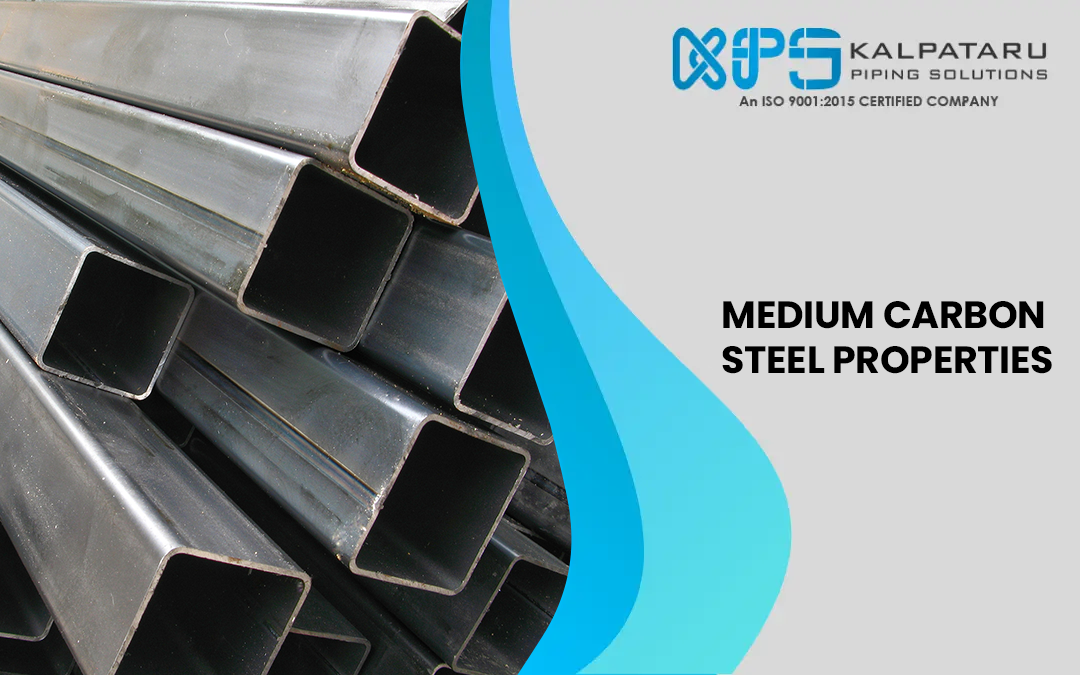
Chemistry helps us change materials by mixing different elements, strengthening some features while weakening others. Medium-carbon steel is often seen as the middle ground among carbon steels, offering a balance between high-carbon steel’s toughness and low-carbon steel’s flexibility.
This alloy is commonly used in industries where machinery, tools, and parts experience heavy wear, such as axles, gears, train wheels, etc. It’s a popular choice for items that need to handle tough conditions. This blog will explore what makes medium-carbon steel stand out from other materials and its common uses.
What is Medium Carbon Steel?
Medium-carbon steel is a type of steel with a carbon content ranging from 0.3% to 0.6% by weight. This gives it a harder structure than low-carbon steel, while still being easier to shape than high-carbon steel. Often referred to as mild or plain carbon steel, it has a lower tensile strength than metals like stainless steel and aluminum alloys.
Properties of Medium Carbon Steel
Medium-carbon steels offer several useful properties due to their composition, such as good hardness, strength, ductility, shock resistance, and wear resistance. These qualities make them suitable for machining and welding in many applications. They also have good thermal conductivity and can be heat-treated to boost surface hardness, fatigue life, and wear resistance.
Containing between 0.30% to 0.60% carbon, medium-carbon steels are harder than low-carbon steels but not as strong as high-carbon steels. They are flexible enough to be formed using methods like hot forming, cold forming, and machining. Heat treatment can further enhance their strength and hardness.
Medium-carbon steels are commonly used in applications like automotive parts, machinery components, tools, and construction materials. The addition of other elements like manganese, chromium, vanadium, or molybdenum can modify their properties for specific needs.
The following tables provide information on the physical and thermal properties of medium-carbon steel.
| Property | Value |
| Property Yield Strength |
Value 420 Mpa |
| Property Hardness |
Value 200 MPa |
| Property Density |
Value 7.75–7.89 g/cm³ |
| Property Magnetism |
Value It is typically magnetic |
Medium-Carbon Steel Chemical Composition
Iron is the main part of medium-carbon steel, and it has a carbon content between 0.30% and 0.60%. Some types of medium-carbon steel may also contain other elements like silicon, phosphorus, sulfur, chromium, and nickel.
The table below shows the usual percentage of different chemical elements in medium-carbon steel.
| Chemical Element | Percentage composition |
| Chemical Element Carbon (C) |
Percentage composition 0.3%–0.6% |
| Chemical Element Manganese (Mn) |
Percentage composition 0.6%–1.65% |
| Chemical Element Sulfur (S) |
Percentage composition 0.05 |
| Chemical Element Phosphorus (P) |
Percentage composition 0.04 |
| Chemical Element Chromium (Cr) |
Percentage composition 0.80–1.10 |
| Chemical Element Copper (Cu) |
Percentage composition 0.08 |
| Chemical Element Vanadium (V) |
Percentage composition 0.51 |
| Chemical Element Nickel (Ni) |
Percentage composition 0.15 |
| Chemical Element Molybdenum (Mo) |
Percentage composition 1.61 |
| Chemical Element Iron |
Percentage composition Balance |
Additionally, Kalpataru Piping Solution offers different finishing options, like black oxide or powder coating, to protect or improve the surface of this steel.
Common Forms of Medium-Carbon-Steel
You can find medium-carbon steel in several different shapes:
- Bars
Medium-carbon steel bars come in both round and rectangular shapes. They are very strong and are great for making heavy-duty shafts, axles, and gears. These bars often have pearlite and ferrite, which help make them more durable. Bar stock is commonly used for parts made with CNC machines. - Sheets
Medium-carbon steel sheets are often used for things like car panels and other structures that need to be shaped, formed, machined, or welded. Like the bars, these sheets also contain different amounts of pearlite and ferrite. - Wire
Medium-carbon steel wire is made for creating springs, cables, and other items that need to be strong but still easy to work with. This wire can be bent, twisted, and shaped without losing its strength.
How Kalpataru Piping Solution Can Help?
Kalpataru Piping Solution is a top carbon steel supplier in India, ready to meet your needs for medium-carbon steel. We offer a wide variety of high-quality products, including bars, sheets, and wires, suitable for different uses. You can trust our materials to handle heavy loads and tough conditions.
Our team is dedicated to providing excellent customer service and support. We will help you choose the right medium-carbon steel for your specific needs. Whether you need standard products or custom solutions, Kalpataru Piping Solution is here to support your projects.
Contact us today to explore your Medium Carbon Steel solutions. Request your custom quote now!
FAQ
What is the density of medium carbon steel?
Medium carbon steel has a density ranging from 7.75 to 7.89 g/cc, with an average of 7.85 g/cc based on 917 grades. Its particle size typically varies from 6.70 to 12.0 µm, averaging 9.27 µm across 12 grades. The hardness, measured on the Brinell scale, ranges from 126 to 578, with an average of 247 from 831 grades.
Does medium carbon steel rust?
Yes, medium carbon steel can rust, as all carbon steel is prone to corrosion. This makes them unsuitable for certain applications unless protective coatings are used.
Can medium carbon steel be hardened?
Yes, medium carbon steel can be hardened through quenching. Adding small amounts of manganese improves its hardenability. It can also be case-hardened for applications that require wear resistance, such as crankshafts.
What is the melting point of medium carbon steel?
The melting point of medium carbon steel is approximately 1500 °C. In comparison, cast iron, which contains more than 1.7 wt% carbon, melts at around 1160 °C.
Related Posts

Types of Carbon Steel
Carbon Steel Pipes Complete Guide