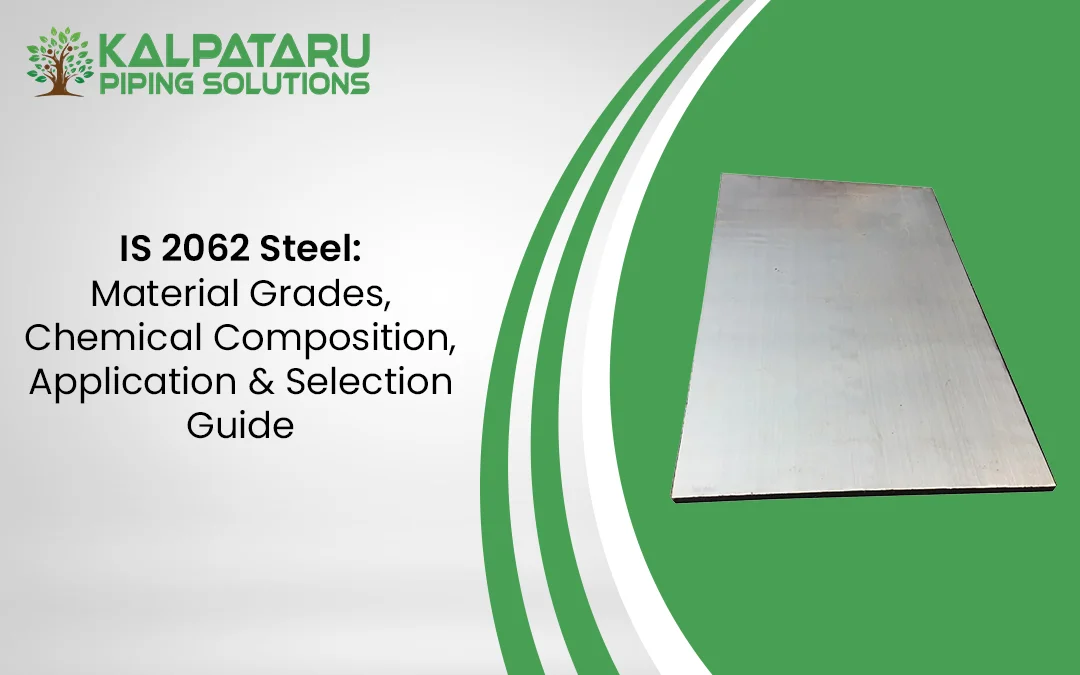
The process of identifying the appropriate structural steel grade may be very slow when going through technical names such as IS 2062, E250BR, or E350BO. The grades are unique to each and therefore selecting the wrong one may affect your performance and safety of your building. This is the reason why engineers, fabricators, and even the buyers should understand IS 2062 steel.
This guide will assist you in eliminating the confusion. We shall give the definition of what IS 2062 steel is, its various grades and names, IS 2062 chemical composition and IS 2062 mechanical properties. You will also learn where each grade is most suited, and will also get practical tips to aid you in selecting the correct IS 2062 material to use in your particular application that assures strength, dependability and longevity in each products.
What is IS 2062 and Why It’s Important in Structural Steel?
The official Indian Standard of hot-rolled structural steel requirements that are released by the Bureau of Indian Standards (BIS) is the IS 2062. It specifies the quality, strength, and performance of steel in a number of structural and engineering uses in India.
The standard concerns steel provided in various forms, which include:
Plates
Sections (beams, angles, and channels)
Flats (flat bars)
Bars (round, square, and others).
The main aim of IS 2062 is to provide consistency in the strength, reliable weldability, and extended durability of structural steel utilized in the construction and fabrication of structural steel. It is used as a reference point for predictable and reliable quality in the steel industry.
IS 2062 is mainly used in medium and high tensile grades of carbon steel, which is extensively used in construction, fabrication, bridges, and shipbuilding. The standard ensures such characteristics as high strength, good formability, and high weldability.
The IS 2062 specification of E250C and E410BR, among others, is selected depending on project specifications- the appropriate balance of performance, safety, and cost efficiency is guaranteed on each application.
- Plates
- Sections (like beams, angles, channels)
- Flats (flat bars)
- Bars (round, square, etc.)
Its core purpose is simple: to ensure that the structural steel used across India for building and engineering provides consistent strength, reliable weldability and long-lasting durability. It sets a predictable quality benchmark.
Why IS 2062 is Foundational for Indian Infrastructure?
Its widespread use in different industries makes it a suitable choice for them. Below are the different industries that use this steel.
- Large Infrastructure: The support of bridges, airports, metro railway initiatives, stadiums, and enormous business premises.
- Energy and Process Industries: Pipeline supports, oil and gas structures, refinery equipment, and power plant structures are also required.
- Pressure Equipment: Certain grades are selected to develop the low-to-medium pressure vessel and boiler components that are reliable.
Compliance with the IS 2062 standards poses a direct relationship with safer structures, better quality of a project, and reliable long-term operation.
Key Reasons IS 2062 Steel is the Go-To Choice
Its widespread use comes down to its dependable properties and versatility:
- Major Infrastructure: The backbone of bridges, airports, metro rail projects, stadiums and large commercial buildings.
- Energy & Process Industries: It is essential for pipeline supports, oil & gas structures, refinery equipment and power plant frameworks.
- Pressure Equipment: Specific grades are chosen for constructing reliable low-to-medium pressure vessels and boiler components.
Adhering to IS 2062 specifications directly translates to safer structures, enhanced project quality and dependable long-term performance.
Understanding The Different Material Grades In IS 2062
IS 2062 provides a family of steel grades, which are mainly characterized by the level of strength and occasionally impact toughness:
Basic Grades (Older Naming Still Encountered):
- Grade A: This is a mild steel, which is normally employed in lighter, less critical structural components.
- Grade B: Medium strength, which will be the usual choice in general construction and fabrication.
Yield Strength of the Based Grades (IS 2062: 2011 and above):
- E250: The workhorse type that is popular with a minimum yield strength of 250 Mpa. Stable to various common building applications.
- E350: Strength (350 MPa minimum yield) is significantly high to be used in an application that requires higher load capacity or can design it with less weight.
E410 / E450: Harder grades (min. yield 410/450 Mpa) are used in heavy-duty buildings and other high-specialized engineering components.
Looking for the Best Price on Inconel 600 Round Bars?
What Do E250BR, E250BO, E350BR Mean?
Those letters tacked onto the grade aren’t random; they tell you crucial information about impact testing which measures the steel’s resistance to brittle fracture, especially in colder conditions:
- B: Indicates the steel must be impact tested. (Grades without ‘B’ like ‘A’ usually aren’t).
- R: Impact tested at Room Temperature (typically 27°C). Suitable for general applications where severe cold isn’t expected.
- O: Impact tested at 0°C (Zero Degrees Celsius). This signifies enhanced toughness, making it essential for structures exposed to colder climates or applications requiring higher safety margins against fracture.
- (C): Sometimes seen, indicates testing at -20°C, for even greater low-temperature toughness.
Quick Grade Comparison: Strength & Toughness
| Grade | Min. Yield Strength (MPa) | Impact Test Temp. | Key Feature / Common Use |
| E250BR | 250 | Room Temp | Standard structural use, normal climates |
| E250BO | 250 | 0°C | Structural use, moderate cold/higher safety |
| E350BR | 350 | Room Temp | Higher load capacity, normal climates |
| E350BO | 350 | 0°C | Higher load capacity, moderate cold/safety |
Indian Standard (IS) 2062 Chemical Composition
The chemical composition of IS 2062 steel is carefully controlled by BIS to achieve the desired balance of strength, weldability, formability and toughness. Here are the typical maximum limits for the key players:
| Element | Symbol | Max % (Typical) | Role in the Steel |
| Carbon | C | ~0.20 – 0.23 | Main strengthening element; lower for better weldability. |
| Manganese | Mn | ~1.50 | Increases strength, hardness and toughness. |
| Sulphur | S | ~0.040 – 0.045 | Impurity; kept low to improve toughness & weldability. |
| Phosphorus | P | ~0.040 – 0.045 | Impurity; kept low to avoid brittleness. |
| Silicon | Si | ~0.40 | Helps remove oxygen; adds some strength. |
| Carbon Equiv. (CE) | CE | Varies | Calculated value indicating weldability (lower is better). |
Note: These are general guidelines. Specific maximums (especially for Carbon and CE) vary slightly between grades (A, B, E250, E350 etc.). Always refer to the specific grade requirements in the latest IS 2062 standard or the supplier’s MTC for exact figures.
Chemical Differences Between Grades
The limits are relatively constant in Sulphur (S), Phosphorus (P), and Silicon (Si) but the first difference is in the amount of Carbon. Grades with greater strength like E350 and E410 have stricter Carbon and Carbon Equivalent (CE) limits to maintain outstanding weldability despite the higher strength produced with an increase in Manganese or alloy additions. These regulated chemical mixes provide predictable performance in the fabrication and in the service in the long run.
Understanding IS 2062 Mechanical Properties
These properties tell you how the steel performs under load:
| Property | What it Measures | Importance |
| Yield Strength (YS) | The stress point where steel starts to deform permanently. | Primary indicator of load-bearing capacity (MPa). |
| Tensile Strength (UTS) | The maximum stress steel can handle before starting to break. | Indicates ultimate strength (MPa). |
| Elongation (%) | How much the steel can stretch before fracturing. | Measures ductility and ability to deform without failing. |
| Impact Strength (J) | Energy absorbed during a sudden impact (Charpy V-Notch Test). | Indicates toughness, crucial for BR/BO/C grades. |
How BR and BO Grades Differ in Practice?
It boils down to temperature toughness:
- BR (Room Temp Tested): Perfectly adequate for most structures in moderate climates where temperatures don’t frequently drop near freezing.
- BO (0°C Tested): The safer choice for structures in regions experiencing colder winters or for critical applications where low-temperature fracture resistance is paramount. It provides documented assurance of toughness at freezing point.
Key Updates in the IS 2062:2011 Edition
The 2011 revision brought important clarifications:
- Clearer Strength Grades: Introduced the “E” followed by yield strength (E250, E350, etc.), making selection more intuitive based on design needs.
- Mandatory Impact Testing: Formalized the BR/BO/C classifications, linking impact toughness requirements directly to the grade designation.
- Stricter Controls: Reinforced the need for manufacturers to meet specific chemical and mechanical property ranges consistently.
These changes enhanced the standard’s usability and alignment with international practices.
IS 2062 Material Equivalent Standards Globally
When projects involve international specifications, knowing approximate equivalents is helpful (but always verify!):
| IS 2062 Grade | Common International Equivalents | Key Considerations |
| E250 | ASTM A36 (USA), EN 10025 S275JR/JO (Europe) | Similar strength. IS 2062 BR/BO often has better guaranteed impact toughness than basic A36/S275JR. |
| E350 | ASTM A572 Gr 50 (USA), EN 10025 S355JR/JO (Europe) | Comparable higher strength grades. Verify impact requirements. |
IS 2062 vs. ASTM A36: While E250 and A36 are close cousins in strength and chemistry, IS 2062 material (especially BR/BO) is often specified with mandatory impact testing relevant to varied Indian climate conditions which isn’t standard for basic A36. Direct substitution requires careful review of project specs.
Common Applications of IS 2062 Steel Across Industries
IS 2062 steel plays a vital role in a wide range of industrial sectors:
Construction: This metal is commonly used to make buildings, flyovers, stadiums, and other industrial structures.
Oil & Gas: Many offshore platforms, pipeline supports, and storage tanks are made with the help of this material.
Shipbuilding: This steel comes with the features of resistance against corrosion and saltwater. It’s commonly used to make ship hulls, decks, and internal support structures.
Automotive: Utilized for heavy truck chassis, trailer frames, and various vehicle components.
Machinery & Equipment: Commonly used in crane structures, heavy machine bases, earthmoving equipment, and lifting mechanisms.
Choosing the right IS 2062 grade ensures the required strength, toughness, and durability for each specific application.
Typical Applications of IS 2062 Steel in Various Industries
You’ll find IS 2062 steel hard at work in:
- Construction: Structural frames for buildings, bridges, flyovers, stadiums, industrial sheds.
- Oil & Gas: Offshore platforms, pipeline supports, storage tank walls and roofs.
- Shipbuilding: Ship hulls, decks, internal structures.
- Automotive: Heavy truck chassis, trailer frames, vehicle components.
- Machinery & Equipment: Crane structures, heavy industrial machine bases, earthmoving equipment components, lifting gear.
Selecting the correct IS 2062 grade ensures the structure or equipment has the optimal strength, toughness and durability for its intended job.
How to Select the Right IS 2062 Grade: A Practical Checklist
Make an informed decision by considering:
- Strength Needed: Does your design require E250’s standard strength or the higher capacity of E350 or E410? Match the grade’s Yield Strength to calculations.
- Weldability: Will there be extensive or complex welding? While all grades are weldable, lower carbon/CE variants (often found in higher grades) can sometimes simplify procedures for very thick sections.
- Operating Temperature: Will the structure face freezing temperatures? If yes, BO grade is strongly recommended for enhanced safety against brittle fracture. BR is suitable for moderate climates.
- Impact Requirements: Does the design specification explicitly call for certain impact energy values? Ensure the chosen grade (BR/BO/C) meets these.
Common Mistakes to Avoid During Selection
- Ignoring Temperature: Choosing BR for a cold environment application is a significant risk.
- Skipping Certification: Accepting material without a valid, traceable Material Test Certificate (MTC) from the manufacturer. This compromises quality assurance (Trustworthiness signal).
- Assuming Equivalence: Treating international grades as identical without verifying detailed specs.
Locating Reliable Suppliers: The Relevance of Certified IS 2062 Material and MTCs.
Where structural uses are emphasized and safety and reliability are paramount, it is always better to source IS 2062 steel at.
verified suppliers that have BIS-certified material with a valid Material Test Certificate (MTC).
With an MTC, you know you are good, because it certifies:
Adherence to the definite IS 2062 grade (e.g. IS 2062 E350BO).
Real chemical analyzing results (heat specific).
Tested mechanical data (Yield, Tensile, Elongation, Impact values).
It can be traced back to the batch / heat of steel.
Suppliers who exhibit this interest in certification such as Kalpataru Piping Solutions offer quality assurance, compliance and traceability.
Resources for Deeper Dives (Official Documentation)
To get proper and up-to-date information, read the instructions below:
- Obtain the official standard of the IS 2062:2011 through the website of the Bureau of Indian Standards (BIS).
- Ask your selected supplier to provide detailed datasheets of certain grades.
- Familiarize yourself with the format and content of a proper Material Test Certificate (MTC).
(Note: Official standards are typically copyrighted and require purchase.)
Conclusion: Making Smart & Confident IS 2062 Steel Choices
IS 2062 structural steel offers a versatile range of options tailored for diverse engineering needs. By understanding the grades, the meaning behind BR/BO, the key chemical and mechanical properties and how they relate to your application (especially temperature!), you can move beyond confusion and select the most suitable and safest material. Always prioritize certified steel backed by comprehensive MTCs.
Frequently Asked Questions About IS 2062
What's the typical hardness of IS 2062 E250?
Around 120-140 HB (Brinell). Hardness isn’t the main spec like strength but indicates general resistance to indentation. Values can vary slightly.
Is IS 2062 the standard for steel pipes?
No. IS 2062 covers plates, sections and bars. For pipes/tubes, look to Indian Standards like IS 1239 (general use) or IS 3589 / IS 1161 (structural).
Is IS 2062 E250 just like ASTM A36?
They’re similar in strength/chemistry. Key difference: IS 2062 E250 (BR/BO) requires impact testing relevant for varied climates, unlike basic A36. Verify specs before substituting.