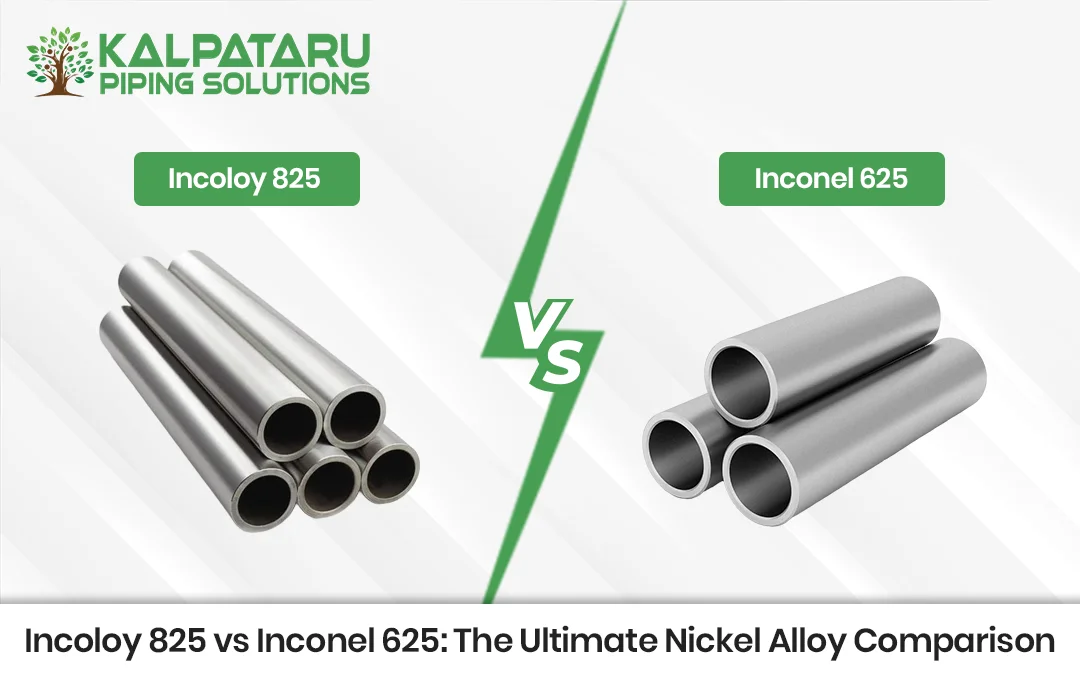
Incoloy 825 vs Inconel 625 is considered to be one of the most popular material selection choices in marine industry in oil and gas, chemical processing and engineering. They are both good corrosion alloys, both nickel-based, although they cannot be interchanged. Incoloy 825 (UNS N08825 / W.Nr. 2.4858) is a nickel iron chromium alloy that is used to reduce acidic conditions in the middle temperature regime. Inconel 625 (also known as UNS N06625, W.Nr. 2.4856) is a high temperature limit and chloride-resistant nickel-chromium-molybdenum alloy that is available in high mechanical strength.
Choose incorrect alloy and you will have to contend with premature corrosion, incomplete welds or overspecification that costs you your project budget. This is compared in terms of chemical composition, mechanical properties, temperature limits, corrosion resistance, weldability, cost and applications used in industries – everything that is needed to make the correct decision before sourcing.
Incoloy 825 and Inconel 625 Kalpataru Piping has supplied EPC contractors and end users in 40 plus countries with Incoloy 825 and Inconel 625 pipe, tube and fittings. All these are accompanied by full Mill test reports and third party inspection documents.
Chemical Composition of Incoloy 825 vs Inconel 625
Incoloy 825 vs Inconel 625 is one of the most popular choices of the material selection in the marine industry in oil and gas, chemical processing, and engineering. Both are nickel-based alloys with good corrosion credentials but they are not interchangeable. Incoloy 825 (UNS N08825 / W.Nr. 2.4858) is a nickel iron chromium alloy that is produced to reduce acidic environment in the middle temperature range. High temperature limits, resistance to chlorides and high mechanical strength Inconel 625 (also known as UNS N06625, W.Nr. 2.4856) is a high temperature, nickel-chromium-molybdenum alloy.
Choose the wrong alloy and you must contend with premature corrosion, incomplete welds or overspecification and lose your project budget. This comparison encompasses chemical composition, mechanical characteristics, temperature capabilities, resistance to corrosion, welding capabilities, cost and usages in the industry which is all one needs to make the right choice prior to sourcing.
Incoloy 825 and Inconel 625 pipe, tube and fittings have been sold by Kalpataru Piping to over 40 countries to contractors and end users of EPC. All this is accompanied with full Mill test reports and third party inspection documentation.
| Element | Incoloy 825 (%) | Inconel 625 (%) | Role in 825 | Role in 625 |
| Nickel (Ni) | 38–46 | 58 min | Base resistance | High-temp base |
| Chromium (Cr) | 19.5–23.5 | 20–23 | Oxidation / acids | Oxidation / pitting |
| Iron (Fe) | 22 min | 5 max | Structural filler | Controlled dilution |
| Molybdenum (Mo) | 2.5–3.5 | 8–10 | Crevice corrosion | Pitting / crevice |
| Copper (Cu) | 1.5–3.0 | — | Reducing acid resist. | Not present |
| Titanium (Ti) | 0.6–1.2 | — | Carbide stabiliser | Not present |
| Niobium (Nb) | — | 3.15–4.15 | Not present | High-temp strength |
Mechanical Properties Comparison of Incoloy 825 vs Inconel 625
| Property | Incoloy 825 | Inconel 625 |
| Tensile strength (min) | 690 MPa (100 ksi) | 862 MPa (125 ksi) |
| Yield strength (0.2%) | 310 MPa (45 ksi) | 517 MPa (75 ksi) |
| Elongation (min) | 30% | 30% |
| Density | 8.14 g/cm³ | 8.44 g/cm³ |
| Hardness (typical) | ~87 HRB | ~96 HRB |
Temperature Performance of Incoloy 825 vs Inconel 625
Inconel 625 has a continuous operating temperature of up to 982degC (1800degF), almost twice that of Incoloy 825 (538degC) which is 1000degF. The disparity is attributed to the presence of niobium and molybdenum in the Inconel 625 that inhibits the formation of grain boundary precipitation and oxidation in extreme temperatures.
Incoloy 825 is technically perfect and more economical where the reducing acids are required at lower temperatures (below 538degC). Above 538degC -or any place there is thermal cycling, flame impingement, or combustion gasses Inconel 625 is the proper specification.
Corrosion Resistance of Incoloy 825 vs Inconel 625
Rule of thumb: Inconel 625 is the specification in case the operating environment is filled with chloride, is marine, or is pitting at risk. When the reducing acid is the main corrosive agent sulfuric phosphoric hydrofluoric Incoloy 825 is technically correct and less expensive.
| Environment | Incoloy 825 | Inconel 625 |
| Sulfuric acid (reducing) | Excellent — Cu + Ni synergy | ⚠ Limited |
| Phosphoric acid | Excellent | ⚠ Moderate |
| Chloride pitting | ⚠ Moderate | Excellent — high Mo |
| Seawater / marine immersion | ⚠ Moderate | Excellent |
| Crevice corrosion | ⚠ Moderate | Excellent |
| Stress corrosion cracking (Cl) | ⚠ Susceptible | Highly resistant |
| Sour gas (H2S) | Good — NACE compliant grades | Excellent |
| Oxidising acids (nitric) | Good | Good |
Both alloys have NACE MR0175 / ISO 15156-compliant grades for H2S service — confirm grade and heat treatment condition with your supplier before specifying.
Incoloy 825 vs Inconel 625 Weldability and Fabrication
Industrial service In standard service both alloys can be welded without post-weld heat treatment (PWHT). The methods vary greatly in the choice of fillers and heat control.
- Incoloy 825: Use ERNiCrMo-3 (or ERNiCrFe-5) to weld dissimilar joints. Less thermal sensitive than Inconel 625. Normal GTAW processes using argon shielding exist.
- Inconel 625: Must contain filler wire of ERNiCrMo-3 (AWS A5.14 / ASME SFA-5.14 certified). The thermal conductivity is low resulting in speedy heat build-up in the HAZ. Thin sections and pipe are required as pulsed-current TIG. The maximum temperature of the interpass should be limited to 300 F (150 C). purge out all pipe root passes with argon.
View Inconel 625 Pipes & Tubes | View Incoloy 825 Pipes & Tubes
Cost Comparison of Incoloy 825 vs Inconel 625 Price
Incoloy 825 is also continuously the inexpensive alloy. The higher iron content (22% min vs 5% max in 625) replaces the costly nickel and eliminates the costly addition of niobium, which saves the costs of raw materials 30-50 percent compared to the product form and market environment.
Incoloy 625 has not been recommended in projects whose operating conditions are within the corrosion and temperature tolerance of Incoloy 825 – particularly in acid gas scrubbing, or processing phosphoric acid, and where the operating temperature is below 538degC – a move that is not an over-engineering measure but rather raises the cost of the project.
Industry Applications of Incoloy 825 vs Inconel 625
| Industry | Incoloy 825 — Typical Applications | Inconel 625 — Typical Applications |
| Oil & Gas | Acid gas scrubbers, sour gas pipelines, wellhead components | Subsea risers, flexible pipes, umbilicals, FPSO components |
| Chemical Processing | Sulfuric & phosphoric acid handling, heat exchangers | High-temp reactors, catalyst regenerators |
| Marine | Seawater cooling systems (moderate duty) | Offshore structures, submarine systems, propulsion |
| Power Generation | Flue gas desulfurization, heat recovery | Gas turbine components, transition liners |
| Pollution Control | Scrubbers, stacks, ductwork | High-temp exhaust systems |
Related product links:
Inconel 625 Flanges | Incoloy 825 Plates & Sheets | Inconel 625 Round Bars | Incoloy 825 Fasteners
When to Choose Inconel 625
- Service temperature exceeds 538°C (1000°F)
- Exposure to chloride-rich environments — seawater, brine, marine splash zones
- Pitting or crevice corrosion is the primary failure mode
- High mechanical stress combined with corrosive environment
- Subsea or deepwater application requiring fatigue resistance
- Spec calls explicitly for UNS N06625 or W.Nr. 2.4856
When to Choose Incoloy 825
- Operating temperature is below 538°C (1000°F)
- Primary corrosive medium is sulfuric acid, phosphoric acid, or other reducing acids
- Budget is a constraint — Incoloy 825 delivers sufficient performance at lower cost
- Aqueous corrosion service without extreme chloride loading
- Sour gas service where NACE MR0175 compliance is required at moderate temperature
- Spec allows UNS N08825 or W.Nr. 2.4858 as an acceptable material
Browse Inconel 625 Products:
- View Inconel 625 Pipes & Tubes
- Browse all Inconel Products
Browse Incoloy 825 Products:
- View Incoloy 825 Pipes & Tubes
- Browse all Incoloy Products
Read our full Inconel vs Incoloy family comparison
FAQs – Incoloy 825 vs Inconel 625
Is Inconel 625 better than Incoloy 825?
Not categorically. Inconel 625 is superior to Incoloy 825 in chloride and high temperature services. Incoloy 825 is an improved reducing acid service (sulfuric, phosphoric) and better cost bettor, unlike Inconel 625. Both alloys are not always the best, the correct one depends on the environment.
Which is cheaper, Incoloy 825 or Inconel 625?
Incoloy 825 is normally 30-50% cheaper than Inconel 625 in the same forms of products. This increment in price is forced by the fact that Inconel 625 contains a higher level of nickel (58% min vs 38-46) and that it has an expensive additive of niobium.
Can Incoloy 825 replace Inconel 625?
In some applications, yes. Service below 538degC at reducing acid, not subjected to extreme chloride loading, Incoloy 825 is technically acceptable and less costly. It cannot with high-temperature, seawater or high-stress applications.
Which alloy is better for sour gas service?
The alloys are both sour gas (H2S) service compliant grade (NACE MR0175). Incoloy 825 is very popular with sour gas wellheads and moderate temperature pipelines. Where temperature or mechanical requirements are beyond those of Incoloy 825, Inconel 625 is the material of choice.
Which is better for seawater applications?
The obvious solution to seawater immersion, offshore structures and marine splash zones would be Inconel 625. It has a very high molybdenum content (8-10%) and the high molybdenum content gives it better pitting and crevice corrosion resistance than Incoloy 825 does when exposed to sustained chloride environments.