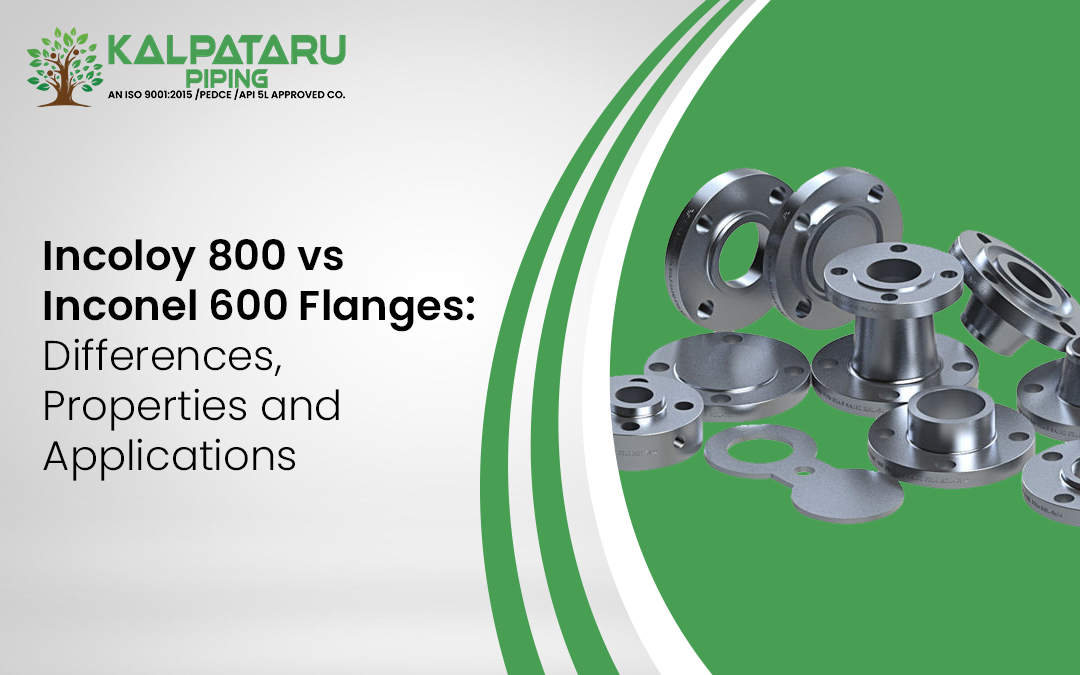
Whenever engineers and procurement teams consider utilizing high-performance alloy flanges in petrochemical plants, power generation facilities, or furnace equipment, the choice between Incoloy 800 vs Inconel 600 frequently arises. Both alloys are of the nickel-based family and are designed to work in the conditions where normal stainless steels would not even last. Nevertheless, their chemical structures, mechanical properties, and most effective applications vary enough to require material choice to be a significant engineering choice.
This is a comprehensive guide that takes a breakdown of all the major distinctions between the Incoloy 800 flanges and the Inconel 600 flanges in terms of chemical composition, mechanical properties, corrosion resistance, temperature performance, weldability, applications, and the cost-effectiveness of the two. By the conclusion, you will have a concise, empirical foundation to the choice of the right alloy to use in your particular operating environment.
Understanding the Two Alloys
Incoloy 800 and Inconel 600 are both nickel-based superalloys widely used in high-temperature and corrosive service, yet they differ significantly in composition, mechanical behaviour, and the environments where each performs best. Understanding these distinctions is essential for engineers and procurement teams specifying flanges for critical applications. The sections below outline the key characteristics of each alloy.
What Is Incoloy 800?
Incoloy 800 (UNS N08800) is an austenitic alloy consisting of nickel, iron and chromium, specially crafted to provide high-temperature service. It has about 30-35 percent nickel, 19-23 percent chromium and at least 39.5 percent iron content, with minimal amounts of aluminum and titanium added to it that increase its oxidation and carburization resistance at sustained temperatures. The alloy family is continued by Incoloy 800H (UNS N08810) and Incoloy 800HT (UNS N08811) with more carbon to enhance creep-rupture strength.
Kalpataru Piping produces and distributes a full collection of Incoloy 800 flanges, conforming to ASTM B564 UNS N08800 in a variety of types, such as weld neck, slip-on, blind, socket weld and ring type joint designs.
What Is Inconel 600?
Inconel 600 (UNS N06600) is a nickel-chromium-iron solid-solution strengthened superalloy. Having a minimum nickel content of about 72, 14-17 percent chromium and 6-10 percent iron, it offers an excellent corrosion resistance in a wider array of chemical conditions. Its high nickel level predisposes it to work especially in chloride-ion stress-corrosion cracking situations and highly reducing acidic conditions. It also forms a thick protective layer of oxide at high temperatures that protects against surface attack on the alloy.
Explore the full product range through Kalpataru Piping’ dedicated page for Inconel 600 flanges, available in all standard pressure classes from 150# to 2500# and face types including flat face, raised face, and ring type joint.
Chemical Composition: Incoloy 800 vs Inconel 600
The most fundamental distinction between these two alloys lies in their elemental makeup. Incoloy 800 carries a significantly higher iron content and lower nickel concentration compared to Inconel 600. This difference in base composition directly shapes their respective performance envelopes.
Incoloy 800’s elevated chromium level (up to 23%) and the inclusion of aluminum and titanium improve its oxidation resistance and carburization resistance at high service temperatures. The aluminum and titanium additions stabilize the alloy against sensitization to intergranular corrosion, a phenomenon that can compromise structural integrity in long-term thermal exposure.
Inconel 600, by contrast, derives its exceptional corrosion resistance primarily from its dominant nickel content. Higher nickel lowers susceptibility to chloride-induced stress-corrosion cracking and provides superior performance in both oxidizing and reducing environments. The controlled limits on silicon (0.5% max) and manganese (1.0% max) in Inconel 600 further improve its base mechanical properties, since these elements are generally considered detrimental to superalloy performance when present in excess.
Incoloy 800 vs Inconel 600 Mechanical Properties Comparison
Both alloys are austenitic and non-magnetic, which makes them dimensionally stable across wide temperature ranges. However, their mechanical behavior diverges at elevated temperatures.
Incoloy 800 exhibits superior creep resistance and stress rupture properties, particularly in the 800H and 800HT grades where controlled carbon, aluminum, and titanium levels are optimized for sustained high-temperature loading. This makes Incoloy 800 flanges the preferred choice in applications involving long-duration thermal cycling, such as ethylene cracking furnaces, steam generator components, and nuclear superheater tubing.
Inconel 600 offers higher tensile strength and better mechanical properties at moderate temperatures due to its greater nickel content and stricter control of tramp elements. At lower operating temperatures where creep is not a concern, Inconel 600 provides better overall mechanical reliability than Incoloy 800. Its higher strength also makes it suitable for aerospace and nuclear applications where components must withstand simultaneous thermal and mechanical stress.
Incoloy 800 vs Inconel 600 High Temperature Performance
Temperature capability is among the most critical selection criteria when comparing Incoloy 800 flanges to Inconel 600 flanges.
Incoloy 800 flanges are rated for continuous service at temperatures up to approximately 815 degrees Celsius (1,500 degrees Fahrenheit). In this range, the alloy maintains excellent resistance to oxidation, carburization, and sulfidation. The 800H and 800HT variants extend effective service life further at sustained high temperatures by virtue of their improved creep-rupture properties.
Inconel 600 flanges, despite having a lower creep resistance, can tolerate short-term peak temperatures up to approximately 1,095 degrees Celsius (2,000 degrees Fahrenheit) before significant oxidation loss occurs. When exposed to such extreme thermal conditions, Inconel 600 forms a dense, adherent chromium-nickel oxide layer that acts as a self-repairing shield. This property makes it suitable for applications such as jet engine components, gas turbine parts, and industrial furnace fixtures that experience frequent thermal cycling.
In practical terms: for sustained high-temperature loading, Incoloy 800 is the stronger performer. For applications requiring resistance to peak thermal exposure or aggressive oxidizing atmospheres at extreme temperatures, Inconel 600 holds the advantage.
Corrosion Resistance: Which Alloy Performs Better?
Both alloys deliver excellent corrosion resistance, but the nature of that resistance differs considerably based on the corrosive environment encountered.
Incoloy 800 Flanges: Corrosion Behavior
Incoloy 800 provides outstanding resistance to organic acids such as formic acid and acetic acid, as well as chloride-containing environments including seawater and brackish water. It is highly resistant to carburization, a form of high-temperature degradation caused by carbon absorption that embrittles alloy structures over time. The alloy also resists nitric acid and hot sulfuric acid attack. Its chromium content ensures reliable performance in oxidizing atmospheres.
To understand the complete alloy profile in greater technical depth, review the Incoloy 800 properties and composition resource from Kalpataru Piping.
Inconel 600 Flanges: Corrosion Behavior
Inconel 600 delivers superior resistance to reducing acids, particularly sulfuric acid and hydrochloric acid, where it significantly outperforms Incoloy 800. Its high nickel content provides an inherent barrier against chloride-ion stress-corrosion cracking, a failure mode that plagues standard stainless steels in marine and chemical service. Inconel 600 also resists alkaline solutions, dry gases at elevated temperatures, and caustic soda environments encountered in the paper pulp and nuclear power industries.
The key takeaway: for aggressive reducing acid environments and halide-rich chemical service, Inconel 600 flanges are the superior choice. For oxidizing, carburizing, and sulfidation environments at moderate-to-high temperatures, Incoloy 800 flanges are better suited.
Incoloy 800 vs Inconel 600 Weldability and Fabrication
Weldability is a practical engineering consideration when planning flange connections in complex piping systems.
Incoloy 800 is recognized for excellent weldability using standard techniques such as GTAW (TIG), GMAW (MIG), and SMAW (stick) welding. It retains its mechanical and corrosion-resistant properties after welding when recommended pre-weld and post-weld procedures are followed. The alloy is also easy to machine and form using standard metalworking equipment, making it cost-effective for large-scale fabrication.
Inconel 600 is weldable but requires more careful attention to procedure, particularly with respect to post-weld heat treatment. Without proper heat treatment after welding, the heat-affected zone may experience sensitization, leaving it vulnerable to intergranular corrosion. That said, with the correct approach, Inconel 600 flanges can be reliably incorporated into demanding piping systems with no compromise to performance.
Industrial Applications of Incoloy 800 vs Inconel 600
|
Incoloy 800 Flange Applications |
Inconel 600 Flange Applications |
|
Ethylene and propylene cracking furnace headers and manifold flanges |
Flanged joints in sulfuric acid and hydrochloric acid process lines |
|
Steam generators and superheater flanges in nuclear power plants |
Flanges in jet engine and gas turbine exhaust systems |
|
Heat exchanger flanges in petrochemical processing units |
Reactor vessel flanges in nuclear engineering where chloride cracking resistance is mandatory |
|
Flanged connections in industrial heating and heat treating equipment |
Flange assemblies in food processing and pharmaceutical manufacturing where purity and corrosion resistance are non-negotiable |
|
Pressure vessel nozzle flanges in chemical plants handling organic acids |
High-temperature furnace retort flanges and door frame connections |
|
Flanges in offshore gas processing equipment with sour gas exposure |
Caustic soda and alkaline process line flanges in chemical manufacturing |
How to Choose Between Incoloy 800 and Inconel 600 Flanges
The correct selection depends on the specific demands of your operating environment. Consider the following guiding principles:
- Choose Incoloy 800 flanges when the application involves sustained high-temperature exposure in the 600 to 815 degree Celsius range, carburizing or sulfidizing atmospheres, petrochemical cracking service, or where long-term creep resistance under continuous thermal load is a design requirement.
- Choose Inconel 600 flanges when the environment involves reducing acids, high halide concentrations, nuclear service requiring chloride-cracking immunity, aerospace thermal cycling, or peak operating temperatures approaching 1,095 degrees Celsius.
- Consider budget: Inconel 600 commands a higher price because of its elevated nickel content. In applications where Incoloy 800 meets the performance threshold, it delivers a more economical solution without compromising operational reliability.
- Consider fabrication requirements: Incoloy 800 flanges offer better weldability and are easier to fabricate, which reduces total installed cost in complex piping configurations.
Source Incoloy 800 Flanges and Inconel 600 Flanges from Kalpataru Piping
When evaluating Incoloy 800 vs Inconel 600, neither alloy is universally superior. Each occupies a distinct performance niche defined by its composition. Incoloy 800 flanges are the ideal choice for sustained high-temperature service in petrochemical, power generation, and furnace environments where creep resistance and carburization protection are paramount. Inconel 600 flanges excel in aggressive acid environments, nuclear service, aerospace thermal cycling, and applications demanding the highest possible nickel-based corrosion protection.
Kalpataru Piping maintains ready stock of both alloys in all standard configurations. For technical inquiries, material test reports, or quotations on Incoloy 800 flanges and Inconel 600 flanges, contact the team directly for a fast, expert response tailored to your project specifications.
Frequently Asked Questions About Monel 400 Tubes
What is Monel 400 tube used for?
Monel 400 tubes are used primarily in heat exchangers, seawater cooling circuits, desalination plants, chemical processing lines handling HF acid and other aggressive media, oil and gas chemical injection systems, subsea umbilicals, and a broad range of marine structural applications. Their outstanding corrosion resistance and wide operating temperature range make them a versatile solution for demanding service.
What are the key Monel 400 tube properties?
The defining properties are: excellent corrosion resistance in seawater and reducing acids; immunity to chloride stress corrosion cracking; operating range from cryogenic (-196 degrees C) to elevated temperature (538 degrees C); high tensile strength; good ductility and weldability; and essentially non-magnetic behaviour in the annealed condition.
What is the difference between Monel 400 and Monel K-500 tubes?
Monel K-500 is a precipitation-hardened variant of Monel 400 that achieves significantly higher tensile and yield strengths through the addition of aluminium and titanium and a controlled age-hardening heat treatment. For applications requiring higher strength, such as pump shafts or drill collars, Monel K-500 is preferred. For standard corrosion-resistant tubing service, Monel 400 is the economical and practical choice.
What standard covers Monel 400 seamless tubes?
The primary standard for Monel 400 seamless tubes and pipe is ASTM B165 (and its ASME equivalent SB165). Other relevant standards include ASTM B725 for welded pipe and AMS 4674 for aerospace tubing.
Is Monel 400 magnetic?
Monel 400 is essentially non-magnetic in the annealed condition. Cold working can introduce a minor magnetic response, but this is generally not a concern for standard industrial applications. Its non-magnetic nature is an advantage in sensitive instrumentation and certain defence applications.
Can Monel 400 tubes be welded?
Yes. Monel 400 tubes can be welded using TIG (GTAW), MIG (GMAW), and stick (SMAW) welding processes. The use of matching Ni-Cu filler metal, inert gas shielding, and controlled heat input is essential to achieve sound, corrosion-resistant welds. Pre-heating is generally not required in the standard annealed condition.
How does Monel 400 compare to 316L stainless steel in seawater service?
Monel 400 substantially outperforms 316L stainless steel in seawater and chloride-containing environments. While 316L can suffer pitting, crevice corrosion, and chloride SCC in marine service, Monel 400 is essentially immune to these failure modes, providing a much longer and more predictable service life.
Is Beryllium Copper C17200 the Right Alloy for Your Application?
Beryllium copper C17200, also known as UNS C17200, Alloy 25, and BeCu 25, stands unchallenged as the highest strength available of all the most common commercially available precipitation-hardenable copper alloys. Its tensile strength up to 212 ksi in the form of wire, beryllium copper hardness of up to RC 45, beryllium copper conductivity of 22% IACS in the peak-aged condition, excellent fatigue life, and excellent corrosion resistance all add up to a material that engineers turn to when nothing else will do.
The list of applications of the C17200 is immense starting with electrical connectors, current carrying springs, non-sparking oilfield tools, precision plastic injection molds, aerospace firing pins and the list goes on and on as engineers find more ways of using this special alloy. Knowing the material property of C17200, composition to temper and fabrication practice – helps procurement teams and design engineers to confidently specify C17200 and achieve its maximum performance potential.
Sourcing C17200 from Kalpataru Piping
If this guide has helped clarify the properties and potential of Alloy 25, Kalpataru Piping’s dedicated C17200 page covers available forms, tempers, and applicable specifications in one place.
Explore the full range: Beryllium Copper C17200 — Forms & Specifications.
Further Reading from Kalpataru Piping