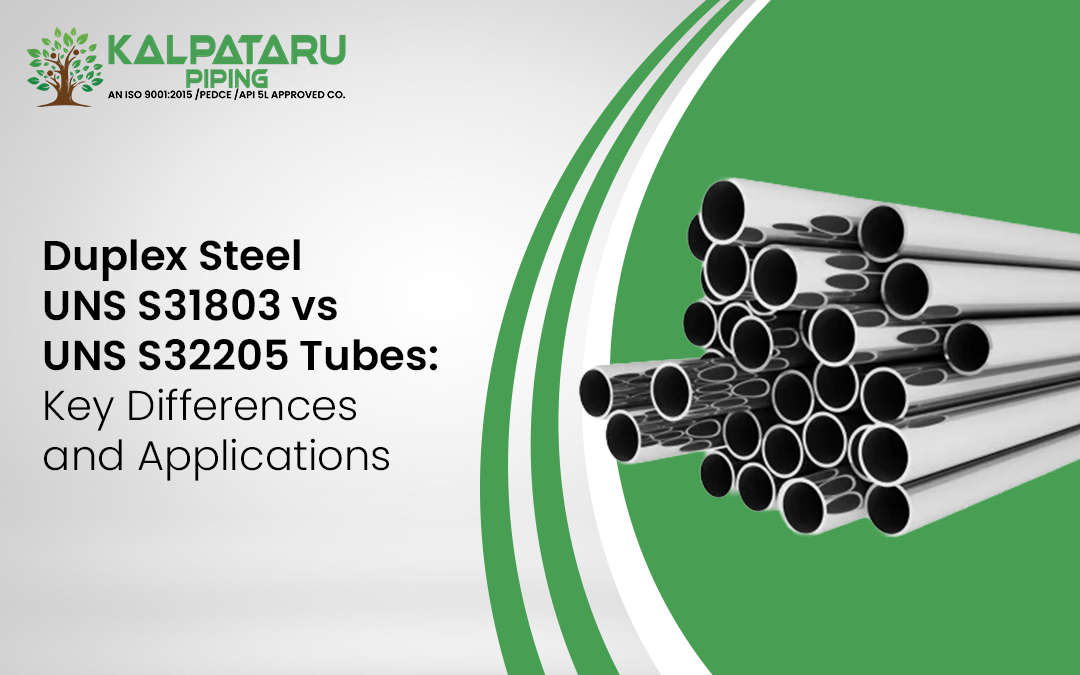
When engineers are shortlisting duplex stainless steel tubes to be used in offshore platforms, oil and gas pipelines, or chemical processing equipment, the two designations are visible on almost all datasheets UNS S31803 and UNS S32205. The two grades are seemingly similar at first sight. Their popular 2205 duplex family name is the same, their European Werkstoff number is the same 1.4462, and their product specifications are the same, like ASTM A789 on seamless, welded tubing. However any specification of the incorrect grade may cost a project time and money when a tube section does not last long in a chloride rich environment or even during welding.
This guide is based on the specifications of s31803 vs s32205 comparison that is published under ASTM A789, ASTM A790, and ASME SA 789 to provide a clear understanding of how the comparison works out in terms of chemical composition, mechanical performance, pitting resistance, weldability, cost, and end use application. Afterwards, the procurement managers and process engineers will have a proper guideline on how to choose the appropriate grade of duplex steel tube to use in their project.
What Are Duplex Stainless Steel Tubes?
Duplex stainless steel tubes are named after the two phase microstructure made up of approximately equal amounts of ferrite and austenite. This is a balanced microstructure that provides a unique combination of properties. The ferritic phase is a source of high yield strength and stress corrosion crack resistance. The austenitic phase offers toughness, ductility and corrosion resistance engineers relate to traditional austenitic alloys like 316L.
This allows high internal pressures at lower wall thicknesses of duplex steel tubes compared to 316L tubes and withstands them in chloride environments. S31803 and S32205 are both covered by international standards such as EN 10216 5 and ASTM A789 and both are in this family.
For a deeper understanding of the full duplex grade portfolio and how properties vary across grades, visit the Kalpataru Piping resource on duplex steel properties, grades, and composition.
UNS S31803 vs UNS S32205: The Origin of Two Designations
The history of the two UNS numbers justifies the reason why engineers would be referred to by both designations when referring to the same project. At the time of the initial commercialisation of duplex 2205 steel, it was specified initially as UNS S31803. Gradually, the manufactures always produced this grade at the high end of its composition range especially that of chromium, molybdenum, and nitrogen as this provided them with better performance in the field of corrosion.
This reduced production habit gradually became the rule and not the exception and the metallurgical fraternity realised that a special name was justified to material manufactured to these higher minimums. UNS S32205 was thus created to detect duplex stainless steel manufactured at the upper portion of the S31803 alloy mix. The turning point was the critical one in that nitrogen which was a background element was now being actively utilized to enhance the alloy and enhance the phase balance in the heat affected zone during the welding process.
Chemical Composition: Where S31803 and S32205 Diverge
The two grades share many of the same elemental boundaries. The key differences concentrate on the minimum limits for chromium, molybdenum, and nitrogen, and these small shifts produce measurable differences in real world corrosion performance.
| Element | UNS S31803 (Min) | UNS S31803 (Max) | UNS S32205 (Min) | UNS S32205 (Max) |
| Chromium (Cr %) | 21.0 | 23.0 | 22.0 | 23.0 |
| Nickel (Ni %) | 4.5 | 6.5 | 4.5 | 6.5 |
| Molybdenum (Mo %) | 2.5 | 3.5 | 3.0 | 3.5 |
| Nitrogen (N %) | 0.08 | 0.20 | 0.14 | 0.20 |
| Carbon (C %) | 0.000 | 0.030 | 0.000 | 0.030 |
| Manganese (Mn %) | 0.000 | 2.00 | 0.000 | 2.00 |
| Silicon (Si %) | 0.000 | 1.00 | 0.000 | 1.00 |
| Phosphorus (P %) | 0.000 | 0.030 | 0.000 | 0.030 |
| Sulfur (S %) | 0.000 | 0.020 | 0.000 | 0.020 |
The table confirms that the maximum values for each element are identical. The meaningful divergence sits in the minimums. S32205 mandates a higher floor for chromium (22.0 vs 21.0 percent), molybdenum (3.0 vs 2.5 percent), and nitrogen (0.14 vs 0.08 percent). These higher minimums close the composition window within which the steel can be produced, so a tube mill making S32205 always delivers chemistry that sits in the upper region of the broader S31803 envelope.
Mechanical Properties of Duplex S31803 and S32205 Tubes
Because both grades are produced from the same 2205 duplex family, their minimum mechanical requirements under ASTM A789 are essentially the same. The practical advantage of S32205 shows up not in the minimum specification but in average production values, which trend higher due to the tighter nitrogen control.
| Property | UNS S31803 | UNS S32205 |
| Tensile Strength (min) | 620 MPa (90 ksi) | 620 MPa (90 ksi) |
| Yield Strength 0.2% (min) | 450 MPa (65 ksi) | 450 MPa (65 ksi) |
| Elongation (min) | 25% | 25% |
| Hardness (max) | 217 HB | 217 HB |
| Density | 7.805 g/cm3 | 7.805 g/cm3 |
| Modulus of Elasticity | 200 GPa | 200 GPa |
| Thermal Conductivity | 19.0 W/m.K | 19.0 W/m.K |
Both grades deliver yield strengths that are approximately twice those of standard 316L austenitic tubes. This allows engineers to specify thinner wall sections in pressure bearing applications without compromising safety factors, reducing both material weight and procurement cost. Thermal expansion is lower and thermal conductivity is higher than in austenitic grades, making both duplex grades advantageous in heat exchanger designs.
Pitting Resistance Equivalent Number: The Critical Differentiator
When specifying duplex steel tubes for chloride rich media, the Pitting Resistance Equivalent Number (PREN) is the single most important comparative metric. The PREN formula for duplex grades is:
PREN = %Cr + 3.3 x %Mo + 16 x %N
Applying minimum chemistry values for each grade:
UNS S31803 minimum PREN = 21.0 + (3.3 x 2.5) + (16 x 0.08) = 21.0 + 8.25 + 1.28 = approximately 30.5
UNS S32205 minimum PREN = 22.0 + (3.3 x 3.0) + (16 x 0.14) = 22.0 + 9.90 + 2.24 = approximately 34.1
A PREN above 34 is a widely cited threshold for reliable performance in seawater and high chloride process streams. UNS S31803 at its minimum chemistry sits below this threshold, meaning a tube produced at the lower end of the S31803 specification may underperform in aggressive environments. UNS S32205, because its minimums are set higher, consistently clears the 34 mark. For offshore heat exchangers, subsea umbilicals, and desalination condensers this gap is decisive.
Weldability and Heat Affected Zone Performance
Welding duplex stainless steel creates a heat affected zone where rapid thermal cycling can disturb the ferrite to austenite phase balance, potentially producing a ferrite heavy zone that is susceptible to corrosion and embrittlement. The elevated nitrogen content in UNS S32205 was specifically engineered to address this phenomenon.
Nitrogen slows the rate at which ferrite forms in the heat affected zone during cooling after welding, preserving a more balanced microstructure. Field experience and published metallurgical data confirm that S32205 welds retain better corrosion resistance and impact toughness than S31803 welds produced under the same parameters. This has led many engineering specifications and project documents in the offshore and chemical processing sectors to mandate S32205 over S31803 even when the client procurement document simply reads 2205 duplex.
For small bore tube and instrumentation tubing applications where multiple welds are concentrated in a tight space, S32205 is the preferred specification precisely because each weld joint carries the same risk of heat affected zone degradation.
Industry Applications for Duplex Steel S31803 and S32205 Tubes
Oil and Gas
Duplex steel tubes are used extensively in subsea flowlines, topside piping, heat exchanger shells, and instrument tubing on offshore platforms. S32205 is the dominant specification because platform environments combine seawater spray, produced water containing chlorides and hydrogen sulfide, and elevated pressures that demand consistent pitting resistance across every weld seam.
Kalpataru Piping maintains ready stock of duplex steel UNS S31803 pipes and tubes and can supply S32205 tubes to ASTM A789 and ASTM A790 in both seamless and welded forms for offshore project requirements.
Chemical Processing
Reactors, heat exchangers, distillation columns, and scrubber tubes handling chloride bearing acids, caustic solutions, and oxidising media represent a primary application segment for both grades. S32205 is selected when chloride concentration is high and operating temperature exceeds 50 degrees Celsius, as these conditions accelerate pitting. S31803 remains acceptable in less aggressive media where procurement cost is a priority and service conditions are within controlled parameters.
Desalination and Water Treatment
Multi stage flash and reverse osmosis desalination plants expose tubing to concentrated brine at elevated temperatures. The PREN advantage of S32205 is most visible here. Plant operators who specified S31803 tubes in early MSF installations reported accelerated pitting at tube sheet joints, leading subsequent projects to mandate S32205 throughout the heat rejection and heat recovery sections.
Pulp and Paper
Digesters, bleach plant equipment, and wash columns in pulp mills handle hot acidic chloride liquors that are highly corrosive. Duplex tubes offer an economical upgrade from 316L without the price premium of super duplex or nickel alloys. S32205 is the standard specification for bleach plant applications where hypochlorite is present.
Marine and Seawater Systems
Seawater cooling circuits, ballast water treatment systems, and overboard discharge piping represent demanding corrosion environments where the consistent PREN of S32205 provides a reliable safety margin. S31803 tubes can be used in brackish water or low temperature seawater service where chloride concentrations and temperatures are within well defined limits.
Food and Beverage and Pharmaceutical
Sanitary tubing for process lines handling saline brines, cleaning agents, and high temperature CIP solutions specifies duplex grades where 316L tubes have shown inadequate service life. S32205 is preferred for its consistency and for the confidence that tighter nitrogen control provides when third party inspection is mandatory.
UNS S31803 vs S32205: Which Grade Should You Specify?
The following framework summarises the decision criteria used by most materials engineers when comparing the two grades:
| Selection Criteria | Recommended Grade |
| Chloride concentration above 1,000 ppm with temperatures above 50C | UNS S32205 |
| Seawater or brine service requiring PREN above 34 | UNS S32205 |
| Offshore oil and gas with multiple weld joints | UNS S32205 |
| Heat affected zone corrosion resistance critical | UNS S32205 |
| Mild chloride environment with controlled operating parameters | UNS S31803 |
| Budget sensitive project with moderate corrosion requirements | UNS S31803 |
| Legacy system replacement where original spec was S31803 | UNS S31803 (or upgrade to S32205) |
| Pulp and paper bleach plant or desalination heat rejection | UNS S32205 |
In practice, many engineering procurement and construction contractors have moved toward mandating S32205 as the default duplex tube specification for new projects, treating S31803 as a legacy designation. Where project documents specify 2205 duplex without distinguishing between the two UNS numbers, it is advisable to confirm with the materials engineer which designation is intended rather than defaulting to the lower minimum chemistry grade.
Considering Super Duplex over Duplex
For applications involving concentrated seawater above 50 degrees Celsius, concentrated chloride acids, or sour gas service with high hydrogen sulfide partial pressure, both S31803 and S32205 may be insufficient. In these scenarios, engineers should evaluate super duplex S32750 pipes and tubes, which carries a PREN typically above 41 and delivers superior resistance to pitting, crevice corrosion, and stress corrosion cracking in the most aggressive process environments.
Super duplex grades command a higher price premium due to their elevated nickel, molybdenum, and tungsten content, so a careful techno economic evaluation should weigh the corrosion allowance and expected maintenance intervals before upgrading from duplex S32205 to super duplex S32750.
Frequently Asked Questions
Are UNS S31803 and UNS S32205 interchangeable?
Technically S32205 is produced within the S31803 composition range, so any S32205 tube satisfies an S31803 specification. The reverse is not true. S31803 material produced at the lower end of its chemistry range may not meet S32205 minimum requirements for chromium, molybdenum, and nitrogen. Always confirm the UNS designation on the mill test certificate before accepting material for a project that specifies S32205.
What PREN value should I target for seawater service?
A minimum PREN of 34 is the widely cited threshold for reliable resistance to pitting corrosion in ambient temperature seawater. For elevated temperature seawater above 35 degrees Celsius, or for concentrated brine, engineers typically specify a minimum PREN of 40, which requires super duplex grades such as S32750 or S32760.
Which standards govern duplex steel tube production?
The primary standard for duplex stainless steel tubes is ASTM A789 for seamless and welded tubing and ASTM A790 for pipes. The European equivalent is EN 10216 5 for seamless tubes and EN 10217 7 for welded tubes. Both S31803 and S32205 are covered under these standards using the common grade designation 1.4462.
Does S32205 cost more than S31803?
Because S32205 requires tighter chemistry control and consistently higher alloy content, mill pricing for S32205 certified tubes is marginally higher than for S31803. In practice the price difference is small relative to total project cost. The corrosion life cycle advantage of S32205 almost always justifies the premium for offshore and chemical processing applications.
The Bottom Line:
The uns s31803 vs s32205 comparison resolves clearly when engineers focus on the minimums that matter. UNS S32205 demands higher floors for chromium, molybdenum, and nitrogen, and those higher minimums translate directly into a PREN that consistently exceeds 34 and weld joints that retain corrosion resistance across the heat affected zone. For offshore oil and gas, seawater cooling, desalination, and aggressive chemical processing, S32205 is the correct specification. S31803 remains a valid and cost effective choice in moderate environments where service parameters are tightly controlled.
Kalpataru Piping stocks both grades in a broad range of sizes and schedules. Whether your project requires seamless tubes to ASTM A789 or welded pipes to ASTM A790, the Kalpataru technical team can advise on grade selection, standard compliance, and lead times. Reach out today to discuss your duplex steel tube requirements and receive a competitive quotation.
Contact Kalpataru Piping to request a quotation for duplex steel UNS S31803 pipes and tubes or S32205 tubes in the size range your project requires.
Related Resources