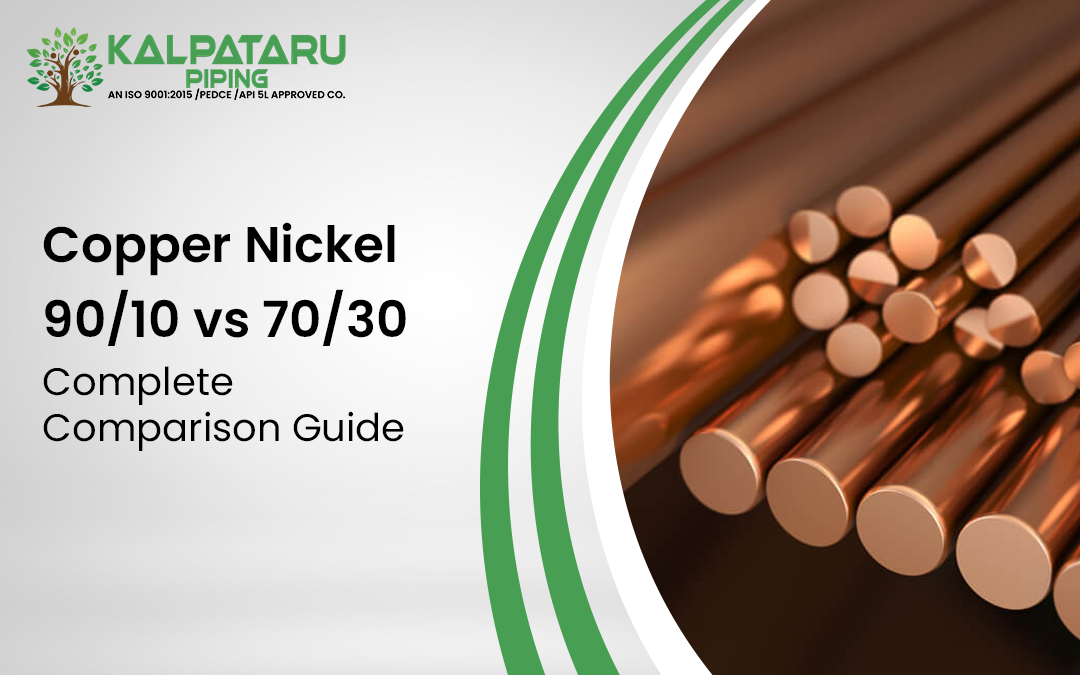
When selecting piping, tubing, or marine hardware in extreme conditions, marine engineers and buyers are faced with one vital dilemma, which is Copper Nickel 90/10 or 70/30? Both alloys are high-grade copper-nickel (Cu-Ni) alloys known for their resistance to corrosion in saltwater, biofouling and stress corrosion. An incorrect selection can result in failure early due to erosion-corrosion at high velocities or unnecessary engineering due to the use of too much nickel. There is a comparison between UNS C70600 (90/10) and UNS C71500 (70/30) below, to aid in the procurement decision.
What Is Copper Nickel 90/10 (UNS C70600)?
Copper Nickel 90/10 (UNS C70600, EN CW352H, BS CN102) is a copper alloy with approximately 10% Ni and controlled amounts of Fe, and Mn. Iron is added (usually 1.0%–1.8%) to create a coating of iron oxide, which provides a protective layer on the surface of the alloy when it comes in contact with seawater; this layer is self-healing. This protective film offers outstanding protection from general corrosion, pitting and stress corrosion cracking. The high thermal conductivity, natural resistance to marine biofouling (e.g. barnacles and mussels) and its relatively low cost make C70600 the most commonly specified Cu-Ni alloy for commercial marine piping, seawater desalination and heat exchanger tubing.
What Is Copper Nickel 70/30 (UNS C71500)?
Copper Nickel 70/30 is a material made of approximately 70% copper and 30% nickel, with small amounts of iron and manganese. The significantly greater nickel content changes the mechanical characteristics of C71500 to provide improved tensile strength, fatigue resistance and ability to withstand impingement attack and erosion-corrosion from high velocity turbulent fluids. It has a high level of resistance to general corrosion in marine environments, but the higher nickel content results in higher cost and a slightly less ability to resist biofouling attachment than 90/10. C71500 is widely used in high pressure seawater heat exchangers and offshore oil platforms where no operating failures are tolerable, as well as in naval surface ships and submarine piping systems.
Chemical Composition Comparison Between Copper Nickel 90/10 vs 70/30
| Element | UNS C70600 (CuNi 90/10) | UNS C71500 (CuNi 70/30) |
| Copper (Cu) | Remainder (86.5 – 90.5%) | Remainder (65.0 – 71.0%) |
| Nickel (Ni) (+ Co) | 9.0 – 11.0% | 29.0 – 33.0% |
| Iron (Fe) | 1.0 – 1.8% | 0.40 – 1.0% |
| Manganese (Mn) | 1.0% max | 1.0% max |
| Zinc (Zn) | 1.0% max (0.50% for tube) | 1.0% max (0.50% for tube) |
| Lead (Pb) | 0.05% max | 0.05% max |
| Carbon (C) | 0.05% max | 0.05% max |
| Sulfur (S) | 0.02% max | 0.02% max |
| Phosphorus (P) | 0.02% max | 0.02% max |
Copper Nickel 90/10 vs 70/30 Mechanical Properties Comparison
| Mechanical Property | UNS C70600 (CuNi 90/10) | UNS C71500 (CuNi 70/30) |
| Tensile Strength (min) | 275 MPa (40 ksi) | 360 MPa (52 ksi) |
| Yield Strength (0.2% Offset, min) | 105 MPa (15 ksi) | 140 MPa (20 ksi) |
| Elongation (in 2 inches / 50 mm, min) | 30% | 30% |
| Hardness (Rockwell B, typical annealed) | 45 – 65 HRB | 60 – 80 HRB |
| Density | 8.94 g/cm³ (0.323 lb/in³) | 8.94 g/cm³ (0.323 lb/in³) |
| Elastic Modulus | 135 GPa (19.6 × 10³ ksi) | 150 GPa (21.8 × 10³ ksi) |
Thermal & Electrical Conductivity of Copper Nickel 90/10 vs 70/30
| Physical Property | UNS C70600 (90/10) | UNS C71500 (70/30) |
| Thermal Conductivity (at 20 °C) | 50 W/m·K (29 BTU/ft·h·°F) | 29 W/m·K (17 BTU/ft·h·°F) |
| Electrical Conductivity (% IACS) | 9.1% IACS | 4.6% IACS |
| Electrical Resistivity (at 20 °C) | 19.0 µΩ·cm | 37.5 µΩ·cm |
| Coefficient of Thermal Expansion | 17.1 × 10⁻⁶ /°C | 16.2 × 10⁻⁶ /°C |
Weldability, Fabrication & Galvanic Compatibility
CuNi 90/10 (UNS C70600) and CuNi 70/30 (UNS C71500) are very weldable using the GTAW/TIG, GMAW/MIG and SMAW processes. Qualified welding procedure and the applicable material specification should be used to interpret the type of filler metal to be used, and the welding of specific Cu-Ni joints should be performed with Ni-Cu type filler metal (ERNiCu-7). For common piping applications, both alloys can typically be welded without any preheating or PWHT; however, this may be different for certain thicknesses, joint designs, service conditions, and codes. If the two grades are electrically coupled in sea water, a galvanic potential difference may be created which may be in favor of the CuNi 90/10 as more anodic. Factors such as dielectric isolation, exposed-area ratios, and wall-thickness allowances are important points to consider when dealing with galvanic interaction, which can be evaluated by engineers.
Cost Comparison: Nickel Pricing & TCO
Because the higher nickel content exposes CuNi 70/30 to changes in the raw-material prices of nickel and copper, in general, CuNi 70/30 is more expensive than CuNi 90/10. It is important to note that a specific premium over LME nickel and copper prices may not be taken for granted, as the actual price difference will depend on various factors such as product form, dimensions, quantity, supplier and market conditions. UNS C70600 is generally less expensive than the other, but for applications where the higher nickel content of UNS C71500 allows it to meet more stringent service demands in seawater, the advantages of such a change may not justify the extra expense. Initial CAPEX and potential maintenance, replacement and downtime costs over the expected service life should therefore be taken into consideration when selecting the appropriate grade.
Applications Uses of Copper Nickel 90/10 vs 70/30
| Industrial Application | Preferred Alloy Grade | Selection Rationale |
| Commercial Ship Hulls & Seawater Piping | CuNi 90/10 (C70600) | Excellent biofouling resistance, lower material cost, adequate velocity resistance for standard cooling loops. |
| Naval Submarines & Surface Warships | CuNi 70/30 (C71500) | High yield strength for shock loads, elevated erosion resistance in high-speed fluid systems. |
| Desalination Plants (MSF / RO) | Both (Zoned Use) | 90/10 for main heat recovery and cooling water loops; 70/30 for high-temperature brine heaters and high-pressure pumps. |
| Power Plant Condensers | CuNi 90/10 (C70600) | High thermal conductivity (50 W/m·K) ensures maximum heat transfer efficiency. |
| Offshore Oil & Gas Riser Piping | CuNi 70/30 (C71500) | Resists high turbulent wave action, high fluid velocities, and deep-sea pressure stresses. |
| Seawater Hydraulic Lines & Valves | CuNi 70/30 (C71500) | Superior mechanical strength for high-pressure hydraulic service. |
Frequently Asked Questions
Which is stronger, Copper Nickel 90/10 or 70/30?
Copper Nickel 70/30 (UNS C71500) is stronger, with higher yield and tensile strength than 90/10 (UNS C70600).
Which copper nickel alloy is better for seawater piping?
CuNi 90/10 is preferred for standard seawater piping, while CuNi 70/30 is better for higher velocities and turbulent flow conditions.
What is the difference between UNS C70600 and C71500?
UNS C70600 is CuNi 90/10 with about 10% nickel, while C71500 is CuNi 70/30 with about 30% nickel. C71500 offers higher strength and velocity resistance.
Is Copper Nickel 70/30 more expensive than 90/10?
Yes. CuNi 70/30 generally costs more because its higher nickel content increases raw-material costs.
Can Copper Nickel 90/10 and 70/30 be welded together?
Yes. Both alloys can be welded together using suitable Cu-Ni filler metal and a qualified welding procedure.
What is the maximum flow velocity for 90/10 vs 70/30 pipe?
CuNi 90/10 generally supports seawater velocities of about 3.0–3.5 m/s, while CuNi 70/30 can handle approximately 4.0–4.5 m/s under suitable conditions.
Which alloy has better resistance to biofouling?
CuNi 90/10 generally provides better natural resistance to macro-biofouling, particularly in stagnant or slow-moving seawater.