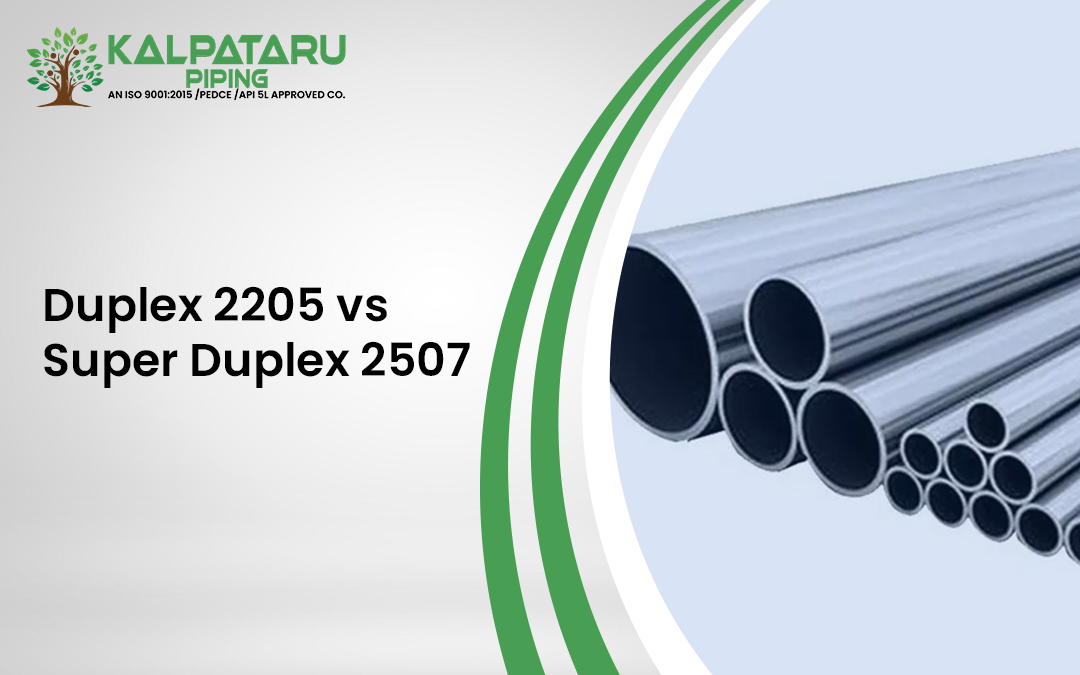
Duplex 2205 and Super Duplex 2507 are on the same spec sheet for pressure vessels, offshore piping, seawater systems, and the choice between them really comes down to one question: how much chloride exposure.The duplex workhorse is 2205, the one sold and priced for use in moderate-chloride and general industrial applications. The 2507 is more expensive, but provides real headroom where seawater, subsea, and high pressure are involved where there is no room for pit or crevice failure. The tables below provide you with the composition, PREN, mechanical, standards and welding data you need. The Duplex stainless steel 2205 to 2507 comparison is the most direct of our comparison posts, but if you aren’t already familiar with what duplex stainless steel is and how the grade family is divided, take the time to read our guide to duplex stainless steel first.
What Is Duplex 2205?
Duplex stainless steel commonly utilized in industry includes the Duplex 2205 (UNS S32205/S31803), which consists of almost equal amounts of ferrite and austenite. That mixed structure gives it close to double the yield strength of the common 300-series austenitic stainless steels It is the most preferred steel until it is surpassed by the operational environment due to its easy availability and low cost. Duplex 2205 is available in various forms from Kalpataru Piping.
What Is Super Duplex 2507?
Super Duplex 2507 (UNS S32750), on the other hand, uses the same two-phase metallurgy but goes one step ahead with alloying elements – higher amounts of chromium, molybdenum, and nitrogen when compared with the 2205 alloy, resulting in improved resistance to pitting and crevice corrosion in environments having high chloride content, and an increased strength. This increased margin comes at a higher cost, and it is also not easy to weld and machine. Therefore, the Super Duplex 2507 is used only where there is really tough service requirement and not just as a general replacement to 2205.
Chemical Composition: Duplex 2205 vs Super Duplex 2507
The difference starts with alloy content. 2507 carries meaningfully more chromium, molybdenum, and nitrogen than 2205, and that gap is what drives every other difference on this page.
| Element | Duplex 2205 (S32205 / S31803) | Super Duplex 2507 (S32750) |
| Carbon (C) max | 0.030 | 0.030 |
| Manganese (Mn) max | 2.00 | 1.20 |
| Silicon (Si) max | 1.00 | 0.80 |
| Phosphorus (P) max | 0.030 | 0.035 |
| Sulfur (S) max | 0.020 | 0.020 |
| Chromium (Cr) | 22.0 to 23.0 | 24.0 to 26.0 |
| Nickel (Ni) | 4.5 to 6.5 | 6.0 to 8.0 |
| Molybdenum (Mo) | 3.0 to 3.5 | 3.0 to 5.0 |
| Nitrogen (N) | 0.14 to 0.20 | 0.24 to 0.32 |
| Copper (Cu) max | not specified | 0.50 |
PREN and Corrosion Resistance of Duplex 2205 vs Super Duplex 2507
| Grade | Midpoint Cr / Mo / N used | Calculated PREN | Typical published range |
| Duplex 2205 | 22.5 / 3.25 / 0.17 | approximately 36 | 34 to 38 |
| Super Duplex 2507 | 25.0 / 4.0 / 0.28 | approximately 43 | 40 to 45 |
Mechanical Properties of Duplex 2205 vs Super Duplex 2507
Both grades outperform standard austenitic stainless steel on strength, a direct result of the duplex microstructure. 2507’s higher alloy content pushes that advantage further, at some cost to ductility.
| Property | Duplex 2205 | Super Duplex 2507 |
| Yield Strength (0.2% offset), min | 450 MPa (65 ksi) | 550 MPa (80 ksi) |
| Tensile Strength, min | 620 MPa (90 ksi) | 795 MPa (116 ksi) |
| Elongation, min | 25% | 15% |
| Hardness, max | 293 HB / 31 HRC | 310 HB / 32 HRC |
Standards Cross-Reference Duplex 2205 vs Super Duplex 2507
| Standard | Duplex 2205 | Super Duplex 2507 |
| UNS | S32205 / S31803 | S32750 |
| ASTM (plate/pipe/bar) | A240 / A789 / A182 / A276 | A240 / A789 / A182 / A276 |
| EN | 1.4462 | 1.4410 |
| Werkstoff No. | 1.4462 | 1.4410 |
| DIN designation | X2CrNiMoN22-5-3 | X2CrNiMoN25-7-4 |
Duplex 2205 vs Super Duplex 2507: Welding and Fabrication
| Duplex 2205 | Super Duplex 2507 | |
| Typical filler metal | ER2209 / E2209 | ER2594 / E2594 |
| Welding difficulty | Moderate; standard duplex technique | Higher; stricter heat input control needed |
| Heat input guidance | Controlled heat input, standard interpass limits | Typically limited to roughly 0.5 to 2.5 kJ/mm to avoid intergranular embrittlement and preserve corrosion resistance |
Applications: Where Each Grade Is Actually Used
Duplex 2205 applications
- Chemical processing equipment and pressure vessels
- Heat exchangers in moderate-chloride service
- Onshore oil and gas piping and process lines
- Desalination plant components outside the most aggressive zones
- Marine and coastal structural components
Super Duplex 2507 applications
- Offshore oil and gas platforms, topside and subsea
- Subsea pipelines and flowlines
- High-pressure seawater injection and cooling systems
- Desalination plants in the highest-chloride, highest-temperature zones
- Heat exchangers in continuous seawater service
How to Choose Between Duplex 2205 and Super Duplex 2507
- Chloride exposure: moderate exposure, splash zones, or general industrial chemical service points to 2205; continuous seawater immersion, subsea, or high-chloride process streams point to 2507.
- Pressure and wall thickness: if 2507’s higher yield strength lets you drop a wall-thickness schedule while still meeting the pressure rating, the weight and material savings can offset a meaningful part of its price premium.
- Cost and lifecycle cost: 2205 is the more economical choice up front and the wider-availability grade. 2507 costs more per kilogram but can cost less over the service life of the asset when the alternative is early pitting failure and unplanned downtime.
- What to put in the purchase order: specify a minimum PREN value rather than a brand name, name the required filler metal and any PWHT, and ask for a mill test certificate with heat traceability on any critical order, since 2205 and 2507 are not visually distinguishable from finish alone.
Frequently Asked Questions
What is the main difference between Duplex 2205 and Super Duplex 2507?
2507 carries higher chromium, molybdenum, and nitrogen than 2205, which gives it a higher PREN and better resistance to pitting and crevice corrosion, along with higher strength. 2205 is more economical and easier to weld and machine.
Which is stronger, Duplex 2205 or Super Duplex 2507?
Super Duplex 2507 is stronger on both measures that matter: a minimum yield strength of 550 MPa versus 450 MPa for 2205, and a minimum tensile strength of 795 MPa versus 620 MPa.
What is the PREN of Duplex 2205 vs Super Duplex 2507, and why does it matter?
2205 calculates to approximately 36 and 2507 to approximately 43 using the standard PREN formula. A PREN above roughly 40 is generally treated as the threshold for reliable seawater and severe offshore service, which is why 2507 gets specified there and 2205 does not.
Is Duplex 2205 or Super Duplex 2507 more cost-effective?
2205 is more cost-effective on material price and is more widely available. 2507 costs more but can be more cost-effective over an asset’s service life in severe chloride environments, where the alternative is early corrosion failure and replacement.
When should I choose Super Duplex 2507 over Duplex 2205?
Choose 2507 for continuous seawater exposure, subsea or offshore hardware, high-pressure chloride-rich process streams, or any application where a pitting or crevice corrosion failure would be unacceptable.
Can Duplex 2205 and Super Duplex 2507 be welded with the same filler metal?
No. Filler metal should match the base metal’s alloy content: ER2209/E2209 for 2205, and a higher-alloy filler such as ER2594/E2594 for 2507. Using a 2209-type filler on 2507 base metal would leave the weld with lower corrosion resistance than the parent material.
What is the difference between UNS S32205 and UNS S31803?
S32205 is a tightened-composition revision of S31803, with a narrower nitrogen range to give more consistent properties. In practice the two names are used interchangeably for what is commercially sold as Duplex 2205.
Where can I buy Duplex 2205 and Super Duplex 2507 pipe, plate, or round bar?
Kalpataru Piping stocks both grades across plate, sheet, pipe, tube, round bar, and flanges, with mill certification available on request.