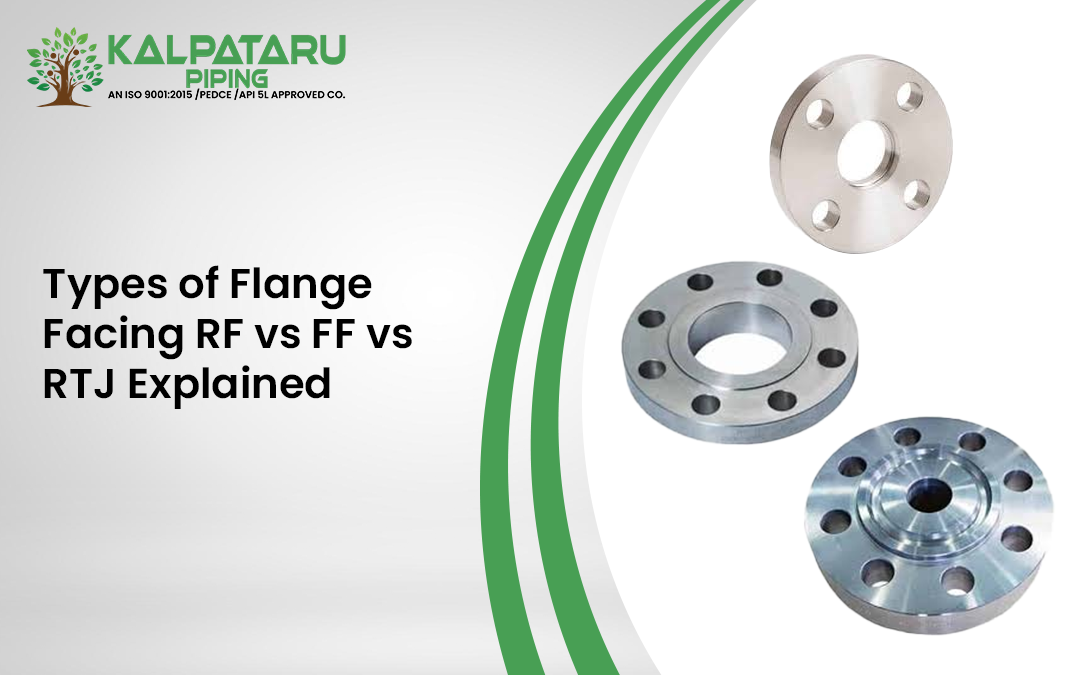
The types of flange facing are raised face, flat face and ring type joint, plus two special faces called tongue and groove and male and female. Every face refers to the machined surface that holds the gasket. The design determines how the joint will function. If the wrong face is chosen, the joint may leak or, worse, the brittle flange may break at the bolts. Kalpataru Piping supplies flanges in all of these faces, and the questions we hear most are which face takes which gasket and which faces can go together. This guide answers both, with tables you can check against on site.
What Is a Flange Face?
Flange face refers to the machined part on the front side of a flange that holds the gasket. The total flange carries load, however, the flange face is the one which actually seals. When bolts are tightened, they compress the gasket between the two faces, but they have to compress the gasket properly to fill the small gaps in the surface and withstand the pressure in the pipe. This is called gasket stress, with the face design governing where the stress will be applied.
Because of this, a face can never be chosen on its own. It has to suit the gasket, and it has to suit the flange on the other side of the joint. A face that works well with a spiral wound gasket may fail with a plain sheet, and two faces that look close can still be incompatible. For the wider picture of how flange bodies differ, read our guide to types of flanges, uses, materials, and standards. The diagram below shows all five flange face types side by side.
https://www.tangovalve.com/blogs/rf-vs-rtj-flanges-explained-key-differences/
Flange Face Types Compared at a Glance
The table sets the five flange face types next to each other, which is the quickest way to see how RF vs FF vs RTJ and the two special faces differ. Read it as typical use, not as a rule. The final choice always depends on the project specification, the piping class and the gasket. The sections after it take each face one at a time.
|
Face type |
How it seals |
Gasket used |
Typical pressure use |
Typical service |
|
Raised face, RF |
Gasket is squeezed on a narrow raised ring around the bore |
Spiral wound, sheet, kammprofile |
Low to high |
General process piping, utilities, oil and gas |
|
Flat face, FF |
Gasket is squeezed across the whole flat face |
Full face non metallic |
Low |
Water lines, cast iron and ductile iron equipment, non metallic connections |
|
Ring type joint, RTJ |
Metal ring is squeezed into a machined groove |
Metal ring, R, RX or BX |
Medium to very high |
Hydrocarbon, high temperature and wellhead service |
|
Tongue and groove |
Gasket is trapped between a raised tongue and a matching groove |
Flat ring or sheet |
Low to high |
Pump covers, valve bonnets, heat exchanger joints |
|
Male and female |
Gasket sits in a recess that takes a raised male face |
Flat ring or sheet |
Low to high |
Heat exchanger shells and channel covers |
Raised Face Flange
The raised face flange is the most common of the flange face types. A narrow ring stands above the bolt circle, so the gasket sees higher stress and seals across a wide pressure range. Spiral wound, sheet and kammprofile gaskets all suit it. In the raised face vs flat face flange comparison, RF concentrates load on a ring while FF spreads it.
|
Pressure class |
Raised face height in mm |
Raised face height in inches |
|
Class 150 and Class 300 |
About 1.6 |
About 0.06 |
|
Class 400 and above |
About 6.4 |
About 0.25 |
In ASME B16.5 the 1.6 mm raised face on Class 150 and 300 is included in the flange thickness, while the 6.4 mm raised face on Class 400 and above is not, so the overall thickness differs between the two groups. Confirm every height and thickness against the current edition of ASME B16.5, and see our guide to types of stainless steel flanges for face and flange combinations.
Flat Face Flange
A flat face flange sits in one plane from bore to edge, and its full face gasket reaches past the bolt holes. In flat face vs raised face terms, the safety point matters most. Cast iron, ductile iron and non metallic flanges are brittle, and a raised ring bolted against them acts as a lever that can crack the rim. That is why FF suits cast iron valves, pumps and low pressure lines. A steel flange meeting a cast iron FF flange is normally flat face too. Body styles are covered in types of flanges, uses, materials and standards.
Ring Type Joint Flange
A ring type joint flange seals with a solid metal ring squeezed into a machined groove, giving a metal to metal seal for high pressure and high temperature service. Our guide on raised face vs ring type joint flanges, pressure and temperature ratings holds the full ratings.
RTJ ring gasket types:
- R ring: oval or octagonal, the standard style.
- RX ring: pressure energised, fits the R groove.
- BX ring: for API 6BX flanges, not interchangeable.
The ring must be softer than the groove, and used once only. Keep groove walls clean, because a scratch becomes a leak path.
Which Flange Faces Can Be Bolted Together?
Which flange face types can be bolted together is the most practical question on site. In RF vs FF vs RTJ terms, the table gives the usual answer.
|
Face combination |
Can they be bolted together? |
|
RF to RF |
Yes |
|
FF to FF |
Yes |
|
RTJ to RTJ |
Yes |
|
RF to FF |
Generally avoid |
|
RF to RTJ |
No |
|
Tongue and groove, male and female |
Only with their matching partner |
The project piping class and a piping engineer decide special cases, such as a steel RF flange meeting a flat face equipment nozzle. A spectacle blind flange is fitted between two flanges, so it must match the joint face as well.
Matching the Gasket to the Flange Face
Buyers usually start from the gasket, so this table works the other way round. Pick the face first, then read across to the gasket and the standard that governs it. ASME B16.20 covers metallic gaskets such as spiral wound and ring joint gaskets, and ASME B16.21 covers flat non metallic ones. Confirm the scope of each standard in the edition your project uses.
|
Face |
Common gasket |
Gasket standard |
|
RF |
Spiral wound, sheet, kammprofile |
ASME B16.20 for metallic, ASME B16.21 for non metallic |
|
FF |
Full face non metallic |
ASME B16.21 |
|
RTJ |
R, RX or BX ring |
ASME B16.20 and API 6A |
How to Choose the Right Flange Face
Work through this checklist in order. Most face decisions are settled by the first three points.
- Pressure class of the line.
- Operating temperature and any thermal cycling.
- Fluid hazard, such as flammable, toxic or high value product.
- Material and face of the mating flange or equipment nozzle.
- Gasket that is available and approved for the job.
- Maintenance access and how often the joint will be opened.
- Project specification and piping class, which override everything else.
Here is how it works on two real lines. A Class 150 cooling water line runs at moderate pressure and temperature with a harmless fluid. A raised face flange with a spiral wound gasket does the job, it is easy to source and it is easy to maintain. A Class 900 hydrocarbon line carries a flammable fluid at high pressure and temperature. Here an RTJ flange with an octagonal ring is the safer choice, because the metal to metal seal handles the duty and a leak would be serious.
Material changes the picture too. Our comparison of stainless steel flanges vs carbon steel flanges, the guide to duplex steel flanges, grades and uses and the page on flanges in different materials will help you match the face to the metal.
Standards for Flange Facing
Flange facing standards tell you what is allowed, and each one controls something different. The table gives the scope of the ones you will meet most. If you want to understand how the two main standards bodies differ, read our guide to ASTM vs ASME standards for pipes, tubes and fittings. Always check the scope and the edition before you quote a standard.
|
Standard |
What it controls |
|
ASME B16.5 |
Pipe flanges up to NPS 24, including face types and face dimensions |
|
ASME B16.47 |
Large diameter flanges above NPS 24 |
|
ASME B16.20 |
Metallic gaskets, including ring joint and spiral wound |
|
ASME B16.21 |
Non metallic flat gaskets |
|
API 6A |
Wellhead equipment and BX rings |
|
EN 1092 Part 1 |
European steel flanges, with face types named by letters |
Common Mistakes With Flange Faces
- Bolting an RF flange to a cast iron FF flange. The raised ring can crack the brittle rim.
- Using a flat gasket in an RTJ groove. It cannot seal in a groove made for a metal ring.
- Reusing an RTJ ring. It has already deformed and will not seat properly again.
- Scratching across the serrations. A scratch that crosses them gives the fluid a way out.
- Ordering only half of a tongue and groove pair. The joint cannot be made.
- Mixing R and BX rings. They are not interchangeable and the wrong ring will not seat.
The right face still has to come in the right material, so it is worth knowing how to check what you receive. Our quality checklist for genuine stainless steel flanges shows what to verify before accepting a consignment.
Frequently Asked Questions
What are the types of flange facing?
The main types of flange facing are raised face, flat face and ring type joint. Two special faces, tongue and groove and male and female, are used on pumps, valve bonnets and heat exchangers. The face is the sealing surface where the gasket sits, and its shape decides how the joint seals.
What is the difference between RF and FF flanges?
An RF flange has a raised ring around the bore, so the gasket sits only on that ring and is squeezed harder. An FF flange is flat from bore to edge and uses a full face gasket. RF suits most steel piping. FF suits cast iron, ductile iron and low pressure lines where brittle flanges must not bend.
Can a raised face flange be bolted to a flat face flange?
It should generally be avoided. Bolting an RF flange to an FF flange leaves a gap at the rim, and the bolts can bend or crack the flat face flange, especially on cast iron. When it cannot be avoided, the steel flange is normally made flat face too. A piping engineer decides special cases.
What is an RTJ flange used for?
An RTJ flange is used where a joint must hold high pressure, high temperature or hazardous fluid. A metal ring sits in a machined groove and is squeezed into it by the bolts, giving a metal to metal seal. It is common on higher class hydrocarbon lines, refinery piping and wellhead equipment.
What is the raised face height of a Class 150 flange?
The raised face on a Class 150 flange is about 1.6 mm, which is one sixteenth of an inch. Class 300 uses the same height. From Class 400 upward the raised face is about 6.4 mm, or one quarter of an inch. Always confirm the figure against the current edition of ASME B16.5.
What is flange face finish?
Flange face finish is the surface texture machined onto the sealing face. Raised face and flat face flanges usually have a serrated finish of about 125 to 250 microinch Ra, or 3.2 to 6.3 micrometre. RTJ grooves need a finer finish, about 63 microinch Ra maximum. The finish must suit the gasket.
Choosing the Right Flange Face for Your Joint
Every face in this guide does the same job in a different way. Raised face concentrates stress on a ring, flat face protects brittle flanges, ring type joint locks a metal ring into a groove, and tongue and groove and male and female trap the gasket between a matched pair. The rule holds across all of them. Match the face to the pressure, the gasket and the mating flange, then check it against the project specification. If you are planning a project, explore our full product range or get in touch with our team with your size, class, face and material, and we will help you confirm the right flange.