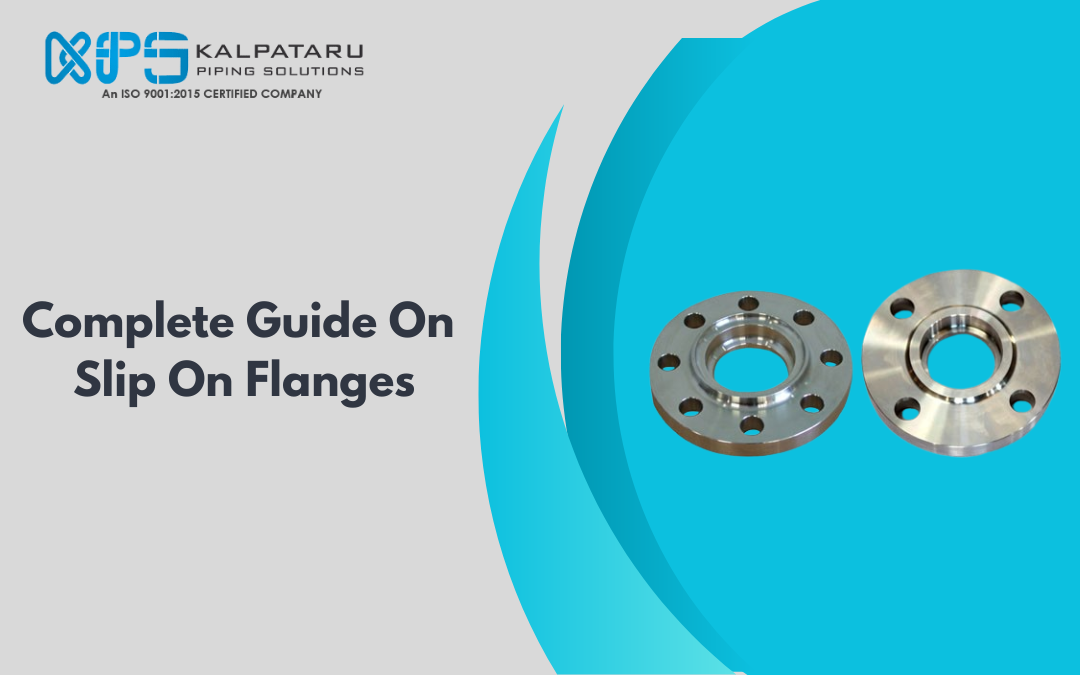
A Complete Guide on Slip On Flanges
One of the most frequent specification choices that engineers and procurement teams make when specifying nickel alloy bearings is between Inconel vs Incoloy. Both alloy families use nickel as a base element and that is as far as the similarities go. Inconel and Incoloy are different in terms of nickel content, maximum temperature, corrosion behaviour, weldability and cost.
This guide explains the Inconel vs Incoloy difference at a grade level, covering Inconel 625 vs Incoloy 825, Inconel 718 vs Incoloy 800, chemical composition, Inconel vs Incoloy temperature resistance, corrosion resistance, weldability, and cost that will give you a clear decision framework before you specify or source.
Kalpataru Piping has supplied both nickel-chromium and nickel-iron-chromium alloys to fabricators and EPC contractors across 40+ countries. Browse our complete Inconel Products range and Incoloy Products range to see available grades and forms.
What is Inconel?
Inconel is a family of austenitic nickel-chromium superalloys containing 50–72% nickel. The high nickel content gives Inconel its exceptional resistance to oxidation, carburisation, and thermal fatigue at temperatures that would degrade stainless steel. The most widely specified grades are:
- Inconel 600 — general-purpose high-temperature resistance; furnaces, heat exchangers
- Inconel 625 (UNS N06625) — nickel-chromium-molybdenum-niobium; outstanding pitting, crevice, and stress corrosion resistance in seawater and sour gas. See our certified Inconel 625 Pipes & Tubes range.
- Inconel 718 (UNS N07718) — age-hardenable; preferred where high strength and creep resistance above 700°C are required. See our Inconel 718 Pipes & Tubes range.
- Inconel X-750 — spring and fastener applications in extreme heat
Inconel alloys are specified under ASTM B443 (plate/sheet), B444 (pipe/tube), and B446 (bar/wire), and are the default material under most aerospace, nuclear, and offshore standards where service exceeds 800°C.
What is Incoloy?
Incoloy is a family of nickel-iron-chromium alloys containing 30–45% nickel. The iron backbone reduces raw material cost while retaining corrosion resistance in aqueous, acidic, and moderately high-temperature environments. The most specified grades are:
- Incoloy 800 / 800H / 800HT (UNS N08800/N08810/N08811) — heat-resistant grades for petrochemical furnaces and steam superheaters up to 980°C (creep-limited). See our certified Incoloy 800 Pipes & Tubes range.
- Incoloy 825 (UNS N08825) — nickel-iron-chromium with molybdenum and copper additions; excellent in sulphuric acid, phosphoric acid, and seawater. A cost-effective alternative to Inconel 625 where temperatures permit. See our Incoloy 825 Pipes & Tubes range.
- Incoloy 925 — age-hardenable version of 825; used in oil and gas completions equipment (tubing hangers, packers)
Incoloy alloys are covered under ASTM B423 (825 pipe/tube), B408 (800 bar), and B514/B515 (825 welded tube). They comply with ASME B31.3 and are widely used in chemical process and offshore applications rated below 600°C.
Chemical Composition — Inconel vs Incoloy
The most visible Inconel vs Incoloy difference is in the nickel, iron, and molybdenum percentages. Higher nickel and molybdenum directly drive corrosion performance and cost.
| Grade | Ni (%) | Cr (%) | Mo (%) | Fe (%) |
| Inconel 625 | 58 min | 20–23 | 8–10 | 5 max |
| Inconel 718 | 50–55 | 17–21 | 2.8–3.3 | Balance |
| Incoloy 825 | 38–46 | 19.5–23.5 | 2.5–3.5 | Balance |
| Incoloy 800H | 30–35 | 19–23 | — | Balance |
Inconel 625’s molybdenum content (8–10%) is more than double that of Incoloy 825 (2.5–3.5%), this is why Inconel 625 resists pitting and crevice corrosion in chloride environments that would attack Incoloy 825. Where that extra Mo content is not needed, specifying Incoloy is the cost-efficient decision.
Inconel vs Incoloy Temperature Resistance
Inconel vs Incoloy temperature resistance is the most decisive selection criterion for most engineers:
| Grade | Max Continuous Temp | Oxidation Limit | Typical Application |
| Inconel 625 | 980°C (1800°F) | 1093°C (2000°F) | Offshore, chemical reactors |
| Inconel 718 | 700°C (1292°F) creep | 980°C (1800°F) | Aerospace, gas turbines |
| Incoloy 800HT | 898°C (1650°F) creep | 1093°C (2000°F) | Pyrolysis furnace tubes |
| Incoloy 825 | 450°C (842°F) aqueous | 593°C (1100°F) | Acid piping, heat exchangers |
| Note Incoloy 800HT can withstand up to 1093°C in oxidising atmospheres — but its strength at those temperatures is creep-limited. For mechanical loads above 700°C, Inconel 625 or 718 is the safer specification. |
Inconel vs Incoloy Corrosion Resistance
Inconel vs Incoloy corrosion resistance diverges most sharply in the nature of the corrosive medium:
| Environment | Inconel Performance | Incoloy Performance |
| Oxidising acids (HNO3) | Excellent — high Cr content | Good — adequate for moderate concentrations |
| Reducing acids (H2SO4, H3PO4) | Good | Excellent — Incoloy 825 preferred |
| Seawater / chloride pitting | Excellent — Inconel 625 dominant spec | Good — Incoloy 825 acceptable at lower temps |
| Sour gas (H2S, CO2) | Excellent — NACE MR0175 compliant grades | Limited — risk of stress corrosion cracking |
| High-temp oxidation / carburisation | Excellent — primary advantage of Inconel | Good (800H/HT); limited for 825 at temp |
| Caustic / alkali (NaOH) | Good | Good |
In seawater service, both families perform — Incoloy 825 at lower cost for static or low-velocity applications; Inconel 625 where crevice corrosion risk is critical (e.g. tube-to-tubesheet joints, threaded connections).
Inconel vs Incoloy Weldability
Inconel vs Incoloy weldability is not an even comparison:
- Incoloy 825 and 800 weld readily using standard GTAW (TIG) or GMAW procedures. Preheat is not generally required for sections under 25 mm. Filler wire is ERNiFeCr-1 (825) or ERNiCr-3 (800). The wider weld pool and lower heat sensitivity make Incoloy significantly faster and cheaper to fabricate than Inconel.
- Inconel 625 and 718 require precise heat control. Inconel 625 in particular has low thermal conductivity (9.8 W/m·K), causing heat to accumulate rapidly in the weld zone. Slow pool movement, strict interpass temperature limits (300°F / 150°C maximum), and certified ERNiCrMo-3 filler wire are all mandatory. See the full Inconel 625 welding procedure in the sections below.
If fabrication cost and speed are constraints and the operating conditions permit, Incoloy 825 offers 30–40% lower fabrication time than Inconel 625 on equivalent section thicknesses.
Inconel vs Incoloy Cost Comparison
The difference is Inconel vs Incoloy cost which is based on the raw alloy chemistry. The main cost drivers and Inconel has far more of both:
- Incoloy 825 is 40-70% of the cost of Inconel 625 on a kilo-to-kilogram basis, varying by product form, and current prices of nickel.
- The additional premium on Inconel 718 compared to 625 is due to the additional niobium and heat treatment requirement to harden the alloy.
Incoloy 800H/HT is the least expensive metal to use in high-temperature service when strength is not critical and the environment is non-chloride.
Incoloy 825 is best value in budget sensitive application, chemical plant heat exchanger, acid piping, offshore seawater service below 450degC. Inconel premium should only be spent when it is actually required by operating conditions.
When to Choose Inconel
- Operating temperature exceeds 800°C (1472°F) continuously
- Service environment is strongly oxidising — hot combustion gases, jet exhaust, furnace atmospheres
- Specification requires sour gas resistance under NACE MR0175 / ISO 15156
- Crevice corrosion or pitting in chloride/seawater is a primary failure mode
- Aerospace, nuclear, or offshore codes mandate Inconel-grade material certifications (ASTM B443, B444, B446)
- Pressure-retaining components at elevated temperature require high creep strength (specify Inconel 718)
When to Choose Incoloy
- Operating temperature is below 800°C and material budget is constrained
- Corrosive medium is reducing — sulphuric acid, phosphoric acid, or aqueous contaminated seawater
- Application is heat exchangers, acid piping, or chemical process equipment below 600°C
- Standard ASME B31.3 or API fabrication codes apply — Incoloy 825 or 800 will satisfy without over-engineering
- Incoloy 825 is under consideration as a cost-effective alternative to Inconel 625 — confirm temperature and environment suitability first
- Fabrication speed and weld ease are constraints — Incoloy processes 30–40% faster than Inconel 625
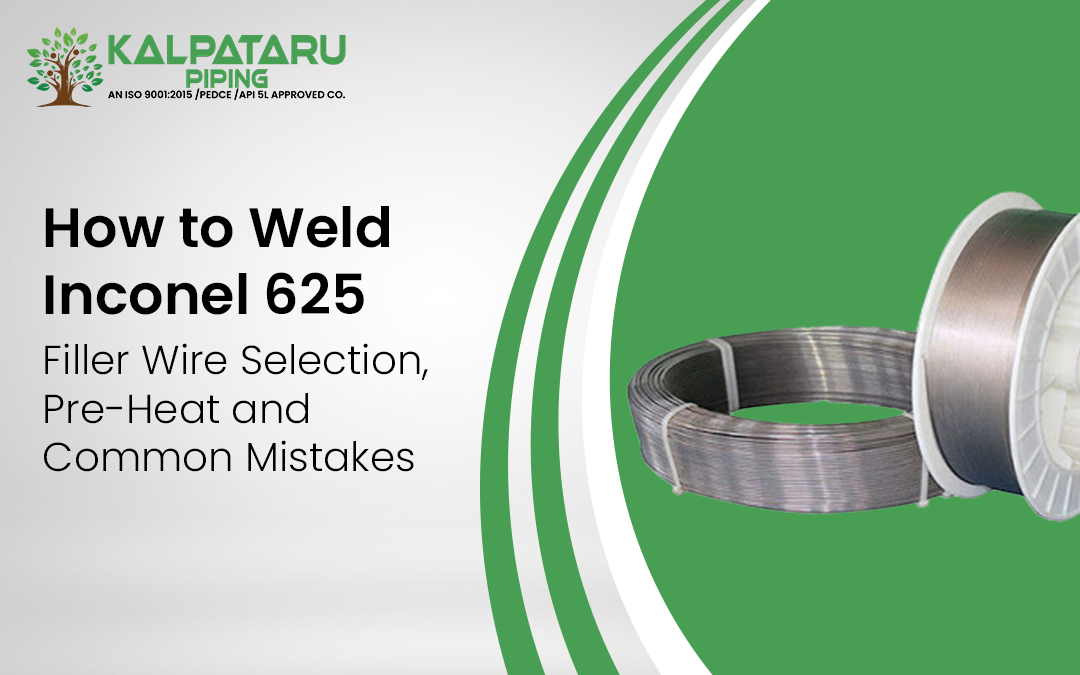
Inconel 625 Filler Wire: What to Specify and Why
Inconel 625 is a nickel chromium molybdenum alloy that resists high temperature and aggressive chemicals and seawater. It does not have high thermal conductivity (9.8 W/m*K) and hence heat builds up in the region of welds. It must be consciously heated in its slow weld pool, abilities that cannot be directly transferred to stainless steel work. The hot area (HAZ) can easily crack hot unless the process is done carefully.
Inconel 625 is used in the correct filler wire, EERNiCrMo-3 in virtually every application. It is identical to the base metal chemistry, and does not cause iron dilution (reducing molybdenum solubility and forming unwanted phases), nor reduces impact toughness. It satisfies mechanical requirements without any post-weld heat treatment (PWHT) and offers pitting and crevice corrosion resistance, and stress corrosion cracking resistance in sour gas and seawater service.
For a full range of certified Inconel 625 pipe and tube to pair with your fabrication specification, see our Inconel 625 Pipes & Tubes supply page.
| Filler Wire | Use Case | Key Risk if Skipped |
| ERNiCrMo-3 (primary) | Like-for-like Inconel 625 joints | Phase instability, low ductility |
| ERNiCrFe-5 / Alloy 82 | Dissimilar welds to carbon steel | Elevated residual stress; no HAZ softening |
Filler Wire Diameter Selection
ERNiCrMo-3 is available in standard diameters. Select based on base metal thickness:
| Base Metal Thickness | Recommended Wire Diameter |
| < 3 mm | 0.8–1.0 mm |
| 3–6 mm | 1.0–1.6 mm |
| 6–12 mm | 1.6–2.4 mm |
| > 12 mm | 2.4–3.2 mm |
| For root passes on pipe, 1.6 mm is the standard starting point regardless of wall thickness. |
Do not substitute stainless steel or carbon steel filler rods. Iron dilution destroys the alloy’s corrosion resistance and mechanical integrity — the weld will not pass testing. Always verify lot certifications against AWS A5.14 / ASME SFA-5.14 and obtain complete Mill Test Reports (MTRs).
Pre-Heat for Inconel 625 Welding: When It’s Needed
Inconel 625 does not demand aggressive preheat — but base metal thickness governs the decision:
| Thickness | Preheat | Purpose |
| < 6 mm | None | Distortion risk outweighs benefit |
| 6–25 mm | 150–200°F (65–93°C) | Remove moisture; reduce thermal shock |
| > 25 mm | ~300°F (150°C) | Reduce HAZ cracking risk |
| Dissimilar joints | Per WPS (150–300°F) | Manage differential expansion |
Never substitute your Welding Procedure Specification (WPS) with project-specific requirements of preheat. Cap interpass temperature 300 o F (150 o C) unless your WPS tells you otherwise. Beyond this limit, the grain will grow and sensitise in the HAZ, both are non-verbal failure modes which will only be realised when the component is in service.
A direct comparison of Inconel vs Incoloy weldability (including the behaviour of Incoloy 825 when subjected to similar preheat conditions) can be found on the Inconel vs Incoloy weldability comparison above.
TIG Welding Inconel 625: Step-by-Step Procedure
GTAW (TIG) is the preferred process for Inconel 625. This alloy requires precise heat control that only TIG consistently delivers. Follow these steps in order.
Step 1 — Clean the Surface
Degrease with acetone. Remover mill scales and oxides. Apply with a special stainless steel wire brush – not carbon. Porosity or cracking will occur when there is any contamination of the weld pool.
Step 2 — Fit-Up and Tack
Aim for zero root gap. The cracks on the craters of Inconel 625 are usually formed by big beads on small throats. Space tack welds the root pass evenly to spread the heat evenly.
Step 3 — Machine Set-Up
DCEN polarity, 60120 A, argon shielding 15 20 cfh. HF arc start helps to stop tungsten contamination. Increase arc energy and fluidity of weld pool to heavier sections by adding up to 25 percent helium to argon shield.
Step 4 — Electrode Preparation
It should be 2% Thoriated or Ceritated tungsten. To a sharp taper sharpen with specific grinder. A sharp, rounded or dirty end results in arc drifting and tungsten in-growths. Hone prior to each session.
Step 5 — Welding Technique
Keep the arc length at about 3 mm. Hold the torch at 10-15 o. Apply pulsed current – by alternating peak and background amps, the bead is narrowed and the possibility of hot-cracking reduced. Insert filler wire on the front of the weld pool and pull out without collapsing the arc. Predominantly more grain growth or discolouration means there is too much heat input into it, decrease amperage or travel faster.
Step 6 — Multi-Pass Cooling
On places that are greater than 6 mm, permit cooling the weld to less than 300 o C amid passes. Take interpass temperature value using contact thermometer. Look at every run of product any defect in this process can be repaired in a few minutes; the same defect on a radiograph will occupy days.
| The Inconel 625 weld pool moves significantly more slowly than stainless steel. Complete scrap practice before certified pipe welding , heat control instincts built on stainless steel will work against you here. |
Which Welding Process is Best for Inconel 625?
| Process | Suitability | Notes |
| GTAW (TIG) | First choice | Best heat control; preferred for pipe and thin sections |
| GMAW (MIG) | Acceptable for thick plate | Higher deposition rate; less precision; avoid short-circuit transfer mode |
| SMAW (Stick) | Field repair only | Limited alloy-matched consumable availability; highly skill-dependent |
| SAW | Not recommended | Excessive heat input; iron dilution risk from flux |
Sourcing Inconel 718 pipe or tube for a related high-temperature application? See our Inconel 718 Pipes & Tubes range, same material certification standards apply.
Common Mistakes When You Weld Inconel 625
Carbon steel cleaning tools. Galvanic contamination is also caused by even trace particles. Apply nickel alloy stainless steel brushes and discs.
- Wrong filler wire. The only quickest way to a failed corrosion test and a rejected component is to replace a lower grade or stainless filler with certified ERNiCrMo-3.
- Excessive heat input. The accumulation of heat is rapid in Inconel 625. In the absence of pulsed current or tight interpass control, the grain growth and HAZ sensitisation proceeds follows, neither would appear until the part is in service.
- No argon back purge pipe welds. Purge pipe bore with root passes using argon. A corroded internal surface becomes unresistant to corrosion, and cannot pass a radiograph inspection.
- Skipping NDT. Radiography has also shown that there was absence of fusion and voids in welds that were visually clean. In the case of pressure retaining components, NDT is not optional, but mandatory.
- Poor fit-up. The beads made by open root gaps are wide with a thick texture, and most likely to have craters. Check twice, tack accurately, and check root gap before devoting to root pass.
Post-Weld Inspection for Inconel 625
Employ a multi-layer NDT method: initial visual inspection is followed by a liquid penetrant to identify surface-breaking defects, and subsequent radiographic or ultrasonic testing to identify any indications subsurface on pressure-sensitive joints. Hardness tests are also necessary on sour-service and dissimilar-metal welds. Record every finding – adherence to either ASME IX or AWS D1.6 should be recorded prior to the service of the component.
Post-Weld Heat Treatment (PWHT)
Standard service like-for-like Inconel 625 welds do not need PWHT. Nevertheless, your WPS might need solution annealing (1093-1149 degC / 2000-2100 degF) on:
- Dissimilar metal joints where the carbon steel side requires to be relieved.
- Components going into cryogenic service.
- Projects in which end-user requirements require it.
- In cases where no PWHT is needed, you should state this clearly in your weld record.
Conclusion: Weld Inconel 625 Right the First Time
Shortcuts cannot be made when welding Inconel 625. It requires a long period to weld, a lot of heat accumulation, and contamination, so each step in this guide has its cost: the right filler wire is specified, the preheat is applied, the TIG technique is employed using pulsed current, and the final step of the process is the completion of the NDT.
Wrong filler wire, loss of interpass temperature control and lack of argon back purge on pipe welds are the most prevalent causes of failure observed in practice. The removal of these three helps to remove most of the risk of rework at the weld.
For procurement decisions that extend beyond Inconel 625 welding, understanding the broader Inconel vs Incoloy difference is equally important. If your application runs below 800°C or involves reducing acid environments, Incoloy 825 Pipes & Tubes or Incoloy 800 Pipes & Tubes may offer equivalent corrosion protection at a lower material cost. For oxidising, extreme-temperature, or sour-gas service above that threshold, Inconel remains the required specification.
Read our full Inconel Grade Guide for a complete breakdown of 600, 625, and 718 grade selection, or view all Nickel Alloy Products available from Kalpataru Piping.
Certified source documentation matters. The minimum acceptable standard is AWS A5.14 / ASME SFA-5.14 with complete MTRs. Kalpataru Piping Solutions distributes ERNiCrMo-3 filler wire and Inconel 625 piping and tubing to oil and gas, chemical processing, marine, and power generation industries with full project inspection documentation packages.
Frequently Asked Questions
What is the main difference between Inconel and Incoloy?
Inconel is a nickel-chromium alloy (50-72% nickel) designed to operate at very high temperatures of over 800degC and in very oxidising conditions. A nickel-iron-chromium alloy (30-45% nickel) modified to moderate temperature corrosion service, especially in reducing acid and aqueous environments, is incoloy. The reduced nickel content means that Incoloy is much more economical in areas with a high temperature limit.
Is Inconel stronger than Incoloy?
Yes, higher temperatures, Incoloy Inconel 625 and 718 both have high tensile and creep strength at temperatures above 700 degC than any Incoloy grade. The difference in strength between the two decreases significantly at ambient and moderate service temperature, and at reduced material cost Incoloy 825 and 925 can satisfy most structural considerations.
Can Incoloy replace Inconel?
In certain service conditions only. Other options that are viable include incoloy: operating temperatures remain less than about 800 deg C and the corrosive media is reducing (sulphuric acid, phosphoric acid or seawater). Inconel is the necessary specification where temperatures rise above 800 o C, or where aerospace/nuclear codes are in operation.
Which is cheaper, Inconel or Incoloy?
With its lower levels of nickel and molybdenum, incoloy is always cheaper than Inconel. Inconel 625 is usually priced at a 40-70% higher than Incoloy 825 on a kilogram basis depending on product form and market conditions. Incoloy is the cost-effective alternative to use in budget sensitive projects where operating conditions allow.
What is the difference between Inconel 625 and Incoloy 825?
UNS N06625 Inconel Univamp 625 (IN 625) is a nickel-chromium-molybdenum alloy exhibiting excellent pitting, crevice corrosion and stress corrosion cracking resistance, continuous service up to 980 -C. Incoloy 825 (UNS N08825) is a nickel-iron-chromium alloy with good sulphuric and phosphoric acid resistance, and has a corrosive service rating of about 450 deg C in aqueous environments. High-temperature or sour gas: Offshore, high-temperature, or sour gas: specify Inconel 625. Below 450degC in acid heat exchanger or seawater: Incoloy 825 is the cost-effective offering.
Need Certified Material for Your Next Project?
Kalpataru Piping supplies AWS A5.14-compliant Inconel and Incoloy materials — pipe, tube, fittings, flanges, round bar, and filler wire — to fabricators and EPC contractors across 40+ countries, with full Mill Test Reports and project documentation packages.
- Browse Inconel Products — 625, 718, 600, X-750
- Browse Incoloy Products — 825, 800, 800H, 800HT, 925
- View all Nickel Alloy Products — complete range
Contact our technical team to discuss filler wire selection, wire diameter, grade qualification, and heat input parameters for your project — export@kalpatarupiping.com | +91 22-66337137