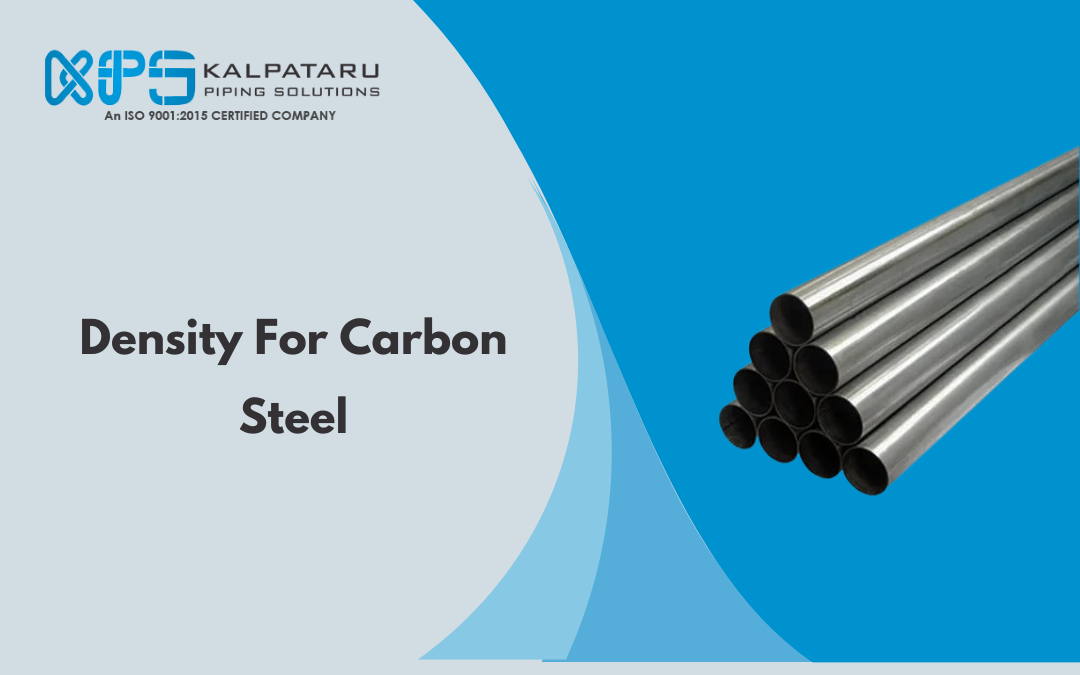
Carbon steel, an alloy of iron and carbon, is a popular choice for many industries due to its strength, durability, and affordability. The amount of carbon in the steel determines its hardness and strength—more carbon makes it harder but less workable. This product can be used in various industrial applications like construction, automobiles, mechanical components, and tools & technology.
While carbon steel is easy to weld and shape, it can rust if not protected. One key factor to consider when using carbon steel is its density, which affects its weight and behavior in different applications. Understanding carbon steel density and its impact on properties is crucial for selecting the right material for your needs. Explore more about carbon steel density and how it influences performance in our blog post.
What Is the Density of Carbon Steel In kg m3, lb in3?
Density is a crucial factor in industrial applications, representing mass per unit volume. The density of carbon steel is approximately 7850 kg/m³ (0.284 lb/in³), making it lighter than stainless steel. This density can vary with alloying elements, typically ranging from 7.75 g/cm³ (0.281 lb/in³) to 8.05 g/cm³ (0.291 lb/in³). High-carbon steel is denser than low-carbon steel. Compared to aluminum, carbon steel is heavier, but it is lighter than stainless steel and copper alloys. The main difference between carbon steel and mild steel lies in their carbon content: carbon steel contains 0.05 to 2.1% carbon, making it more robust but less ductile, while mild steel has 0.05 to 0.25% carbon. Medium carbon steel has 0.30 to 0.60% carbon.
Explore more about the density of carbon steel in kg/m³ and lb/in³ and how it impacts performance in our latest blog post!
How Density Impacts Carbon Steel Properties?
The density of carbon steel impacts various properties such as strength, malleability, ductility, electrical conductivity, heat capacity, and thermal expansion rate. Higher-density materials generally have higher strength-to-weight ratios and are more resistant to deformation, requiring more energy to deform under compressive forces. They also exhibit lower electrical conductivity due to increased resistivity and have higher heat capacities, absorbing more heat energy before temperature changes. Additionally, higher-density materials tend to have higher thermal expansion rates, expanding more when exposed to temperature or pressure increases.
Discover the various uses of carbon steel in our latest blog post!
Formula to Measure the Density of Carbon Steel lb/in3?
Steel density in lb/in³ is not typically calculated directly but can be determined by multiplying the density in g/cm³ by a conversion factor of 0.036127. The formula is: Density in lb/in³ = (Mass/Volume) x 0.036127. The density of steel is approximately 0.284 lb/in³ or 7.8 g/cm³.
Covert Carbon Steel Density of g cm3 in kg m3
Standard units for mass and volume are kilogram and cubic meter (m³). However, if laboratory measurements are in grams and cubic centimeters (cm³), users can convert to carbon steel density in kilograms per cubic meter (kg/m³) by multiplying by 1000. 1 kg/m³ = 0.000001 g/cm³.
Convert Density of Carbon Steel lbs/in3 to kg/m3
In the US, density is often measured in Imperial units (lb/pounds). Users can convert pounds per cubic inch (lb/in³) directly to kilograms per cubic meter (kg/m³) using the conversion factor:
1 lb/in³ = 27679.9 kg/m³
Density Low Carbon Steel Measurement
The density of low carbon steel can vary slightly based on the grade and composition, usually ranging from 7.75 g/cm³ to 8.05 g/cm³ (7.85 lb/in³ to 0.291 lb/in³).
| Carbon Steel Grade | Density in kg/m3 | Density in g/m3 | Density in lb/in3 |
| AISI 1005 | 7850 | 7.85 | 490 |
| AISI 1006 | 7850 | 7.85 | 490 |
| AISI 1008 | 7850 | 7.85 | 490 |
| AISI 1010 | 7850 | 7.85 | 490 |
| AISI 1011 | 7850 | 7.85 | 490 |
| AISI 1012 | 7850 | 7.85 | 490 |
| AISI 1013 | 7850 | 7.85 | 490 |
| AISI 1015 | 7850 | 7.85 | 490 |
| AISI 1016 | 7850 | 7.85 | 490 |
| AISI 1017 | 7850 | 7.85 | 490 |
Density of High Carbon Steel
The density of high carbon steel can vary based on the grade and composition, typically ranging from 7.75 to 8.05 g/cm³ (0.282 to 0.291 lb/in³). This is slightly higher than the density of pure iron, which is around 7.85 g/cm³.
| Carbon Steel Grade | Density in kg/m3 | Density in g/m3 | Density in lb/in3 |
| AISI 1055 | 7810 | 7.81 | 488 |
| AISI 1060 | 7810 | 7.81 | 488 |
| AISI 1064 | 7810 | 7.81 | 488 |
| AISI 1069 | 7810 | 7.81 | 488 |
| AISI 1070 | 7810 | 7.81 | 488 |
| AISI 1078 | 7810 | 7.81 | 488 |
| AISI 1085 | 7810 | 7.81 | 488 |
| AISI 1095 | 7810 | 7.81 | 488 |
| AISI 1141 | 7810 | 7.81 | 488 |
| AISI 1151 | 7810 | 7.81 | 488 |
Density of Medium Carbon Steel
The density of medium carbon steel varies depending on its specific grade and composition but typically falls within the range of 7.75 to 8.05 g/cm³ (0.282 to 0.291 lb/in³).
| Carbon Steel Grade | Density in kg/m3 | Density in g/m3 | Density in lb/in3 |
| AISI 1005 | 7830 | 7.83 | 489 |
| AISI 1010 | 7830 | 7.83 | 489 |
| AISI 1013 | 7830 | 7.83 | 489 |
| AISI 1018 | 7830 | 7.83 | 489 |
| AISI 1019 | 7830 | 7.83 | 489 |
| AISI 1021 | 7830 | 7.83 | 489 |
| AISI 1023 | 7830 | 7.83 | 489 |
| AISI 1026 | 7830 | 7.83 | 489 |
| AISI 1110 | 7830 | 7.83 | 489 |
| AISI 1118 | 7830 | 7.83 | 489 |
Conclusion
In summary, the density of carbon steel has a significant impact on its properties like strength-to-weight ratio, flexibility, electrical conductivity, heat capacity, and thermal expansion rate. Engineers and designers in various fields, such as automotive and construction, use this understanding to choose the right carbon steel grade for their specific needs, considering both cost and performance requirements. With this knowledge, they can make informed decisions that balance the material’s properties with project goals, ensuring optimal performance in diverse applications.
Connect with us Kalpataru Piping Solution now for your business requirements.
FAQ
What is the density of carbon steel kg m3?
The density of carbon steel is approximately 7850 kg/m³, which is less than that of stainless steel. This density can vary slightly depending on the specific grade and alloying elements, typically ranging within this value. Additionally, the coefficient of thermal expansion for carbon steel generally ranges from 10×10−610 \times 10^{-6}10×10−6 to 17.3×10−617.3 \times 10^{-6}17.3×10⁻⁶ m/(m·°C).
What is the weight of carbon steel per m3?
The density of carbon steel is approximately 7850 kg/m³. For a carbon steel sheet with a 1 m² surface area and 1 mm thickness, the weight would be around 7.85 kg.
What is the density of high carbon steel in kg m3?
The density of high carbon steel is 7,810 kg/m³. For more information, view our blog on the properties and uses of high carbon steel.