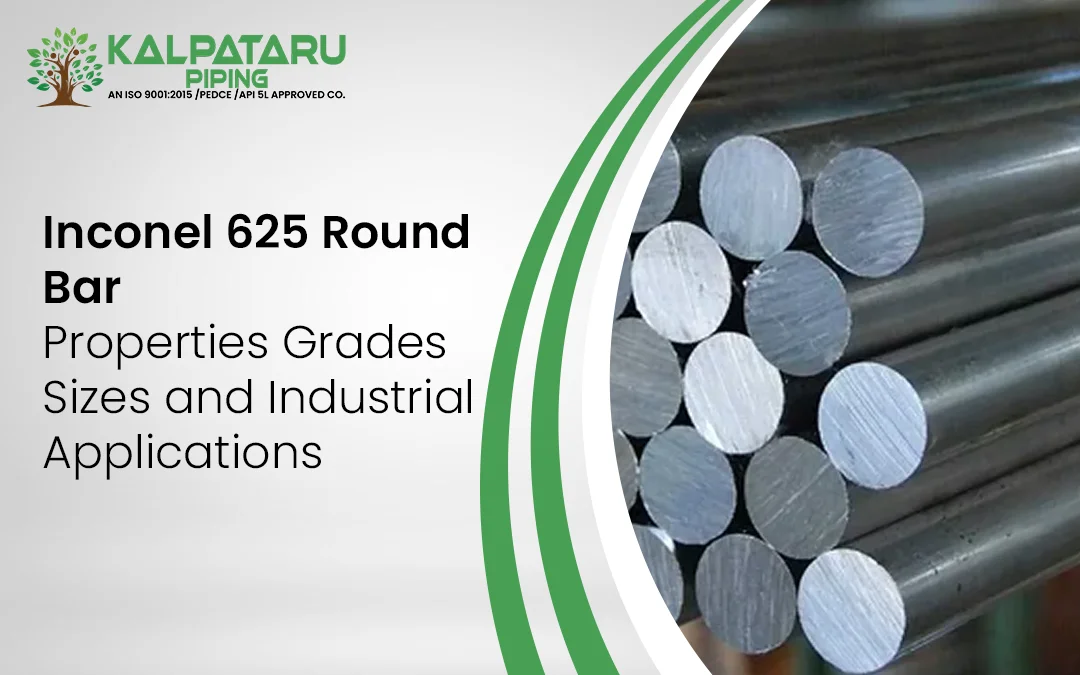
The Inconel 625 round bar is a bar made from a nickel-based chromium-molybdenum-niobium alloy that is used in applications where corrosion resistance and strength and reliable performance are paramount in challenging operating environments. The governing material specification for round bars and rods is ASTM B446, with a corresponding ASME specification ABME SB446.
Kalpataru Piping Solutions supplies Inconel 625 round bars in various forms and sizes to serve various industrial purposes. This guide aims to explain Inconel 625 – its chemical composition, mechanical properties, (UNS N06625), its constituents, state, sizes available, how to calculate the weights of Inconel 625 and its applications so as to provide accurate information for engineers, consumers, and purchasing department for their understanding of the specification prior to making an order.
What Is an Inconel 625 Round Bar?
Inconel 625 is a nickel-based chromium-molybdenum-niobium alloy represented by UNS N06625. Its European material number is 2.4856. The alloy is characterized by the combination of nickel and chromium, together with the considerable amounts of molybdenum and niobium, which bestows it with a high resistance to various corrosive environments, in addition to good properties.
Round bar means a solid circular section manufactured in straight lengths. According to ASTM B446 the alloy UNS N06625 comes in several different heat-treated forms. The chosen condition defines both strength and ductility of the alloy and its intended application.
The larger range of Inconel Round Bar range might help a customer in selecting proper grades when comparing Inconel 600, Inconel 625 and Inconel 718.
Inconel 625 Chemical Composition
|
Element |
Composition |
|
Nickel |
58.0 percent minimum |
|
Chromium |
20.0 to 23.0 percent |
|
Molybdenum |
8.0 to 10.0 percent |
|
Niobium plus Tantalum |
3.15 to 4.15 percent |
|
Iron |
5.0 percent maximum |
|
Cobalt |
1.0 percent maximum |
|
Manganese |
0.50 percent maximum |
|
Silicon |
0.50 percent maximum |
|
Carbon |
0.10 percent maximum |
|
Phosphorus |
0.015 percent maximum |
|
Sulfur |
0.015 percent maximum |
|
Aluminium |
0.40 percent maximum |
|
Titanium |
0.40 percent maximum |
The exact chemical composition should always be checked against the material test certificate supplied for the actual heat. ASTM B446 specifies chemical requirements for UNS N06625 and also covers dimensional and mechanical requirements for the applicable product condition.
Inconel 625 Mechanical Properties
|
ASTM B446 Condition |
Size |
Tensile Strength Minimum |
Yield Strength Minimum |
Elongation Minimum |
|
Grade 1 Annealed |
Up to 102 mm |
827 MPa |
414 MPa |
30 percent |
|
Grade 1 Annealed |
Over 102 to 254 mm |
758 MPa |
345 MPa |
25 percent |
|
Grade 2 Solution Annealed |
All sizes |
690 MPa |
276 MPa |
30 percent |
|
Grade 3 Solution Annealed and Cold Worked |
Up to 63 mm |
930 MPa |
690 MPa |
25 percent |
These indicators illustrate the requirement that the condition is essential in the purchase specification. Buyers ordering Inconel 625 Round Bar should indicate the required ASTM B446 grade and ask for the EN 10204 3.1 material test certificate in situations where traceability is needed.
Standard Specifications and Equivalent Grades
ASTM B166 has been widely misapplied when discussing Inconel 625 bars. The standard actually applies to nickel-chromium-iron alloys, including Inconel 600. The correct standard when specifying Inconel 625 bars and rods is ASTM B446 and if an ASME standard is required, ASME SB446 should be referenced.
Inconel 625 Equivalent Grades
|
Standard or System |
Designation |
|
UNS |
N06625 |
|
Werkstoff Number |
2.4856 |
|
JIS |
NCF 625 |
|
BS |
NA 21 |
|
EN |
NiCr22Mo9Nb |
|
DIN |
2.4856 |
|
AFNOR |
NC22DNB4M |
Equivalent designations help when comparing international material specifications, but they should not be treated as automatic permission to substitute one specification for another. Project specifications, design codes and purchaser requirements should be checked before making a substitution.
Approximate Weight Reference
The theoretical weight of a solid round bar can be estimated using its diameter and material density. Inconel 625 has a density of approximately 8.44 g/cm³.
|
Diameter |
Approximate Weight per Metre |
|
10 mm |
0.66 kg |
|
20 mm |
2.65 kg |
|
25 mm |
4.14 kg |
|
50 mm |
16.57 kg |
|
75 mm |
37.29 kg |
|
100 mm |
66.29 kg |
Actual supplied weight can vary because of dimensional tolerance, length tolerance and finishing operations. Buyers requiring exact shipment weight should use the dimensions and certified material details for the supplied bar
Inconel 625 Industrial Applications
- Oil and Gas: Used for components exposed to aggressive fluids, elevated temperatures and chloride containing offshore environments.
- Marine and Shipbuilding: Suitable for selected components exposed to seawater and chloride environments where corrosion resistance is important.
- Aerospace: Used for exhaust components, ducting and other parts requiring strength and corrosion resistance. Aerospace projects may specify AMS 5666. SeeInconel 718 Round Bar for another nickel alloy option.
- Chemical Processing: Suitable for equipment exposed to acids, chlorides and other corrosive media.
- Nuclear and Power Generation: Used for selected components requiring corrosion resistance and mechanical performance under demanding service conditions.
- Pulp and Paper: Used in equipment exposed to corrosive and elevated temperature conditions. SeeInconel Round Bars in the Pulp and Paper Industry
How to Select the Right Inconel 625 Round Bar
Selecting an Inconel 625 round bar should consider the service environment, applicable standard and material condition. Evaluate temperature, pressure and corrosion exposure before selecting ASTM B446 or ASME SB446. Choose the required annealed, solution annealed or cold worked condition based on mechanical requirements. Then specify diameter, length, tolerance and surface finish. Finally, define inspection requirements such as chemical analysis, tensile testing, hardness testing, dimensional inspection and an EN 10204 3.1 MTC. This approach helps ensure the selected bar meets the application, dimensional and documentation requirements.