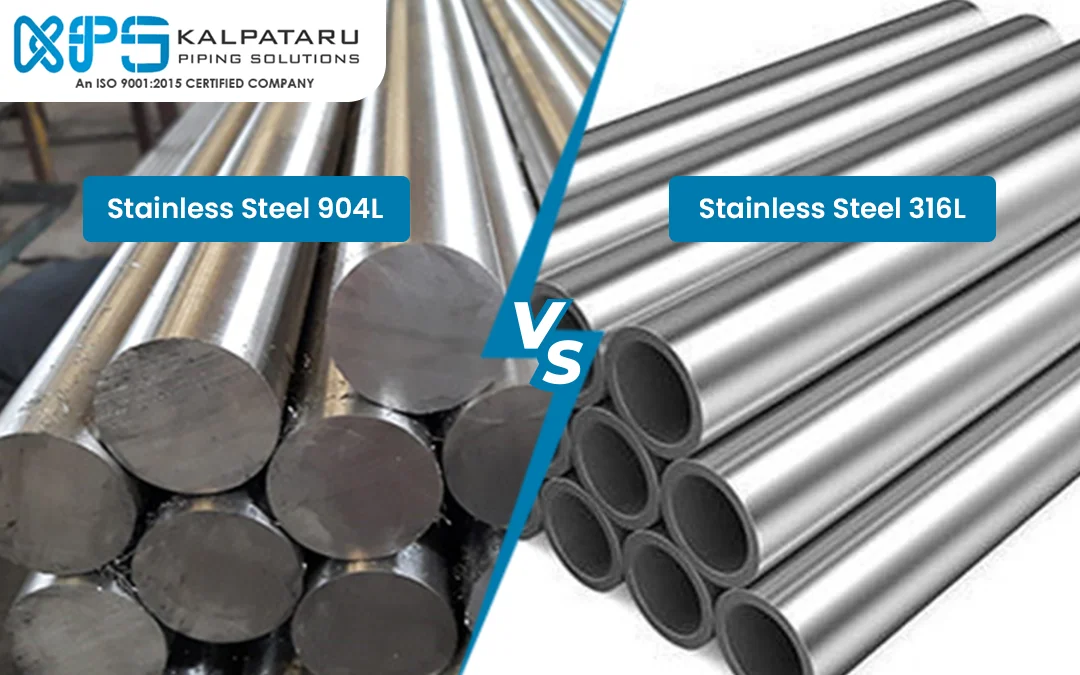
Overview of Stainless Steel 904L and 316L
904L and 316L are austenitic stainless steels, each offering distinct benefits based on their composition and properties. This comparison will delve into their corrosion resistance, mechanical properties, cost-effectiveness, and ideal uses, providing a practical guide for industry professionals.
Stainless Steel 904L: High-Performance Corrosion Resistance
Stainless Steel 904L is also available as plates and sheets, and Kalpataru Piping Solutions is a leading supplier and exporter of these products. You can learn more about their offerings here.
Stainless Steel 316L: Versatility and Cost-Effectiveness
316L stainless steel is a low-carbon variant of 316 stainless steel, designed for better weldability and resistance to intergranular corrosion. It offers a balanced mix of corrosion resistance, mechanical strength, and affordability, making it a popular choice for a variety of industries. Notable features include:
- Good Corrosion Resistance: Suitable for moderate environments, 316L performs well in food processing, pharmaceutical, and marine applications.
- Lower Cost: Compared to 904L, 316L offers a cost-effective solution for projects where extreme corrosion resistance is not a primary requirement.
- Ease of Weldability: The low carbon content reduces carbide precipitation, making 316L a preferred choice for welded structures.
Chemical Composition of 904L and 316L : Key Differences
The differences in the chemical composition of 904L and 316L significantly affect their performance:
- 904L: Contains higher amounts of nickel (up to 23%) and molybdenum (up to 4.5%), along with copper, which enhances its resistance to acids and chlorides.
- 316L: Has lower nickel (10-14%) and molybdenum (2-3%) content, which limits its corrosion resistance compared to 904L but makes it a more economical option.
The higher alloy content in 904L provides better overall protection, particularly in aggressive chemical environments, compared to 316L.
|
Element |
AISI 316L Stainless Steel (%) |
AISI 904L Stainless Steel (%) |
|
Fe |
Balance | Balance |
|
Cr |
16.0 – 18.0 | 19.0 – 23.0 |
|
Ni |
10.0 – 14.0 | 23.0 – 28.0 |
|
Mo |
2.0 – 3.0 | 4.0 – 5.0 |
|
Cu |
– | 1.0 – 2.0 |
|
C |
≤0.03 | ≤0.02 |
|
Mn |
≤2.00 | ≤2.00 |
|
Si |
≤1.00 | ≤1.00 |
|
P |
≤0.045 | ≤0.045 |
|
S |
≤0.03 | ≤0.035 |
|
N |
≤0.10 | ≤0.10 |
Corrosion Resistance Comparison
904L Stainless Steel offers superior resistance to a wide range of corrosive environments, making it the preferred choice for applications involving aggressive chemicals and chlorides. Key points include:
- 904L: Its high nickel and molybdenum content makes it highly resistant to pitting and crevice corrosion, particularly in chloride-rich environments like seawater and chemical plants.
- 316L: While also corrosion-resistant, 316L is more susceptible to chloride attack, making it less suitable for extreme environments compared to 904L.
904L is commonly used in applications such as seawater desalination, chemical processing, and oil and gas extraction, where corrosion resistance is crucial.
Mechanical Properties and Temperature Resistance
The mechanical properties of 904L and 316L also differ, affecting their suitability for different applications:
- 904L: Offers higher tensile strength and can maintain its mechanical properties at elevated temperatures, which makes it suitable for high-temperature applications such as nuclear power and oil refining.
- 316L: Exhibits good tensile strength but is better suited for applications requiring general strength and moderate temperature resistance.
The superior mechanical strength of 904L under extreme conditions makes it ideal for challenging environments, whereas 316L is a practical choice for standard industrial uses.
Applications of 904L vs 316L Stainless Steel
904L and 316L are both versatile, but their unique properties make them suitable for different applications:
- 904L Stainless Steel:
- Chemical Processing: Highly resistant to sulfuric acid, making it ideal for chemical plants.
- Marine Environments: Used in seawater desalination and other chloride-rich settings.
- Oil and Gas: Suitable for high-sulfur environments due to its high resistance to stress corrosion.
- 316L Stainless Steel:
- Food and Beverage Industry: Ideal for hygienic applications where moderate corrosion resistance is required.
- Pharmaceutical Equipment: Commonly used due to its ease of cleaning and resistance to moderate chemicals.
- Marine Construction: Suitable for structural components exposed to saltwater but not in extremely corrosive conditions.
Cost Analysis: Is 904L Worth the Investment?
904L is more expensive than 316L due to its higher nickel and molybdenum content. This cost difference is justified when long-term durability and resistance to harsh chemicals are required, as it reduces maintenance and replacement costs over time.
316L remains a cost-effective option for applications where extreme corrosion resistance is not necessary, making it suitable for general-purpose use in industries like construction and food processing.
Quick Reference Table: 904L vs 316L Stainless Steel
| Property | 904L Stainless Steel | 316L Stainless Steel |
| Nickel Content | High (up to 23%) | Moderate (10-14%) |
| Molybdenum Content | High (up to 4.5%) | Moderate (2-3%) |
| Corrosion Resistance | Superior in aggressive environments | Good for moderate conditions |
| Mechanical Strength | High, retain strength at elevated temperatures | Good, suitable for general purposes |
| Cost | Higher | Lower |
| Applications | Chemical, marine, oil and gas | Food, pharmaceutical, marine construction |
Conclusion: Choosing Between 904L and 316L Stainless Steel
At Kalpataru Piping Solutions, we specialize in providing high-quality stainless steel materials, including 904L and 316L grades, tailored to meet the unique needs of various industries. Our team of experts can guide you in selecting the right material for your specific applications, ensuring you get the best balance of performance and cost-effectiveness.
Contact Us today to discuss how Stainless Steel 904L or 316L can meet your specific industrial needs. Get a custom quote now!
FAQs: Addressing Common Questions About 904L and 316L
Is 904L Better Than 316L?
Yes, 904L offers superior resistance to pitting, crevice corrosion, and stress corrosion cracking compared to 316L, especially in environments with aggressive chemicals or high chloride content.
Why is 904L Stainless Steel More Expensive?
904L has higher levels of alloying elements, such as nickel, molybdenum, and copper, which significantly improve its performance but also increase its cost. The enhanced resistance to corrosion justifies the higher price for demanding environments.
What are the Typical Uses for 904L Stainless Steel?
904L is commonly used in chemical processing, oil refining, marine environments, and acidic solutions due to its robust corrosion resistance and ability to withstand extreme conditions.
Can 904L Be Used in Marine Environments?
Yes, 904L can be used in marine environments but is more suited for components not exposed to extremely high chloride concentrations.
Related Posts
What SS 904L Tube Can Do To Control Air Pollution?
Attention On SS 904L Buttweld Fittings