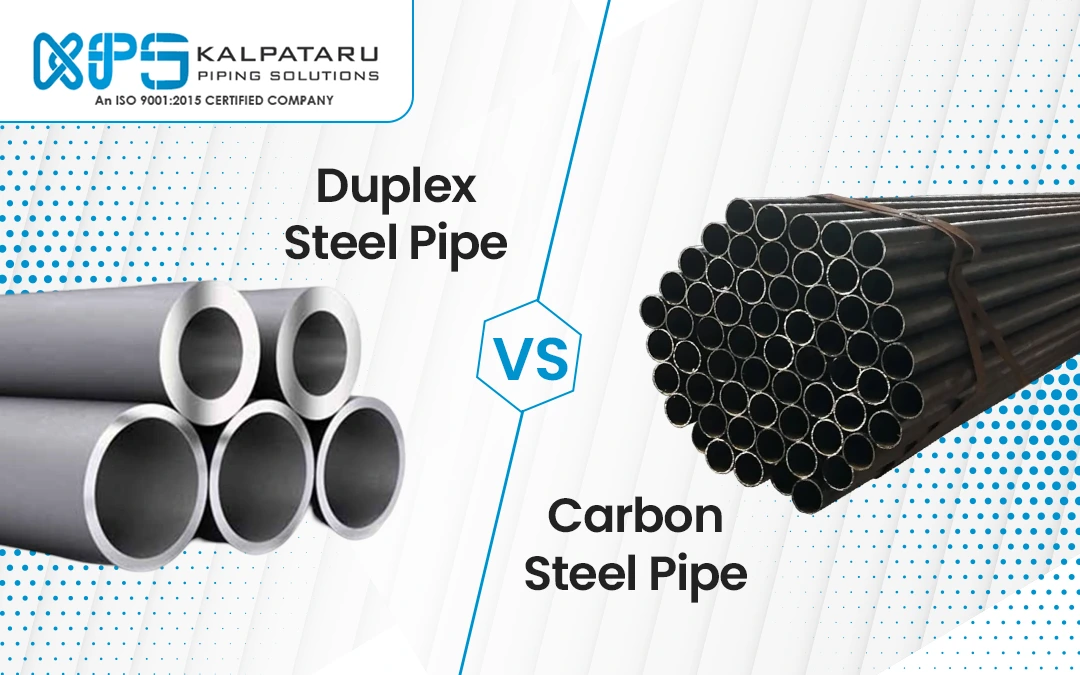
When selecting the right piping material for industrial applications, duplex steel pipes and carbon steel pipes are two of the most commonly used options. Duplex pipe offers distinct advantages, making them suitable for different industrial applications and operational conditions. This blog will help you understand the key differences between duplex stainless steel pipe and carbon steel pipes, their benefits, and how to choose the right one for your business needs.
Why Choose Kalpataru Piping Solutions?
Kalpataru Piping Solutions is a leading manufacturer of duplex stainless steel offering high quality duplex steel pipes as per industrial needs. Our products are manufactured to international standards, ensuring durability and performance. We offer a wide range of duplex pipes available in various sizes and specifications with customized solutions as per project requirements. With competitive pricing and reliable on-time delivery, we provide cost-effective solutions.
What is a Duplex Steel Pipe?
Duplex pipes are made from a mix of austenitic and ferritic stainless steel, offering high strength, excellent corrosion resistance, and improved durability. These duplex stainless pipes are widely used in high temperature applications, such as offshore platforms, plants, and chemical industries, where resistance to chloride induced corrosion.
Benefits of Duplex Steel Pipes
- High Strength: More stronger than stainless steel & carbon steel.
- Corrosion Resistance: Resistant to pitting, crevice corrosion, and stress corrosion cracking, ideal for high temperature applications.
What is Carbon Steel Pipe?
Carbon steel pipes are made primarily from iron and carbon, offering excellent strength, ductility, and affordability. These pipes are widely used in industries such as power plants, oil refineries, and water transportation due to their ability to withstand high pressures and mechanical stress.
Benefits of Duplex Steel Pipes
- High Durability: Strong and impact-resistant, making it ideal for structural and industrial applications.
- Cost-Effective: More affordable compared to duplex and stainless steel pipes.
Key Differences: Duplex Pipe vs. Carbon Steel Pipes
| Feature | Duplex Steel Pipes | Carbon Steel Pipes |
| Composition | Combination of austenitic & ferritic steel | Iron with carbon content up to 1.7% |
| Strength | Higher strength, thinner pipe walls | Strong but requires thicker walls for strength |
| Corrosion Resistance | Excellent, resists pitting & crevice corrosion | Needs coatings or galvanization for protection |
| Weldability | Good weldability with minimal loss in strength | Easy to weld but requires post-weld treatments |
| Weight | Lighter due to high strength-to-weight ratio | Heavier due to higher density |
| Applications | Chemical plants, offshore platforms, marine, desalination, pipelines | Oil & gas, water pipelines, construction, power plants |
| Lifespan | Longer service life with minimal maintenance | Shorter lifespan due to potential corrosion |
How to Select the Right Pipe for Application?
Consider below several factors while selecting duplex steel pipe & carbon steel pipe.
- For high corrosion resistance: Choose duplex steel pipes for applications involving saltwater, chemicals, and extreme environments.
- For cost-effectiveness & durability: Carbon steel pipes are ideal for general industrial use where corrosion is not a major concern.
- For high-pressure systems: Both materials are suitable, but duplex stainless steel pipes offer better long-term performance with thinner walls.
Conclusion
Both piping products play a crucial role in industrial applications. While duplex pipes offer superior strength and corrosion resistance, carbon steel pipes remain a cost-effective solution for many industries.
FAQs
What is a duplex pipe?
A duplex pipe is a Fe-Ni-Cr alloy with a two-phase ferritic-austenitic stainless steel microstructure, offering high strength and corrosion resistance.
What is the density of a duplex pipe?
The density of 22Cr duplex pipe is 7.8 g/cm³, with an elongation of 15% in various applications.
What is a duplex pipe used for?
Duplex pipes are used in oil & gas, petrochemical, chemical, food processing, and marine industries, including offshore drilling and ships.
Why use carbon steel pipes?
Carbon steel pipes offer high strength, wide availability, and multiple connection options like screwed, socket-welded, and butt-welded joints.