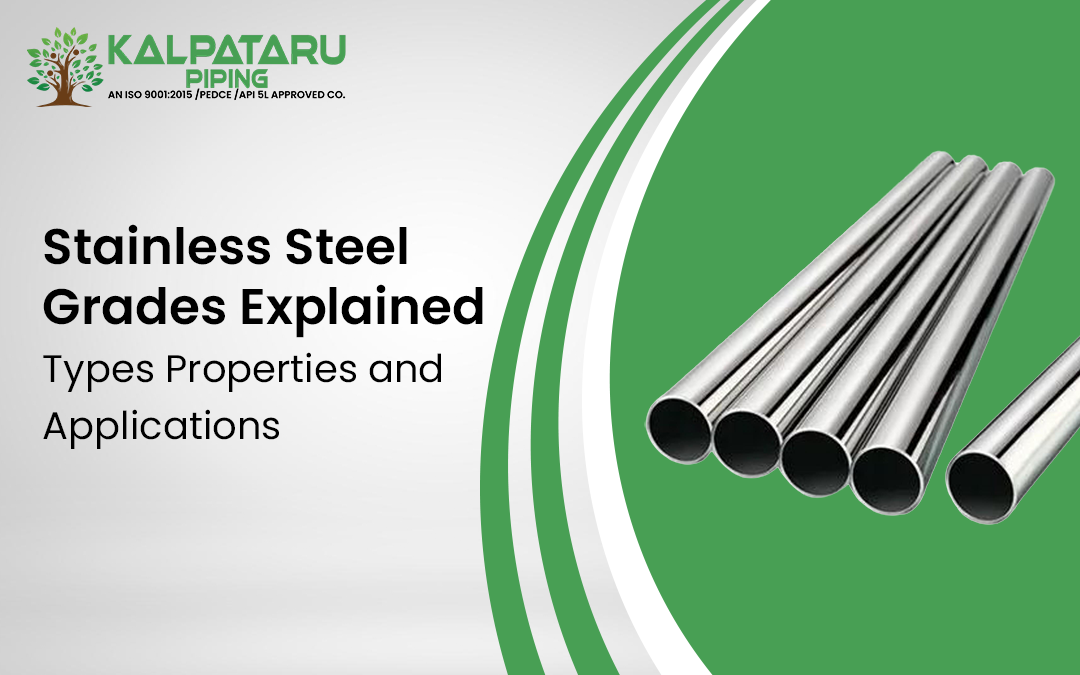
Ask 10 people what makes steel “stainless” and most will say that it doesn’t rust. This is true to a certain extent, but there are more than 150 stainless steel grades and selecting the wrong grade can be one of the costliest errors that a project can encounter. We offer stainless steel pipes, tubes, fittings and fasteners in the entire spectrum of commercial grades and the question that is most often asked by engineers or buyers is which grade should be used? This guide eases up the families, the individual grades within each family, and a match for a grade in an actual application instead of the guesswork.
What is Stainless Steel?
Stainless steel is just steel that has a minimum of approximately 10.5% Chromium within the alloy. It is not the properties of the steel that stop it from corroding, it is a thin coating of chromium oxide which forms on the surface of the steel when it reacts with oxygen. As long as there is enough oxygen and chromium around, the surface would be damaged and it would be regenerated automatically; therefore, stainless steel is said to be self-healing. Add more chromium, some nickel, molybdenum, or nitrogen and you have two very different grades, each with a different level of corrosion resistance, strength and cost. I think that’s the only point that exists for the existence of grades with no single formula that works equally well in a commercial kitchen, chemical tank, and surgical instrument.
Different Families of Stainless Steel
Stainless steels are classified into five groups based on the crystal structure that the alloy can adopt. Learning the family can offer you a lot of insight into a grade prior to looking at the actual number.
Austenitic Stainless Steel
Some of the commonly available types of stainless steel are the austenitic variety, which constitute up to 70% of stainless steel products and 304 & 316 are some of the well-known examples. Austenitic type has a face centred cubic crystalline structure which is stabilized by the presence of nickel and this crystalline structure provides good formability, weldability and non-magnetic nature of these types of stainless steel. Although the austenitic type does not harden by heating process, 16 to 30% chromium present in these different ranges of stainless steel products provide the maximum corrosion resistant properties among all the types of stainless steel families.
Ferritic Stainless Steel
Ferritic grades use nickel to increase chromium, and are generally between 11% and 27% chromium with very little nickel which reduces the cost but also lowers corrosion resistance below that of the austenitic grades. Ferritic steels can be easily identified from the austenitic grades on the shop floor due to their body centered cubic structure which makes them magnetic. These are the most common grades (430 and 409), and are often used in automotive trim and exhaust systems, where the cost is more important than marine-grade corrosion resistance.
Martensitic Stainless Steel
Martensitic grades are the only family where the heat treatment can be used to harden the steel, and hence they are used to make cutlery, surgical instruments and turbine blades. They are strong and wear resistant due to their higher carbon content, but have less corrosion resistance and weldability than austenitic grades. This family is controlled by grades 410 and 420, both of which are magnetic and are easily noticeable by the need for preheating and post-weld heat treatment when welding without it.
Duplex Stainless Steel
Overall, duplex grades are roughly 50/50 austenite and ferrite, and possess properties of both phases, including approximately double the strength of standard austenitic grades and good resistance to stress corrosion cracking. Grade 2205 is a typical reference in this family and super duplex grades (such as 2507) further extend corrosion resistance for offshore and chemical processing service. Whether you need to relax about using custom mill lead times, we have both our Duplex Steel S31803/S32205 and Super Duplex S32750/S32760 pipe and tube lines in stock and available to use in your projects as soon as they are needed.
Precipitation-Hardening (PH) Stainless Steel
They are alloyed with small amounts of copper, aluminum or titanium and age hardened to allow those elements to precipitate as hard intermetallic compounds which impede the movement of dislocations in the crystal structure, resulting in a strength significantly higher than standard austenitic grades. Grade 17-4 PH is the most widely used, and is used in aircraft and precision tooling applications where both strength and corrosion resistance are important. PH grades are not seen often in the general industrial piping, but do play a part in any application where both high mechanical loads and corrosive exposure are present.
Different Grades of Stainless Steel
The stainless steel products are manufactured in a variety of forms and grades according to the industries. Some of the most common grades of stainless steel are listed below.
Grade 304 / 304L
Grade 304 is the default stainless steel for a reason: 18% chromium and 8% nickel give it strong all-around corrosion resistance, excellent formability, and reliable weldability at a moderate cost. The low-carbon 304L variant resists sensitization during welding, making it the safer choice for heavily welded assemblies. We supply 304 across tube fittings and the broader stainless product line for buyers who need it in bulk with full material traceability.
Grade 316 / 316L
Grade 316 adds 2 to 3% molybdenum on top of the 304 composition, and that addition is what gives it meaningfully better resistance to chlorides, saltwater, and industrial chemicals. It’s the standard choice for marine hardware, pharmaceutical processing, and any chemical environment where 304 would eventually pit. Our 316 tube fittings range covers both 316 and the low-carbon 316L variant for welded systems.
Grade 310 / 310S
Grade 310 pushes chromium up to roughly 25% along with 20% nickel, which delivers outstanding resistance to oxidation and scaling at high temperatures, well beyond what 304 or 316 can handle. It’s the grade of choice for furnace parts, kilns, and heat treatment equipment. We supply 310 through our stainless steel valve and fitting range for high-temperature service.
Grade 321 and 347
Both grades are stabilized against intergranular corrosion after welding, 321 with titanium and 347 with niobium, which makes them the preferred choice for expansion joints, exhaust systems, and chemical process equipment that sees repeated heat cycling. Neither is a general-purpose grade; both exist specifically to solve the weld-decay problem that standard austenitic grades face at elevated temperature.
Grade 410 and 420
These martensitic grades trade corrosion resistance for hardness. Grade 410 heat-treats well for shafts, valves, and fasteners exposed to mild corrosive conditions, while 420’s higher carbon content makes it the standard for cutlery, surgical instruments, and cutting tools where edge retention matters more than chemical resistance.
Grade 430
A ferritic grade with no nickel, 430 is the economical choice for kitchen appliances, automotive trim, and dishwasher linings where moderate corrosion resistance and a bright finish matter more than the extreme durability of an austenitic grade.
Duplex 2205 and Super Duplex 2507
These grades combine strength and corrosion resistance in a way no single-phase stainless steel can match, which is why they’ve become standard in offshore platforms, desalination plants, and pressure vessels handling aggressive chemicals. The tradeoff is cost and more demanding welding procedures, but for the right application, duplex grades reduce wall thickness and overall weight compared to an equivalent austenitic design. Our duplex and super duplex lines are stocked specifically for these demanding sectors.
Stainless Steel Applications by Industry
Food and beverage processing. Grade 304 dominates here because it needs no coating or plating, resists the frequent washdowns and cleaning agents used in food production, and can be polished to a hygienic finish for equipment like hoppers, conveyors, and tanks.
Medical and pharmaceutical. The same cleanliness properties that make 304 useful in food service make austenitic grades, particularly 316L, the standard for surgical instruments, medical devices, and pharmaceutical process equipment where sterility and chemical resistance both matter.
Oil, gas, and marine. This is duplex and super duplex territory, alongside 316 for less extreme service. Chloride exposure from seawater and produced fluids demands the pitting resistance these grades provide, which is why our duplex and super duplex products see heavy demand from offshore and petrochemical buyers.
Construction and architecture. Stainless steel’s low maintenance and corrosion resistance justify the higher upfront cost on landmark buildings and structural applications, with 304 and 316 both common depending on whether the structure faces coastal or industrial exposure.
Automotive. Ferritic grades like 409 and 430 dominate here, chosen for their lower cost and adequate corrosion resistance in exhaust systems, trim, and catalytic converter housings where extreme corrosion resistance isn’t required.
How to Choose the Right Stainless Steel Grade
Grade selection comes down to weighing a handful of factors against each other, since the grade that wins on one measure often loses on another.
● Corrosion environment. Match the grade to the specific corrosive agent, not just “how corrosive” the environment is in general. Chlorides call for molybdenum-bearing grades like 316; high heat calls for 309, 321, or 347; general atmospheric exposure is often fine with 304.
● Mechanical requirements. If the part needs to be hardened, only martensitic or PH grades qualify. If it needs maximum strength without heat treatment, duplex is usually the answer.
● Fabrication method. Heavy welding favors austenitic grades; parts requiring hardening favor martensitic; cost-sensitive stamped parts often work fine in ferritic grades.
● Budget. Duplex and high-nickel austenitic grades cost meaningfully more than standard 304, so it’s worth confirming the application actually needs that extra performance before specifying it. Our guide on common mistakes when selecting stainless steel flanges covers several real cases where over-specifying or under-specifying grade caused costly rework.
Why Source Stainless Steel from Aashish Metals
Aashish Metals stocks and supplies stainless steel across the grades covered in this guide, including 304, 304L, 310/310S, 316, 316L, 316Ti, 317L, 321, 347H, and 904L, alongside duplex and super duplex grades, in pipes, tubes, fittings, valves, and shims. Every product ships with full material test certificates and traceability, and we export across more than 50 countries with stock ready for fast dispatch rather than waiting on a fresh mill run. If your project also needs matching flanges in the same grade, our flange range is built to the same material and pressure-class standards. You can learn more about Aashish Metals or contact our team directly for grade-specific technical guidance on your next order.
Conclusion:
Stainless steel grade selection isn’t about finding the “best” grade in some abstract sense, it’s about matching a specific set of properties to a specific application, environment, and budget. Understanding the five families and how the common grades within them differ makes that decision far easier, whether you’re specifying pipe for a chemical plant or fittings for a food processing line. Aashish Metals supplies the full range of grades covered in this guide, backed by material documentation and decades of export experience. Reach out to our team for help matching the right stainless steel grade to your next project.
Frequently Asked Questions
1. What is the most commonly used stainless steel grade?
Grade 304 is the most widely used stainless steel grade worldwide, thanks to its balance of corrosion resistance, formability, weldability, and cost.
2. What’s the difference between 304 and 316 stainless steel?
316 contains added molybdenum, which gives it significantly better resistance to chlorides and saltwater corrosion than 304, making it the preferred choice for marine and heavily chemical environments.
3. Is duplex stainless steel better than 316?
Duplex isn’t strictly better, it’s different. Duplex grades offer roughly twice the strength of 316 and excellent resistance to stress corrosion cracking, but they cost more and require more careful welding procedures.
4. Which stainless steel grade is magnetic?
Ferritic and martensitic grades, such as 430 and 410, are magnetic. Austenitic grades like 304 and 316 are generally non-magnetic, though they can become slightly magnetic after heavy cold working.
5. Can stainless steel rust?
Yes, under the wrong conditions. If the passive chromium oxide layer is damaged and doesn’t get enough oxygen to reform, or if the grade’s chromium and molybdenum content is too low for the chloride or acid exposure involved, localized rust or pitting can still occur.