When you are tasked with selecting between either a weld neck or a slip on flange then it is important to remember that the type of flange considered affects the connection being made and the overall cost. Not only is it true that choosing between a weld neck and a slip on flange impacts which flanges are used but also the pressure and temperature versions used during connection.
Kalpataru Piping Solutions supply custom flange products as well as standard flanges and operate within the industrial sector. All specifications are catered for including joint design, size of flange selected, and type of flange. This guide compares the two flange types by design, connection method, strength, fatigue considerations, dimensions, cost, standards, and applications. It also provides a practical flange selection guide to help engineers and procurement teams understand where each flange type is commonly specified.
What Is a Weld Neck Flange?
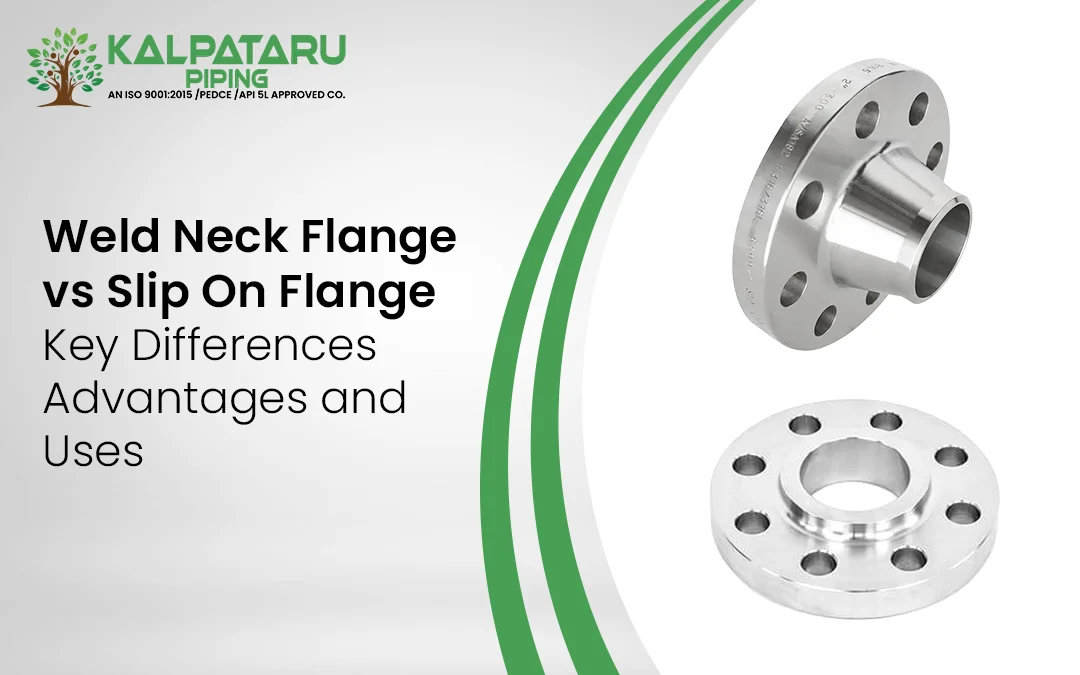
A weld neck flange has a long tapered hub that connects to the pipe through a butt weld. The bore of the flange is machined to match the pipe inside diameter and wall thickness so that the pipe and flange form a continuous internal passage.
The tapered hub is an important part of the design. Instead of placing the main transition directly at the flange face, the gradual change in section helps distribute stresses over a larger area. This makes the design suitable for piping exposed to pressure, temperature changes, vibration, and repeated loading.
The butt weld also provides a direct welded connection between the pipe and flange. Because the joint can be examined using applicable nondestructive examination methods, weld neck flange designs are commonly selected for critical piping where weld quality and stress control are important.
What Is a Slip-On Flange?
A slip on flange has a flat body with a bore that allows the pipe to pass through the flange. The pipe is positioned inside the flange, and the connection is normally completed using fillet welds.
The design makes alignment and installation relatively straightforward and is one reason slip-on flanges are widely used in lower pressure and general utility piping.
For a detailed explanation of slip on flange types, specifications, dimensions, weights, welding, and installation, see Kalpataru’s Complete Guide on Slip On Flanges rather than repeating that information here.
Weld Neck vs Slip On Flange Comparison
The most important differences between the two designs are related to the way the pipe connects to the flange and how loads are transferred through that connection.
|
Comparison point |
Weld Neck Flange |
Slip On Flange |
|
Pipe connection |
Butt weld |
Fillet welds |
|
Weld arrangement |
One primary butt weld |
Welds on the inside and outside |
|
Hub design |
Long tapered hub |
Short, flat body |
|
Bore |
Matched to pipe bore and wall thickness |
A larger bore allows pipe insertion. |
|
Stress distribution |
More gradual transition through tapered hub |
Higher local stress concentration around the attachment area |
|
Pressure service |
Commonly selected for higher-pressure service |
Commonly selected for low- and moderate-pressure service |
|
Temperature service |
Suitable for demanding temperature conditions when correctly specified |
More commonly used for less demanding service |
|
Cyclic loading |
Better suited to systems with significant cyclic loading when properly designed |
Less suitable where repeated thermal or mechanical cycling governs |
|
Vibration |
Suitable for systems where vibration and mechanical loads require stronger flange attachment |
Generally used where service conditions are less severe |
|
Weld inspection |
Butt welds can be examined using applicable NDE methods. |
Two fillet welds require inspection of both attachment welds as specified. |
|
Installation |
Requires accurate pipe preparation and butt welding |
Generally simpler alignment and installation |
|
Material usage |
Usually more material in the hub and flange geometry |
Generally lower material cost |
|
Initial flange cost |
Usually higher |
Usually lower |
|
Common use |
Process, power, oil and gas, and critical piping |
Utility, water, HVAC, and general piping |
|
Selection basis |
Pressure, temperature, fatigue, vibration, and code requirements |
Pressure, temperature, cost, and service requirements |
There is no universal rule that one flange type should replace the other. The correct selection depends on the design conditions and the applicable piping specification.
Dimensional Comparison between Weld Neck and Slip on flange
Dimensions vary with nominal pipe size and pressure class, so flange dimensions should always be confirmed against the applicable standard and purchase specification.
For comparison, the following Class 150 figures show how the geometry differs for common sizes. The values are based on published ASME B16.5 dimensional tables.
|
NPS |
Flange type |
Hub diameter or bore related diameter |
Length through hub H |
Overall flange thickness B |
|
2 |
Weld Neck |
78 mm |
63.6 mm |
17.5 mm |
|
2 |
Slip-On |
78 mm |
25.6 mm |
19.1 mm |
|
4 |
Weld Neck |
135 mm |
76.6 mm |
23.9 mm |
|
4 |
Slip-On |
135 mm |
33.6 mm |
23.9 mm |
|
6 |
Weld Neck |
192 mm |
88.6 mm |
25.5 mm |
|
6 |
Slip-On |
192 mm |
39.6 mm |
25.5 mm |
The dimensional data shows an important difference in geometry. At these Class 150 sizes, the flange thickness is the same or very similar between the two designs, while the weld neck flange has a substantially longer hub section.
For example, the published Class 150 data gives a 63.6 mm H dimension for an NPS 2 weld neck flange compared with 25.6 mm for the slip-on design. At NPS 6, the corresponding dimensions are 88.6 mm and 39.6 mm.
What Does Each Flange Type Cost to Install?
Initial purchase price is often one of the first factors considered during flange selection, but the flange price alone does not represent the complete installed cost.
|
Cost factor |
Weld Neck Flange |
Slip On Flange |
|
Flange purchase cost |
Usually higher |
Usually lower |
|
Material quantity |
Usually higher |
Usually lower |
|
Pipe preparation |
More precise |
Generally simpler |
|
Welding |
Butt welding |
Fillet welding |
|
Welding time |
Depends on size and wall thickness |
Depends on size and weld requirements |
|
Inspection |
Based on applicable weld examination requirements |
Based on applicable weld examination requirements |
|
Fabrication complexity |
Higher |
Lower |
|
Suitability for demanding service |
Commonly preferred |
More limited depending on design |
|
Total installed cost |
Must include fabrication and inspection |
Must include fabrication and inspection |
The final cost difference therefore depends on size, pressure class, material, quantity, welding procedure, inspection requirements and project location. A lower flange purchase price does not automatically mean a lower total project cost.
Flange Selection Guide
The following table provides a practical starting point when comparing a weld neck vs slip on flange.
|
Application or condition |
Common choice |
Reason |
|
Refinery process piping |
Weld Neck |
Better suited to demanding process conditions |
|
Chemical process piping |
Weld Neck |
Useful where pressure, temperature and fluid service are demanding |
|
Oil and gas process piping |
Weld Neck |
Common choice for higher integrity connections |
|
Power plant steam piping |
Weld Neck |
Suitable for demanding temperature and pressure conditions |
|
High pressure process line |
Weld Neck |
Stronger connection geometry and butt weld |
|
Cyclic thermal service |
Weld Neck |
Better suited to repeated thermal loading |
|
High vibration service |
Weld Neck |
Appropriate where connection stresses require greater attention |
|
Hazardous process fluid |
Weld Neck |
Commonly specified for critical piping connections |
|
Cooling water |
Slip On or Weld Neck |
Depends on pressure, temperature and project specification |
|
HVAC piping |
Slip On |
Often suitable for utility service |
|
General water service |
Slip On |
Simple installation where permitted |
|
Water treatment piping |
Slip-On or Weld Neck |
Selection depends on design conditions |
|
Low-pressure utility piping |
Slip On |
Lower material and installation costs can be useful. |
|
Large-diameter low pressure water main |
Slip On |
Can provide a practical, lower-cost connection |
|
Temporary or infrequently used piping |
Slip On |
Simpler installation can be an advantage. |
This is a selection guide rather than a substitute for engineering design. Pressure, temperature, pipe material, fluid service, corrosion allowance, fatigue, welding requirements and the governing code should all be considered before final selection.
Materials and Standards for Flange Selection
Material selection is an important part of any flange selection guide and should consider fluid, pressure, temperature, corrosion conditions, and the applicable code. Kalpataru supplies weld neck flanges in carbon steel, alloy steel, stainless steel, duplex, super duplex, copper, and nickel alloys, including Nickel 200,Monel 400, Inconel 600, Inconel 625 and Hastelloy C276. Its slip on flangesinclude carbon steel, alloy steel, stainless steel, duplex, super duplex, nickel alloys, copper alloys and titanium. Common grades include ASTM A105 and ASTM A182 F5, F9, F11, F22 and F91. For carbon steel requirements, see the ASTM A105 Flange Manufacturerpage. ASME B16.5 flanges cover NPS 1/2 to NPS 24 and define ratings, materials, dimensions, tolerances, marking and testing.