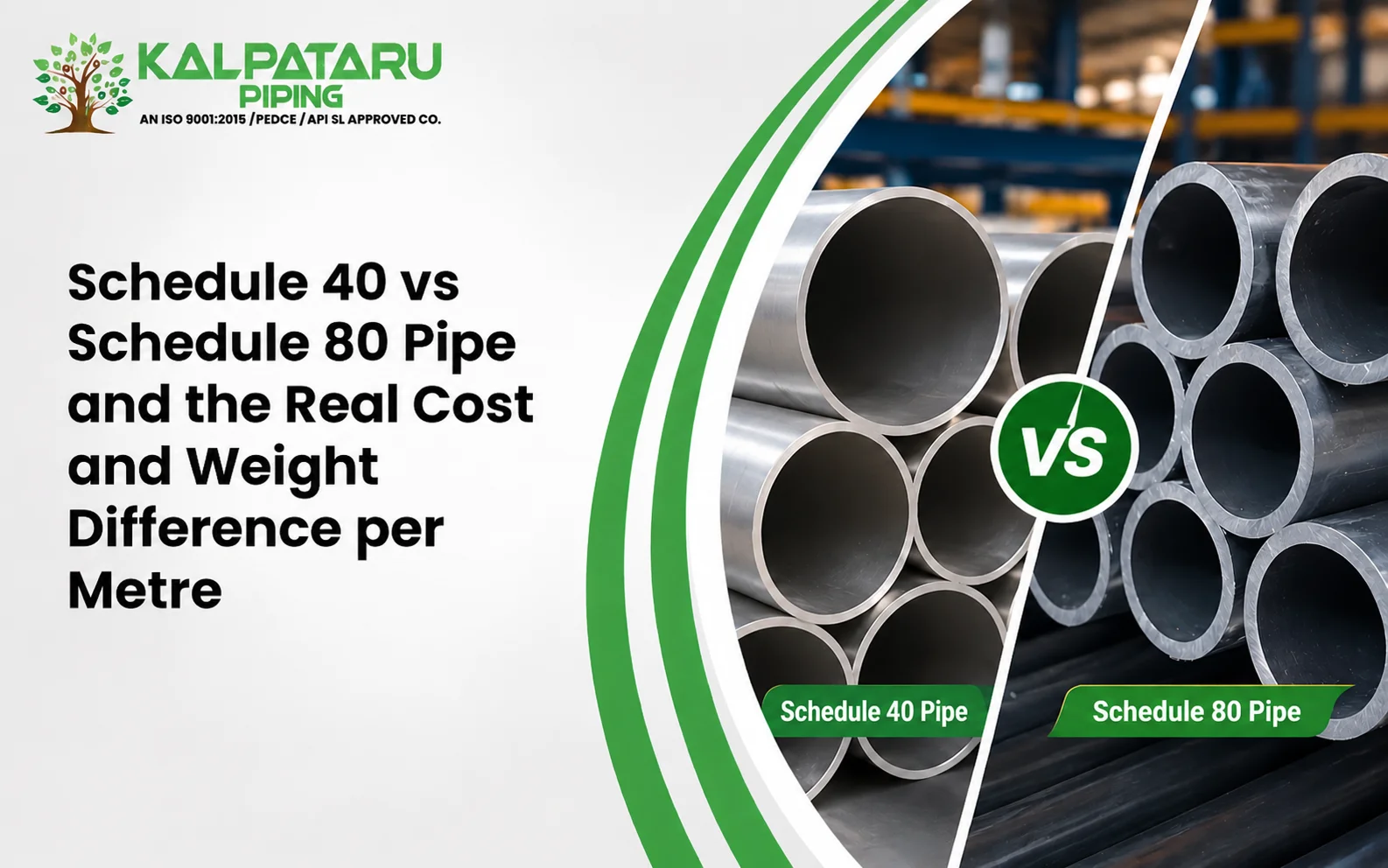
The walls are different thicknesses, but the external diameter remains the same. That is the summary of how schedule 40 differs from schedule 80. The wall of schedule 80 is thicker than that of schedule 40. The thickness varies from 35 to 70 percent depending on the size of the pipes. Anything else will just confuse the reader. The cost of the pipes will also change with the weights of the pipes. All the details can be found in the tables below and our pipe schedule chart covers the other schedules..
What Schedule Means and What Stays the Same
This is rid of the confusion surrounding schedule. It does not refer to a measurement. Instead, it refers to a number that is combined with the nominal pipe size which is represented as NPS and is an indication of the outer diameter and wall thickness of the pipe. ASME B36.10M establishes the measurements for carbon and alloy steel pipe.
People are easily confounded by trying to understand that for any particular pipe size the outside diameter remains constant. For instance, consider a pipe that measures 60.3 mm or the equivalent of a 2-inch NPS pipe. This pipe measures 60.3 mm regardless of whether it has a schedule 40 or schedule 80 designation. What changes is the wall and the bore dimensions. As a result of the change in the thickness of the wall, the bore measurement becomes smaller or thicker respectively and affects the total weight of the pipe considerably.
Because the outside stays put, clamps and supports fit either one. Butt weld fittings still have to match the wall. If you want the outside diameter for any size, our pipe size chart in mm and inches lists it.
Wall Thickness and Inside Diameter, Sch 40 vs Sch 80
The table below shows the wall and the bore for both schedules. Every percentage is calculated from the wall values in the table, so you can check it yourself.
|
NPS |
OD in mm |
Wall Sch 40 in mm |
Wall Sch 80 in mm |
Sch 80 wall thicker by |
ID Sch 40 in mm |
ID Sch 80 in mm |
|
Half inch |
21.3 |
2.77 |
3.73 |
35 percent |
15.8 |
13.8 |
|
Three quarter inch |
26.7 |
2.87 |
3.91 |
36 percent |
21.0 |
18.9 |
|
1 inch |
33.4 |
3.38 |
4.55 |
35 percent |
26.6 |
24.3 |
|
1.5 inch |
48.3 |
3.68 |
5.08 |
38 percent |
40.9 |
38.1 |
|
2 inch |
60.3 |
3.91 |
5.54 |
42 percent |
52.5 |
49.2 |
|
3 inch |
88.9 |
5.49 |
7.62 |
39 percent |
77.9 |
73.7 |
|
4 inch |
114.3 |
6.02 |
8.56 |
42 percent |
102.3 |
97.2 |
|
6 inch |
168.3 |
7.11 |
10.97 |
54 percent |
154.1 |
146.4 |
|
8 inch |
219.1 |
8.18 |
12.70 |
55 percent |
202.7 |
193.7 |
|
10 inch |
273.1 |
9.27 |
15.09 |
63 percent |
254.6 |
242.9 |
|
12 inch |
323.9 |
10.31 |
17.48 |
70 percent |
303.3 |
288.9 |
The difference is approximately 35 percent at 0.5 inches and roughly 70 percent at 12 inches. The bore compensates for it. The flow capacity through a Schedule 80 pipe is around 17 percent less at 1 inch, 12 percent lower at 2 inches, and 9 percent less at 12 inches. If your pipeline is designed to handle tight fit flow, this aspect is as important as the cost.
Schedule 40 Pipe Weight per Metre vs Schedule 80 Pipe Weight per Metre
Here is the schedule 40 vs 80 pipe weight for carbon steel from half inch to 12 inch. Weight is theoretical, worked out from the nominal outside diameter and wall. The formula for kilograms per metre is the outside diameter minus the wall, multiplied by the wall, multiplied by 0.02466, with both in millimetres. The factor assumes a steel density of 7.85.
|
NPS |
OD in mm |
Sch 40 kg per metre |
Sch 80 kg per metre |
Extra kg per metre |
Sch 80 heavier by |
|
Half inch |
21.3 |
1.27 |
1.62 |
0.35 |
28 percent |
|
Three quarter inch |
26.7 |
1.69 |
2.20 |
0.51 |
30 percent |
|
1 inch |
33.4 |
2.50 |
3.24 |
0.73 |
29 percent |
|
1.5 inch |
48.3 |
4.05 |
5.41 |
1.37 |
34 percent |
|
2 inch |
60.3 |
5.44 |
7.48 |
2.04 |
38 percent |
|
3 inch |
88.9 |
11.29 |
15.27 |
3.98 |
35 percent |
|
4 inch |
114.3 |
16.07 |
22.32 |
6.25 |
39 percent |
|
6 inch |
168.3 |
28.26 |
42.56 |
14.30 |
51 percent |
|
8 inch |
219.1 |
42.55 |
64.64 |
22.09 |
52 percent |
|
10 inch |
273.1 |
60.31 |
96.01 |
35.70 |
59 percent |
|
12 inch |
323.9 |
79.73 |
132.08 |
52.36 |
66 percent |
The percentage gap gets bigger as the pipe size increases. It starts at 28 percent for a half-inch pipe. Goes up to 66 percent for a 12-inch pipe. When working with steel, the ASME B36.19M standards use the density of carbon steel. To adjust for stainless steel grades, multiply the weight by about 1.014. For pipe sizes, you can quickly find the weight using our pipe and tube weight calculator. If you need the formula for shapes, check weight formula for steel.
Schedule 40 vs 80 Cost per Metre and What Really Changes
Pipe is usually priced by weight, so cost per metre is the weight in kilograms per metre multiplied by the rate per kilogram. This post lists no rates, because they change with the grade, the manufacturing process and the market. It shows instead how much steel you buy for the same length, so you can compare the two schedules at any rate.
Set Schedule 40 at 100 and compare both schedules at the same rate per kilogram. The index is a weight ratio, not a price, and it covers the pipe only.
|
NPS |
Cost index Sch 40 |
Cost index Sch 80 |
|
1 inch |
100 |
129 |
|
2 inch |
100 |
138 |
|
4 inch |
100 |
139 |
|
6 inch |
100 |
151 |
|
12 inch |
100 |
166 |
A small example makes it real. Take 100 metres of 2 inch pipe. Schedule 40 weighs 544 kilograms and Schedule 80 weighs 748 kilograms, so Schedule 80 means 204 kilograms more steel to buy, handle and ship. At the same rate per kilogram, that is 38 percent more on the pipe line of your quote.
Two cautions. Compare at the same rate, because grade and process can change the rate per kilogram on their own. And remember that pipe is only part of the cost, which the next section covers.
Cost Beyond the Pipe, Fittings, Welding, Threading and Supports
The pipe price is rarely the whole bill. Moving up a schedule changes other lines too.
|
Item |
What changes with Sch 80 |
What to check |
|
Fittings |
Weld end fittings must match the schedule, so Sch 80 fittings are needed |
Order fittings to the same schedule as the pipe |
|
Weld fill |
A thicker wall needs more weld metal and more welding time |
Welding procedure and bevel for the wall |
|
Threading |
A thicker wall leaves more material under the thread |
Thread depth rules in the code |
|
Support load |
Heavier pipe puts more load on hangers and supports |
Support spacing and structure |
None of these is large on its own, but together they widen the gap beyond the weight index. If you are pricing a whole line, add each of them as its own row.
Schedule 40 vs 80 Pressure Rating, How Much Stronger Is Schedule 80?
A thicker wall holds more pressure. The method is Barlow’s formula. Pressure equals 2 multiplied by the allowable stress, multiplied by the wall thickness, divided by the outside diameter.
The table below shows an illustration. It uses an assumed allowable stress of 138 MPa, the nominal wall, no corrosion allowance and no mill tolerance. Confirm the allowable stress for your grade and temperature in your code table.
|
NPS |
Sch 40 in MPa |
Sch 80 in MPa |
Sch 80 higher by |
|
1 inch |
27.9 |
37.6 |
35 percent |
|
2 inch |
17.9 |
25.4 |
42 percent |
|
4 inch |
14.5 |
20.7 |
42 percent |
|
6 inch |
11.7 |
18.0 |
54 percent |
|
12 inch |
8.8 |
14.9 |
70 percent |
Three things follow. Capacity rises roughly in line with wall thickness, so a 2 inch Schedule 80 pipe has about 42 percent more wall and about 42 percent more calculated capacity, not double. Temperature lowers the allowable stress, so the same pipe holds less when it is hot. And pipe walls have a manufacturing tolerance, with ASTM A53 and ASTM A106 allowing the wall to run 12.5 percent under nominal, which a real design has to account for.
These figures are method illustrations, not design ratings. The design code decides, whether that is ASME B31.3 or B31.1, and your piping engineer should confirm the wall.
Schedule 40 vs 40S and 80 vs 80S for Stainless Steel Pipe
Stainless steel pipe has its own dimension standard, ASME B36.19M, and its own schedule names with an S suffix, such as 40S and 80S. For small sizes the walls match carbon steel Schedule 40 and 80. At larger sizes they can differ, so do not assume 40S equals Sch 40 without checking the table.
Weights also shift, because stainless is denser. As noted above, austenitic stainless pipe weighs about 1 percent more than the carbon steel figures. For ready numbers by size, see our stainless steel pipe weight chart.
How to Choose Between Sch 40 and Sch 80, a Selection Table
There is no single right answer, because the schedule follows the job. Use this as a starting point and let the design code settle it.
|
Situation |
Usually fits |
Check |
|
Low pressure water, air and general service |
Sch 40 |
Design code and temperature |
|
Higher pressure or temperature process lines |
Sch 80 or thicker |
Allowable stress and derating |
|
Corrosive or erosive service needing extra wall |
Sch 80 when the Sch 40 wall cannot cover the calculated wall plus corrosion allowance |
Calculated wall plus allowance |
|
Threaded small bore lines |
Sch 80 is common |
Thread depth rules in the code |
If corrosion is the reason, first check whether the Schedule 40 wall still covers the calculated wall plus the corrosion allowance. If it does, there is no need to move up. If it does not, Schedule 80 is the next standard step.
Frequently Asked Questions
What is the difference between schedule 40 and schedule 80 pipe?
Both have the same outside diameter for a given NPS. Schedule 80 has a thicker wall, so a smaller bore, more weight per metre and a higher pressure capacity. Schedule 40 is lighter and cheaper per metre.
How much heavier is schedule 80 than schedule 40?
For carbon steel, about 28 percent heavier at half inch, 38 percent at 2 inch and 66 percent at 12 inch. The percentage gap grows with pipe size.
Is schedule 80 more expensive than schedule 40?
Per metre, yes, because pipe is usually sold by weight and Schedule 80 carries more steel. The percentage matches the weight difference, not a fixed figure. Fittings and welding add to the gap.
Do schedule 40 and schedule 80 have the same outside diameter?
Yes. For each NPS the outside diameter is fixed. Only the wall thickness changes, which is why the inside diameter shrinks as the schedule rises.
Is schedule 80 twice as strong as schedule 40?
No. The pressure rating rises roughly in line with wall thickness. A 2 inch Sch 80 pipe has about 42 percent more wall than Sch 40, so about 42 percent more calculated capacity, not double.
Can I weld schedule 40 pipe to schedule 80 pipe?
Yes, with the correct welding procedure. The wall thickness difference needs a proper bevel and transition, and the design code governs it. Ask your welding engineer.
Need Sch 40 or Sch 80 Pipe Sized to Your Order?
Choosing between the two schedules? Start with the pipe schedule chart for the wall thickness of every schedule, then check the weight of your size in the pipe and tube weight calculator. For questions on a specific line, contact the Kalpataru team.
Contact Us