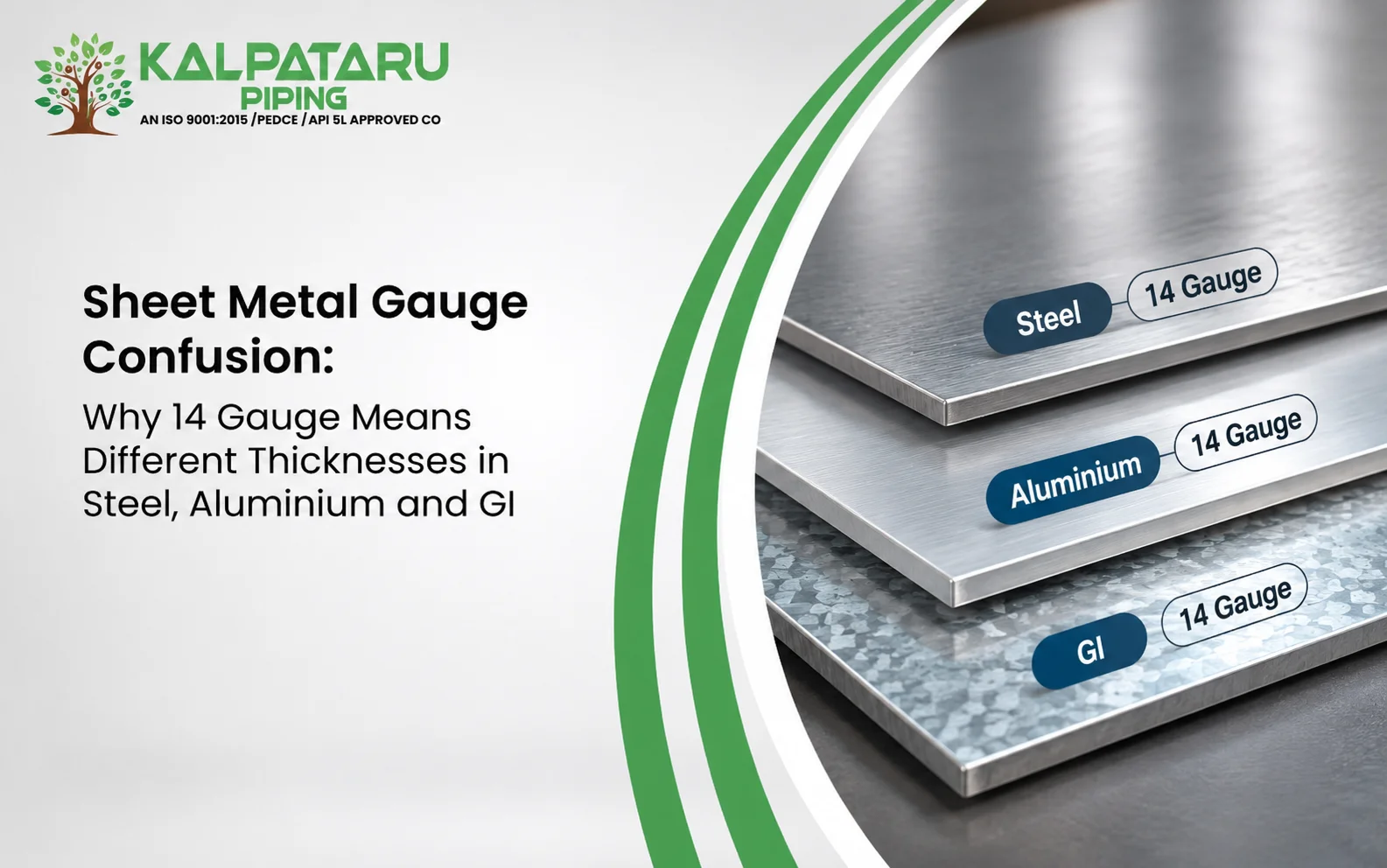
A 14-gauge sheet is ordered and the thickness of the sheet depends on the type of metal. In aluminium, gauge 14 is represented by 1.628 mm, while in standard steel, it is 1.897 mm, in stainless steel it is 1.984 mm and in galvansied iron (GI) it is 1.994 mm. Each metal family has its own gauge table. The table below provides the data for all four metals while the sheet metal gauge chart covers the other gauges.
14 Gauge Thickness by Metal
|
Metal |
Gauge scale |
Inches |
mm |
|
Standard (carbon) steel |
Manufacturers’ Standard Gauge |
0.0747 |
1.897 |
|
Stainless steel |
Manufacturers’ Standard Gauge |
0.0781 |
1.984 |
|
Galvanized steel (GI) |
Galvanized sheet gauge |
0.0785 |
1.994 |
|
Aluminium |
Brown and Sharpe (AWG) |
0.0641 |
1.628 |
|
For comparison: SWG |
Standard Wire Gauge |
0.0800 |
2.032 |
What a Gauge Number Really Means
A gauge number is a label, not a measurement. It points to a row in a table, and on sheet metal a higher number means thinner metal. Each metal family has its own table, so the same number can point to a different thickness. 12 gauge steel is 2.657 mm and 16 gauge steel is 1.519 mm, with 14 gauge in between at 1.897 mm.
Why the Same Gauge Gives Different Thicknesses
Three things cause it. Each metal family has its own scale. Each scale is built on a different basis. And the metals have different densities. Here is how it plays out for each metal.
Steel, Stainless and GI: The Manufacturers’ Standard Gauge
Steel gauge corresponds to weight rather than thickness, as each gauge is related to a weight of sheet per square foot. When it comes to 14 gauge steel, the weight is equivalent to 3.125 lbs per square foot. By dividing that number by 41.82 lbs per squarefoot per inch of thickness, we find out that 0.0747 inches corresponds to 1.897 mm. Stainless and galvanized steels have different tables for the same gauge. For example, the weight of stainless steel is 1.984 mm, while galvanized steel has a value of 1.994 mm at the same value on the table. Always consult your supplier’s table to crosscheck the weight value.
Aluminium: The Brown and Sharpe Scale
Aluminium is measured using the Brown and Sharpe scale, or the AWG scale, and the standard for aluminium sheet is ASTM B258. This particular gauge does not rely on weight. Instead, it progresses through its gauge levels using a fixed ratio. The thickness in inches is given by the formula 0.005 x 92^(36-n), which is then divided by 39. For a gauge of 14, n is equal to 14, resulting in an answer of 0.0641 inches or 1.628 mm. Some prefer to spell the word “aluminium” as “aluminum,” but the method remains unchanged.
|
Scale |
Method |
14 gauge result |
|
Manufacturers’ Standard Gauge (steel) |
Weight per square foot divided by 41.82 lb per square foot per inch of thickness |
3.125 divided by 41.82 gives 0.0747 inch (1.897 mm) |
|
Brown and Sharpe or AWG (aluminium) |
Thickness in inches = 0.005 x 92 raised to (36 minus n) divided by 39 |
n = 14 gives 0.0641 inch (1.628 mm) |
Looking at aluminium sheet? Browse our aluminium plates and sheets
GI Sheet: Its Own Gauge Table and the Coating Question
A 14 gauge GI sheet is 1.994 mm thick, which is 5.1 percent more than 14 gauge plain steel at 1.897 mm. Galvanized sheet has its own gauge table, so the plain steel value does not apply. Charts do not always say whether the gauge value includes the zinc coating, so ask your supplier whether the stated thickness, and its tolerance, applies to the base metal or to the coated sheet.
14 Gauge Compared With Steel: Percentage Differences and Weight
The same gauge number means different thickness, and different thickness means different weight and cost. This table compares each metal with plain 14 gauge steel.
|
Metal |
mm |
Difference in mm |
Difference vs steel |
|
Standard steel |
1.897 |
0.000 |
None |
|
Stainless steel |
1.984 |
0.087 thicker |
4.6 percent thicker |
|
Galvanized steel |
1.994 |
0.097 thicker |
5.1 percent thicker |
|
Aluminium |
1.628 |
0.269 thinner |
14.2 percent thinner |
And here is what a square metre of each sheet weighs, worked out from thickness times density.
|
Metal |
mm |
Density used (g per cm3) |
kg per square metre |
|
Standard steel |
1.897 |
7.85 |
14.89 |
|
Stainless steel |
1.984 |
7.93 |
15.73 |
|
Galvanized steel (approx.) |
1.994 |
7.85 |
15.65 |
|
Aluminium |
1.628 |
2.70 |
4.40 |
The GI weight is approximate because the coating has a different density, so use the mill weight for billing. To work out the weight of your own sheet size, try our plates and sheets weight calculator. For stock in each metal, see our carbon steel plates and sheets and stainless steel plates and sheets.
14 Gauge vs 14 SWG: Another Source of Confusion
Some trade listings, particularly those in India, include SWG, which stands for Standard Wire Gauge. This measurement differs from the gauge. The thickness of a 14 SWG wire measures approximately 2.03 mm, while a 14 gauge steel wire is only 1.897 mm thick. A drawing marked with 14 gauge could mean one of the two, therefore, in order to avoid any confusion, it is necessary to request confirmation of the exact measurement in writing before placing an order.
How to Order Sheet Metal Without Gauge Errors
Use this checklist on every enquiry:
- State the metal, such as carbon steel, stainless steel, GI or aluminium.
- Name the gauge scale, such as Manufacturers’ Standard Gauge, Brown and Sharpe or SWG.
- Give the thickness in mm.
- Name the standard for the product.
- State the tolerance, and for GI say whether it applies to the base or coated thickness.
- Say how the weight is billed, theoretical or actual.
Not sure which gauge scale your drawing uses? Check our sheet metal gauge chart, or contact our team with the metal and the thickness in mm.
Frequently Asked Questions
What is 14 gauge in mm?
Why is 14 gauge different in steel and aluminium?
Is 14 gauge galvanized thicker than 14 gauge steel?
Is 14 gauge the same as 2 mm?
Does a higher gauge number mean thicker metal?
What is 14 gauge stainless steel in mm?
Key Takeaway
Gauge is not a thickness, it is a label that points to a table. The number you get depends on the metal, so the same 14 gauge is 1.628 mm in aluminium and 1.994 mm in GI. Order by mm, and state the metal and the scale.