Inconel 625 and Stainless Steel 316 both show up on the same spec sheets for oil & gas, chemical processing and marine equipment, but one is a nickel-based superalloy and the other is an iron-based stainless, and mixing them up on a BOM gets expensive fast.The niobium is about 4 times the molybdenum and 4 times the nickel. What makes Inconel 625 more corrosion resistant and stronger than SS 316 is not a “premium” version of 316, but rather a different type of material (a nickel-based superalloy versus an iron-based stainless steel) and the difference in composition that translates into the additional corrosion margin, strength and high temp resistance. The question is, whether that margin is worth the price is strictly dependent on what the part actually has to live on. It covers the tested composition of both materials (per ASTM B443/B444/B446 for Inconel 625 and per ASTM A240/A312/A276 for SS 316), how they change between each other, this may be obvious to some, but it bears repeating how a spec sheet applies when it’s directly linked to a real part, whether that’s a round bar, pipe or tube, or tube fitting.
What Is Inconel 625?
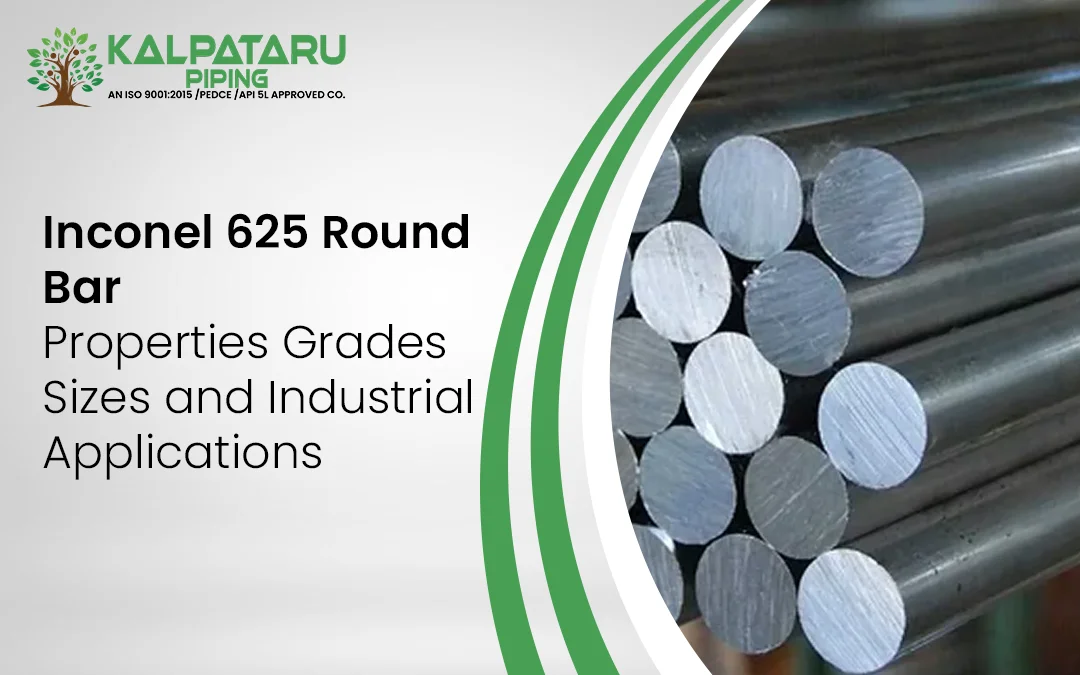
Inconel 625 is a nickel-chromium-molybdenum superalloy, registered under UNS N06625, with a deliberate niobium (columbium) addition that sets it apart from ordinary nickel-chromium alloys. The niobium provides solid-solution strengthening without requiring heat treatment and just as importantly it stabilizes the alloy against sensitization (carbide precipitation) during welding and elevated-temperature service, which is a failure mode SS 316 remains exposed to unless the low-carbon 316L variant is specified. The alloy is covered by three ASTM standards depending on product form: B443 for plate/sheet/strip, B444 for seamless and welded pipe, and B446 for rod and bar all sharing the same UNS N06625 composition. There are also two structural grades: Grade 1 (annealed, suited to structural use up to roughly 593°C) and Grade 2 (solution-annealed for superior high-temperature creep resistance). Aashish Metal & Alloys stocks Inconel 625 as round bars, pipes and tubes, and tube fittings, alongside the full Inconel product range.
What Is SS 316?
SS 316 is an austenitic chromium-nickel-molybdenum stainless steel, registered under UNS S31600, and one of the most widely specified stainless grades in industrial use. The molybdenum addition 2 to 3% is what separates it from SS 304 and gives it meaningfully better resistance to chloride-driven pitting and crevice corrosion. SS 316 is covered by ASTM A240 (plate/sheet/strip), A312 (pipe), and A276 (bar), all under UNS S31600. Like Inconel 625, it has variants worth knowing: 316L, the low-carbon version used wherever the part will be welded, and 316Ti, the titanium-stabilized version used for resistance to sensitization in the 550–800°C range. Aashish Metal & Alloys carries SS 316 as pipes and tubes, tube fittings, fasteners, and shims, across the broader stainless steel product range.
Inconel 625 vs SS 316: Chemical Composition Table
Composition data for this comparison varies depending on where you look, and at least one widely cited supplier table gets a key figure wrong it lists Inconel 625’s iron content as “Balance,” which isn’t correct. Iron is the base element in stainless steel, which is why SS 316’s iron content correctly reads as a balance figure. But in Inconel 625, nickel is the base element, and iron is a controlled minor addition capped at 5% maximum per ASTM B443/B444/B446. The table below is sourced to the governing ASTM standards for both materials:
| Element | Inconel 625 (UNS N06625) | SS 316 (UNS S31600) |
| Nickel (Ni) | 58.0% min | 10.0 – 14.0% |
| Chromium (Cr) | 20.0 – 23.0% | 16.0 – 18.0% |
| Molybdenum (Mo) | 8.0 – 10.0% | 2.00 – 3.00% |
| Niobium + Tantalum (Nb+Ta) | 3.15 – 4.15% | Not present |
| Iron (Fe) | 5.0% max | Balance (~65–72%) |
| Carbon (C) max | 0.10% | 0.08% |
| Manganese (Mn) max | 0.50% | 2.00% |
| Silicon (Si) max | 0.50% | 1.00% |
Key Differences Between Inconel 625 and SS 316
1. Corrosion Resistance
Both alloys resist chloride-driven pitting and crevice corrosion because both carry molybdenum in their passive surface layer. Where Inconel 625 pulls ahead is the niobium addition, which stabilizes the alloy against sensitization during welding and high-temperature exposure, a vulnerability SS 316 doesn’t fully escape unless the low-carbon 316L variant is specified. That combination of higher molybdenum content plus niobium stabilization is also why Inconel 625 holds up in more aggressive acid environments sulfuric, phosphoric, hydrochloric and under stress-corrosion cracking conditions where SS 316 will eventually degrade.
In milder environments general chemical exposure, food processing, moderate marine atmospheres the two perform comparably, which is exactly why SS 316 remains the economical default and Inconel 625 gets reserved for genuinely aggressive service.
2. Mechanical Strength
Worth comparing against standard minimums rather than a flat “higher/lower” claim, since actual mill-certified figures typically run above the specified floor for both materials:
| Property | Inconel 625 (ASTM B446, annealed) | SS 316 (ASTM A276, annealed) |
| Minimum Tensile Strength | ~827 MPa (120 ksi) | 515 MPa (75 ksi) |
| Minimum Yield Strength | ~414 MPa (60 ksi) | 205 MPa (30 ksi) |
| Minimum Elongation | ~30% | 40% |
3. High-Temperature Performance
This is the sub-topic where sources tend to blur two different limits together, so it’s worth separating them clearly. SS 316 has good oxidation resistance in intermittent service up to 870°C and in continuous service up to 925°C but continuous use in the 425–860°C range specifically isn’t recommended where subsequent aqueous corrosion resistance matters, because that band promotes carbide precipitation (sensitization) unless the 316L or 316Ti variant is used. That sensitization caution band is a different thing from the oxidation-resistance ceiling, and conflating the two produces a misleadingly low “limit” for SS 316.
Inconel 625 doesn’t carry that same mid-range caution band. It holds strength and corrosion resistance up to roughly 980°C, which is the real reason it gets specified for continuous elevated-temperature service that would put SS 316 into its sensitization-risk zone.
4. Weldability & Fabrication
Both alloys weld well, but not identically. Inconel 625 requires ERNiCrMo-3 filler metal and tighter heat-input control to avoid Laves-phase segregation in the weld zone, and it work-hardens faster during machining, which raises tooling wear and machining cost. SS 316 welds with standard austenitic technique and readily available 316L filler, and machines conventionally without the same work-hardening penalty.
5. Cost & Machinability
Inconel 625 costs several multiples of SS 316 per kilogram, driven by its far higher nickel and molybdenum content plus the niobium alloying addition all of which track global commodity metal pricing rather than sitting at a fixed premium. That’s also why this guide won’t quote a specific price multiple: nickel- and molybdenum-linked pricing moves with the market, and a hard number here would be stale within months. For a deeper look at how alloy cost tracks nickel and molybdenum pricing, request a quote directly.
Which One Should You Choose?
| Application Requirement | Recommended Material |
| General chemical processing, food-grade, or moderate marine exposure | SS 316 |
| Continuous service in the 425–860°C range with corrosion-sensitive requirements | Inconel 625 |
| Sour gas, high-pressure chemical injection, or severe acid exposure | Inconel 625 |
| Continuous service up to ~925°C, oxidation resistance only | SS 316 |
| Continuous service approaching 980°C | Inconel 625 |
| Standard structural fasteners, shims, or general instrumentation | SS 316 |
| Budget-constrained project where SS 316’s margin is sufficient | SS 316 |
Frequently Asked Questions
Is Inconel 625 always better than SS 316?
No. Inconel 625 is better for extreme corrosion and high temperatures, while SS 316 is suitable for less severe conditions at a lower cost.
How much more expensive is Inconel 625 than SS 316?
Inconel 625 is usually several times more expensive because it contains much more nickel and molybdenum.
Can Inconel 625 and SS 316 be welded together?
Yes. They can be welded together using a suitable nickel-based filler, such as ERNiCrMo-3.
What is the maximum service temperature for SS 316 vs Inconel 625?
SS 316 can handle high temperatures, while Inconel 625 maintains better strength and corrosion resistance at temperatures up to about 980°C.
Is Inconel 625 magnetic?
No. Inconel 625 is generally non-magnetic, similar to SS 316.
What is the difference between Inconel 625 and 316L specifically?
316L is a low-carbon version of SS 316, while Inconel 625 is a nickel-based alloy with higher nickel, molybdenum, chromium, and niobium content.
When should I choose SS 316 instead of Inconel 625?
Choose SS 316 when corrosion, temperature, and operating conditions are within its capabilities and a more economical material is preferred.
What standards govern Inconel 625 and SS 316 pipe, bar, and fitting supply?
Common standards include ASTM B443, B444, and B446 for Inconel 625 and ASTM A240, A312, and A276 for SS 316, depending on the product form.