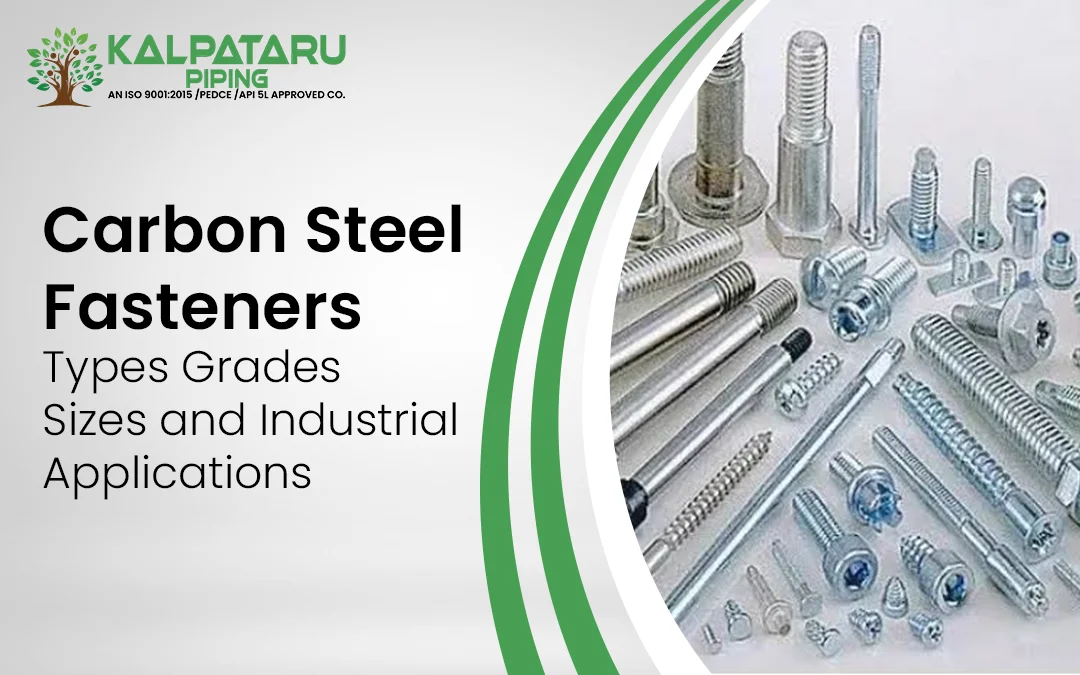
Carbon steel fasteners are widely used in the construction and manufacturing industry to connect parts. In selecting carbon steel fasteners, certain aspects are taken into account, including material grade, strength, size, thread specifics, applicable standards, as well as the environment they will be used in.
Kalpataru Piping Solution provides carbon steel fasteners to its customers fulfilling the industrial needs according to ASTM and SAE specs. By knowing the kinds of fasteners of carbon steel used and their grades customers will determine the right types of bolts, nuts, washers, and steel rods.
The present guide provides information about applicable ASTM standards including ASTM A307, ASTM A193, and ASTM A194 along with SAE grades of bolts including grade 2, grade 5 and grade 8. The guide also provides information about coatings of carbon steel fasteners, physical properties and dimensions to make right decisions when a customer purchases carbon steel fasteners.
Chemical Composition of Common Fastener Grades
|
Specification and Grade |
Carbon % |
Manganese % |
Phosphorus % Max |
Sulfur % Max |
Silicon % |
Chromium % |
Molybdenum % |
|
ASTM A307 Grade A |
0.29 max |
1.20 max |
0.040 |
0.150 |
Not specified |
Not specified |
Not specified |
|
ASTM A307 Grade B |
0.29 max |
1.20 max |
0.040 |
0.050 |
Not specified |
Not specified |
Not specified |
|
ASTM A193 Grade B7 |
0.38 to 0.48 |
0.75 to 1.00 |
0.035 |
0.040 |
0.15 to 0.35 |
0.80 to 1.10 |
0.15 to 0.25 |
|
ASTM A193 Grade L7 |
0.37 to 0.49 |
0.65 to 1.10 |
0.035 |
0.040 |
0.15 to 0.35 |
0.80 to 1.10 |
0.15 to 0.25 |
|
ASTM A194 Grade 2H |
0.40 min |
1.00 max |
0.040 |
0.050 |
0.40 max |
Not specified |
Not specified |
Mechanical Properties
|
Specification / Grade |
Tensile Strength |
Yield / Proof Load |
Notes |
|
ASTM A307 Grade A |
60,000 psi (414 MPa) min |
Not specified |
General-purpose carbon steel bolts, low/medium strength |
|
ASTM A307 Grade B |
60,000 psi (414 MPa) min |
Not specified |
Flanged joint bolting, general service |
|
ASTM A193 Grade B7 |
125,000 psi (860 MPa) min |
105,000 psi (720 MPa) min |
Alloy steel, high-temperature/high-pressure bolting |
|
ASTM A193 Grade L7 |
125,000 psi (860 MPa) min |
105,000 psi (720 MPa) min |
Low-temperature service equivalent to B7 |
|
ASTM A194 Grade 2H |
Proof load per nut size |
Heavy hex nuts for use with B7/L7 studs |
|
|
SAE Grade 2 |
74,000 psi (510 MPa) min |
55,000 psi (379 MPa) proof load |
1/4″–3/4″ dia., low/medium carbon steel |
|
SAE Grade 5 |
120,000 psi (827 MPa) min |
85,000 psi (586 MPa) proof load |
Medium carbon steel, quenched and tempered |
|
SAE Grade 8 |
150,000 psi (1,034 MPa) min |
120,000 psi (827 MPa) proof load |
Alloy steel, quenched and tempered, highest strength |
Types of Carbon Steel Fasteners
Carbon steel fasteners are available in several forms for structural, mechanical, piping and industrial assembly requirements. The selection depends on joint design, load, size, grade and service conditions.
Carbon Steel Bolts
Carbon steel bolts create strong, removable joints in construction, machinery, piping supports and industrial structures. Grade, diameter, thread and length should match the application.
Carbon Steel Screws
Carbon steel screws are used for joining materials directly through threaded engagement. Machine screws, sheet metal screws and wood screws are selected according to the material and installation method.
Carbon Steel Washers
Carbon steel washers distribute the load beneath a bolt head or nut. They help reduce surface damage and support stable fastening in construction, machinery and automotive assemblies.
Carbon Steel Pins
Carbon steel pins are used to align, locate or secure components. They are commonly found in machinery and mechanical assemblies where accurate positioning is required.
Carbon Steel Nuts
Carbon steel nuts work with compatible bolts and studs to create threaded joints. Hex nuts, heavy hex nuts and lock nuts are selected according to bolt grade, thread and service requirements.
For specifications and sourcing options, exploreKalpataru’s Carbon Steel Fasteners range.
SAE J429 Carbon Steel and Steel Fastener Grades
SAE J429 is a separate classification system covering mechanical and material requirements for inch series steel bolts, screws, studs, sems and U bolts within its defined scope.
Common SAE J429 grades encountered in general mechanical and automotive fastening include SAE Grade 2, Grade 5 and Grade 8 bolts.
|
SAE Grade |
General Material Basis |
Head Marking |
Typical Use |
|
Grade 2 |
Low or medium carbon steel |
No radial lines |
General purpose mechanical assembly |
|
Grade 5 |
Medium carbon steel with heat treatment |
Three radial lines |
Automotive and general industrial assembly |
|
Grade 8 |
Higher strength alloy steel with heat treatment |
Six radial lines |
Heavy duty and higher stress mechanical fastening |
The head markings help identify the SAE grade of applicable headed fasteners, but buyers should confirm the marking, dimensions, mechanical requirements and material specification against the relevant standard and supplier documentation.
ASTM and SAE Fastener Grades Compared
ASTM and SAE standards identify fastener requirements in different ways. ASTM specifications commonly define requirements for specific product types and service conditions, while SAE J429 establishes mechanical and material requirements for several inch series externally threaded fastener grades.
|
Standard |
Common Grades |
Main Focus |
Typical Applications |
|
ASTM A307 |
Grade A, Grade B |
Carbon steel bolts and studs for general service |
Construction, piping and general fabrication |
|
ASTM A193 |
B7, L7 |
High strength alloy steel bolting for elevated or low temperature service |
Pressure vessels, piping and industrial equipment |
|
ASTM A194 |
2H |
Nuts for high strength bolting assemblies |
Piping, pressure vessels and industrial equipment |
|
SAE J429 |
Grade 2, Grade 5, Grade 8 |
Mechanical and material requirements for inch series fasteners |
Machinery, automotive and general industrial fastening |
This distinction is important when selecting carbon steel bolts because a grade number alone does not identify the complete material specification.
Carbon Steel Fastener Coatings and Corrosion Protection
Carbon steel can require surface protection when exposed to moisture, outdoor conditions or corrosive environments. The coating should be selected according to the service environment rather than added as a generic specification.
|
Coating or Finish |
General Consideration |
Typical Environment |
|
Zinc plating |
Provides a zinc protective layer for general corrosion protection |
Indoor and moderately exposed applications |
|
Hot dip galvanizing |
Provides a thicker zinc coating suitable for greater environmental exposure |
Outdoor structures and exposed applications |
|
Black phosphate |
Provides surface protection and supports suitable lubrication systems |
Machinery and general mechanical applications |
|
Xylan or PTFE coating |
Low friction and chemical resistance properties can be useful in selected applications |
Chemical and specialised mechanical environments |
|
Epoxy coating |
Barrier protection can be used where a specified coating system is required |
Industrial and exposed applications |
|
Chrome plating |
Provides a hard decorative or functional surface where specified |
Selected mechanical and appearance driven applications |
For related piping requirements, exploreCarbon Steel Buttweld Fittings.
Uses of Carbon Steel Fasteners by Industry
- Construction: Used for structural steelwork, bridges, buildings, equipment frames and general construction assemblies.
- Oil and Gas: Used for pipe supports, equipment connections, flanges and maintenance work where specified grades meet service requirements.
- Automotive: Used in vehicle assemblies, chassis components, engine related parts and mechanical connections.
- Machinery: Used for joining machine components, housings, frames and fabricated equipment.
- Piping: Used with piping systems, supports and related equipment where the selected grade meets pressure and temperature requirements. SeeCarbon Steel Buttweld Fittings for related piping components.
- HVAC and Plumbing: Used for equipment supports, brackets, ductwork and general installation requirements.
For applications involving high carbon steel, the material properties should also be reviewed. SeeProperties and Uses of High Carbon Steel for additional material information.
How to Choose the Right Carbon Steel Fastener
Selecting the correct carbon steel fastener requires the material grade, mechanical requirements, environment and applicable specification to be considered together.
- Confirm the load requirement: Determine the required tensile, shear, proof load and joint strength before selecting the fastener grade.
- Confirm the service temperature: Temperature can affect material selection and mechanical performance. High temperature service may require a suitable alloy steel bolting specification rather than a general purpose carbon steel grade.
- Select the applicable standard: Determine whether the project requires an ASTM product specification, SAE J429 grade or another applicable standard.
- Choose the fastener type: Select bolts, screws, nuts, washers or studs according to the joint design and assembly method.
- Confirm the size: Specify diameter, length, thread, head style and mating nut requirements.
- Select the coating: Consider moisture, outdoor exposure, marine conditions, chemicals and installation requirements when selecting zinc plating, hot dip galvanizing or another finish.
- Check material compatibility: Confirm that the bolt, nut and washer combination is suitable for the selected grade and application.
- Review documentation: Where required, request material certificates, inspection reports and applicable test results before shipment.
For broader product requirements, buyers can also review theKalpataru Products range.