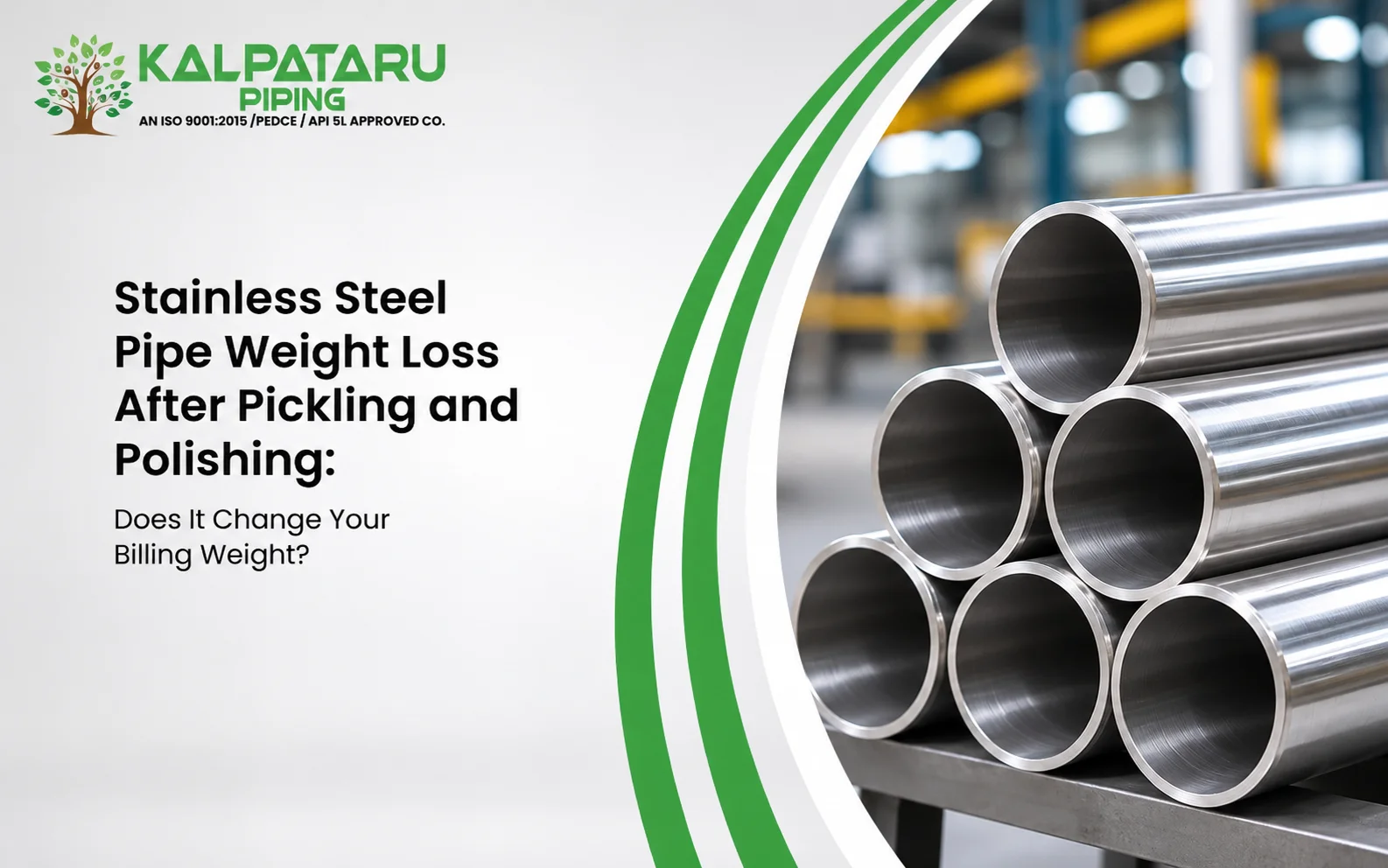
The pipe proceeds to the pickling facility, returns afterward and the weight shows somewhat less than the standard. Does it cause trouble for the invoice? In most cases, no. The pickling and polishing do not destroy the most part of the pipe’s weight. Most often, the invoice will be compliant with the weight standard stated in the purchase order. Check out this guide with the calculations made, weight standards and the checklist for the purchase order. To look for nominal weight of the SS pipe according to its size, review the given SS pipe weight chart.
How SS Pipe Weight Is Calculated and What the Chart Assumes
There are theoretical weights for each of the values on the table. It is computed based on the nominal outside diameter and the nominal wall thickness, rather than weighing the pipe. The kg/m formula for the weight of the pipe is the outside diameter minus the wall thickness multiplied by the wall thickness and multiplied by the value of 0.02491 in mm.
Let’s take as an example a 2 inch Sch 40S pipe. The outside diameter is equal to 60.3mm and the thickness is 3.91mm. If you deduct 3.91 from 60.3 you get 56.39. Now you multiply this number by the wall thickness of 3.91 and then by 0.02491 in mm, which gives you a total of 5.49 kg/m that is the same number you find in the weight of the table.
The number 0.02491 comes from pi multiplied by a density of 7.93 grams per cubic centimetre, which suits austenitic grades such as 304 and 316. The density of carbon steel is approximately 7.85. Therefore, a carbon steel item of the same size would weigh a little less. In ASME B36.19M publications it is noted that carbon steel weights can be converted to austenitic stainless steel weight using the multiplier of 1.014. That is a gap of roughly 1 percent or a little more, and it is usually larger than anything pickling does. If you need the outside diameter and wall for any size and schedule, our stainless steel pipe dimensions chart lists them.
What Pickling, Passivation and Polishing Actually Do
These three words get mixed up on quotes, and only some of them take metal off. Here is what each one does.
|
Process |
What it does |
Removes metal? |
Weight effect |
|
Pickling |
An acid bath removes oxide scale, heat tint and a thin low chromium layer. |
Yes, a thin layer |
Small. Depends on scale and bath time. |
|
Passivation |
A chemical treatment that restores the protective film after cleaning. |
Very little |
Negligible. |
|
Mechanical polishing |
Abrasive grit smooths the surface. |
Yes, by abrasion |
Small. Depends on grit and number of passes. |
|
Electropolishing |
Electrochemical removal of surface peaks and a thin layer. |
Yes, controlled |
Small. Depends on the removal specified. |
Passivation is unique because it is the only method of cleaning that employs citric or nitric acid to remove free iron from the surface and allow the protective oxide layer to regenerate, thereby removing almost nothing. The standard ASTM A380 pertains to all cleaning, descaling, and passivation processes, while ASTM A967 discusses dealing with chemical passivation. If you need to choose between passivated and electropolished surfaces, refer to our guide on electropolish vs passivation finish.
How Much Metal Do Pickling and Electropolishing Remove from Stainless Steel Pipe?
A micron is one thousandth of a millimetre, so we are talking about a very thin skin. The process of electropolishing is said to be effective usually up to about 40 microns. One guide for various industries provides information about the removal possibilities of 0.0001 inch to 0.0025 inch (about 2.5 to 64 microns). It is more complicated to measure the loss of weight inflicted by pickling on stainless steel as this process depends on several factors such as the amount of scale on the pipe, the strength of the solution, and the duration of processing. Therefore, for the processed pipe, values of weight loss are expected to be similar to those associated with electro-polishing. Please note that all figures presented in this section are relative rather than exact, and the only information relevant in your situation is that provided by your finisher.
Here is a useful rule of thumb. Each 5 microns removed from a surface costs about 40 grams of steel per square metre of that surface.
Worked Example of Weight Loss on Half Inch, 2 Inch and 4 Inch Sch 40S Pipe
The method is simple. Work out the surface area of one metre of pipe, inside and outside. Multiply it by the depth removed and by the density of the steel. The inside diameter is the outside diameter minus twice the wall.
Loss per metre equals pi, multiplied by the outside diameter plus the inside diameter, multiplied by the depth removed, multiplied by 7930 kilograms per cubic metre.
The assumptions are stated here so you can check them. Density is 7930 kilograms per cubic metre. Removal is equal on both surfaces. Sizes are the nominal dimensions from ASME B36.19M. We used 5 microns to stand for light pickling or passivation and 25 microns to stand for a heavier electropolish.
|
Pipe |
OD and WT in mm |
Theoretical kg per metre |
Removed per surface |
Loss per metre in grams |
Share of weight |
|
Half inch Sch 40S |
21.3 and 2.77 |
1.28 |
5 microns |
4.6 |
0.36 percent |
|
Half inch Sch 40S |
21.3 and 2.77 |
1.28 |
25 microns |
23.1 |
1.81 percent |
|
2 inch Sch 40S |
60.3 and 3.91 |
5.49 |
5 microns |
14.0 |
0.26 percent |
|
2 inch Sch 40S |
60.3 and 3.91 |
5.49 |
25 microns |
70.2 |
1.28 percent |
|
4 inch Sch 40S |
114.3 and 6.02 |
16.24 |
5 microns |
27.0 |
0.17 percent |
|
4 inch Sch 40S |
114.3 and 6.02 |
16.24 |
25 microns |
134.9 |
0.83 percent |
These are illustrations worked out from the formula, not measured values from any supplier. They do show a pattern. The loss as a share of weight is bigger on small bore, thin wall pipe and smaller on heavy pipe. For other sizes, run your own numbers in our pipe and tube weight calculator, and check the wall for each schedule in the pipe schedule chart.
Is the Weight Loss Bigger Than the ASTM A312 Weight Tolerance?
No, and this is the real reason billing is rarely affected. ASTM A312 is the product standard for austenitic stainless steel pipe, and ASTM A999 holds the general requirements, including how far the weight of a pipe may vary from the specified weight.
Under A999, the weight of any length of pipe in NPS 12 and under may run 10 percent over and 3.5 percent under the specified weight. For sizes above NPS 12 the limits are 10 percent over and 5 percent under. Wall thickness has its own allowance too, and a pipe wall can run up to 12.5 percent under the nominal wall. Check the edition of the standard named on your order, because limits are revised from time to time.
Let’s make a comparison. The cost of a light removal of 5 microns is between 0.17 and 0.36 percent according to the table above. Even for a heavier electropolish of 25 microns on half an inch pipe, which is 1.81 percent, consumes almost half of the 3.5 percent reduction allowance. In big pipes the consumption is much lower. Because of that, finishing passes with allowance in standard schedule pipes, thus it is not a usual billing issue. You can see the full product range on ourASTM A312 stainless steel pipe page.
Theoretical Weight vs Actual SS Pipe Weight, and Which One You Are Billed On
Most billing disputes start here, and not with finishing at all. Both bases are in use, and a purchase order should say which one applies.
|
Basis |
How it is found |
Watch for |
|
Theoretical weight |
Nominal OD and wall in the formula, multiplied by the length. |
It ignores tolerance on wall and diameter, and the grade density used. |
|
Actual weight, also called measured weight |
A bundle or length weighed at dispatch. |
Which stage it was weighed at, and the scale record. |
Theoretical weight is easily applicable since it is easy to perform it and the results can be checked against the chart. Actual weight denotes real pipe but it will keep modifying according to wall tolerance and weighing moment. The bundle weighed prior to pickling will differ from the one weighed afterwards.
Problems arise when the quote was based on one principle and the invoice on another. The buyer sees the price based on theoretical weight and later he sees the invoice based on actual weight, blaming the difference in weight for the finishing stage, which is not correct as tolerance and density are usually the reasons for this difference.
When Finishing Can Matter for Weight
For standard schedule pipe, finishing does not move the weight by much. There are a few cases where you should look more closely. Very thin wall tube loses a larger share of its weight to the same depth of removal, as the half inch row in the table shows. Heavy repeated polishing adds up, because each pass takes a little more. Special electropolish specifications on high purity lines can call for a set removal depth, and that figure belongs on the order.
In each of these cases the effect is still small, but it is worth stating the finish and the removal on the order so everyone is working from the same number.
Frequently Asked Questions
Does pickling reduce the weight of a stainless steel pipe?
Does polishing change the billing weight of SS pipe?
Is SS pipe billed on theoretical weight or actual weight?
What weight tolerance applies to stainless steel pipe?
How much metal does electropolishing remove?
Which formula should I use for SS pipe weight in kg per metre?
Need SS Pipe Sized and Weighed to Your Order?
Send your size list and tell us the weighing basis and the finish. We will confirm weights on the quote. Kalpataru Piping Solutions, based in Mumbai, supplies stainless steel pipes and tubes to the size list and weighing basis your order specifies.
Contact Us