
Overview of Flanges
Functionally, flanges provide several key advantages:
- Connection: They enable the secure assembly of components using bolts & nuts at the joint.
- Sealing: A gasket is placed between flange faces to ensure leak-free connections for liquids or gases.
- Durability: Flanges are built to withstand mechanical stress, temperature fluctuations & system pressure.
- Flexibility: They accommodate changes in pipe sizes, materials & pressure ratings across different sections.
- Maintenance Efficiency: Flanges simplify repair and inspection by allowing easy dismantling & reassembly.
Flanges are circular & come with bolt holes arranged in a pattern. They are usually either welded or threaded onto the pipe ends. Gaskets used between flanges ensure tight sealing under pressure. Flange materials can vary from carbon steel, stainless steel & copper to brass or iron based on application needs. There are many types are available including blind flanges, slip-on flanges, socket weld flanges & weld neck flanges each designed for specific operational needs. Proper alignment, use of sealing elements & uniform bolt tightening are crucial to ensuring leak-proof connections. Flanges are essential components in industrial piping systems offering strength, reliability & flexibility for making them a best choice for engineers across industries like oil & gas, power, water treatment & chemical processing.
How Flange Connections Work in Piping Systems?
A flange connection is a secure & detachable method used to join pipes, valves or equipment in a piping system. It typically involves two flanges including a gasket, bolts & washers to ensure a tight connection with a leakproof seal. These components are used for maintaining system integrity under pressure, temperature changes or vibration. Connected using inner & outer lip parts with a gasket placed between the mating surfaces to prevent leakage. The entire assembly is then bolted together to apply uniform compression on the gasket to ensure a reliable seal. Proper torque must be applied to each bolt to maintain consistent pressure across the flange face. These can be welded or threaded to the ends of the pipes. The gasket surface on the flange face is designed to accommodate the sealing material allowing it to withstand internal forces without movement or displacement. In industrial applications, disk springs & washers are used in flange assemblies to maintain constant pressure and compensate for load variations or thermal expansion. Flange connections offer the flexibility of easy assembly, disassembly, maintenance & component replacement to make them a preferred solution across industries such as oil & gas, power generation & chemical processing.
Types of Flanges
Selecting the right type of flange ensures safe, leak-proof connections, maintenance & supports system reliability under varying pressure & temperature conditions.
Below are the most widely used flange types:
-
Threaded flanges are used for screw on connections without welding in low-pressure applications.
-
Socket weld flanges use a socket where the pipe is inserted & fillet welded to provide strong connections in small-diameter & high-pressure systems.
-
Slip-on flanges allow the pipe to slide through the bore & weld on both sides. Easy to install & suitable for low to moderate pressure systems.
-
Lap joint flanges come in two pieces with a rotating flange used alongside a stub end. They are cost-effective for corrosive or lined piping & are easy to dismantle.
-
Weld neck flanges are butt-welded with a long tapered hub, offering excellent strength and stress distribution for high-pressure, high-temperature applications like oil & gas and power plants.
-
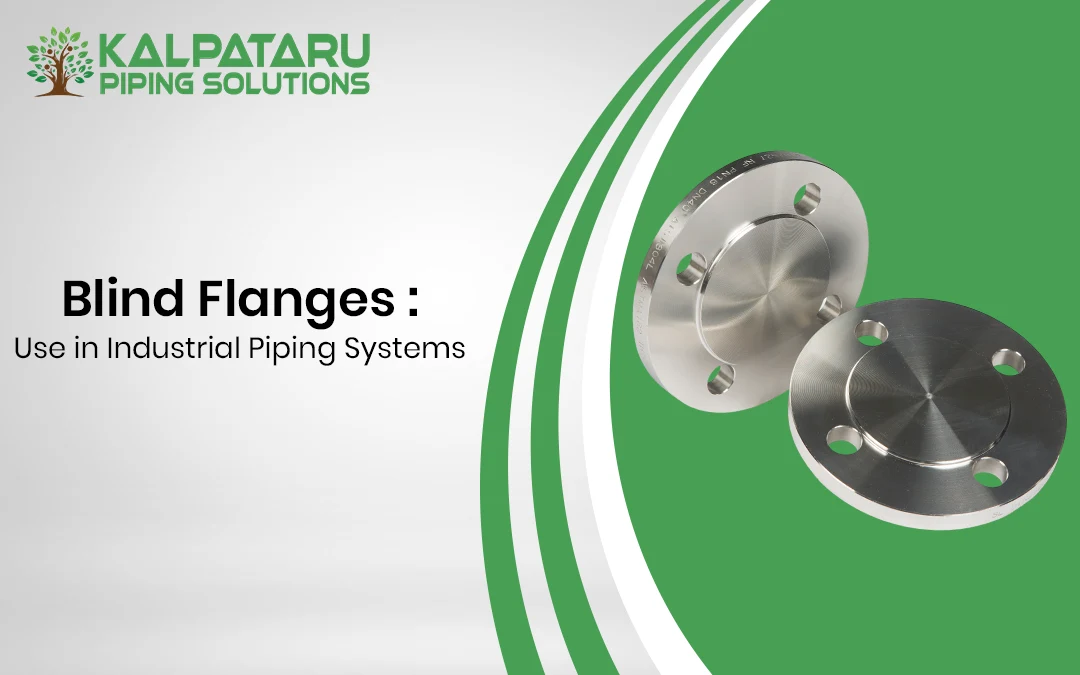
Blind Flanges are solid discs used to seal pipe ends. They are commonly used for system isolation or pressure testing in headers and vessels.
In this blog, we’ll explore blind flanges in detail and their role in industrial piping systems. At Kalpataru Piping Solution, we are a trusted manufacturer and supplier of high-quality blind flanges used across a wide range of piping applications.
Introduction to Blind Flanges
In industrial piping systems, blind flanges are crucial components used to shut a pipe or nozzle’s end. These solid flanges resemble a disc in shape. They vary from other flanges in that they allow no fluid passage. A blind flange closes off a part of the pipework system entirely. This lets tasks like pressure testing or maintenance be completed without completely stopping the system.
Materials including carbon steel and stainless steel have blind flanges accessible to them. SS blind flanges are also used according on system requirements. The decision relies on factors like industry needs and pressure levels of corrosion risks.
Why Use a Blind Flange in Piping Systems?
In many pipe systems, blind flanges play several important functions. Here is the reason they are absolutely essential:
- Isolation for Maintenance or Inspection: At the end of a pipeline, a blind flange offers a safe seal that helps to isolate a pipeline for repairs or inspections free from system-wide closures.
- Pressure Testing: These flanges are often used to verify a system’s integrity by withstanding internal pressures during hydrostatic tests.
- Permanent or Temporary Sealing: They can be either permanently welded or bolted temporarily, depending on application needs and operational flexibility.
Flange Machining Process: Complete Manufacturing Guide
Creating high-quality flanges requires a precise and systematic machining process to meet the demands of modern industrial applications. Here’s a step-by-step overview of how flanges are manufactured:
1. Material Selection
The process starts with selecting suitable raw materials such as carbon steel, stainless steel, or alloy steel. The choice depends on the application’s pressure, temperature, and corrosion resistance needs.
2. Cutting and Shaping
Large steel plates or rods are cut into required sizes using plasma cutting, sawing, or flame cutting. These cut pieces are then shaped to prepare them for forging or machining.
3. Heat Treatment
Based on the material and intended application, flanges undergo heat treatments like annealing, tempering, or quenching. This enhances their strength, toughness, and resistance to wear or corrosion.
4. Forging and Forming
The preheated or cold metal is shaped using hot or cold forging techniques. This process gives the flange its rough form and improves its mechanical integrity.
5. CNC Machining
CNC (Computer Numerical Control) machines are used to ensure precision and accuracy. Key machining operations include:
-
Facing the flange surface
-
Chamfering the edges
-
Drilling bolt holes
-
Boring or grooving as per design requirements
6. Surface Finishing
To improve surface smoothness and aesthetics, processes like grinding and polishing are carried out. This is crucial for proper gasket sealing and a professional finish.
7. Inspection and Quality Control
Each flange undergoes strict inspection procedures such as:
-
Dimensional accuracy checks
-
Surface finish evaluation
-
Non-destructive testing (NDT), including ultrasonic or magnetic particle testing
Types of Blind Flanges
Choosing the right flange for a piping system depends on selecting by understanding the flange face design. The face type of a flange directly influences the kind of gasket required & affects the quality & strength of the seal formed at the joint. There are flange facing types available used in industries designed for specific applications & pressure requirements.
Blind flanges come in several designs, each suited to specific sealing requirements, face types or connection methods. Below are the different types of blind flanges used in industrial applications:
- Raised Face (RF) Blind Flanges: Raised Face (RF) flanges have a feature of a small raised section around the bore. They are compatible with ring gaskets and are widely used in industries such as chemical, petrochemical, and oil & gas due to their ability to concentrate gasket pressure on a smaller sealing area, enhancing sealing performance.
- Flat Face (FF) Blind Flanges: These are designed with a smooth, flat sealing surface & used with full face gaskets to ensure a reliable seal. The flat design helps reduce stress at the flange connection points making them suitable for non-metallic piping systems such as cast iron or fiberglass. Used in applications where excessive load or uneven pressure distribution could lead to damage or leakage.
- Ring Type Joint (RTJ) Blind Flanges: These are designed for high pressure & temperature applications where a strong seal is needed. Have a feature of a precision-machined groove that securely holds a metallic ring gasket to form a durable metal-to-metal seal. Design ensures a leak-proof connection in as oil and gas, petrochemical & power generation plants.
- Threaded Blind Flanges: These flanges are designed for quick installation without the need for welding. They are used in low-pressure applications & with small-diameter pipes. They will provide a tight seal while allowing for easy disassembly & maintenance to use in modular piping systems.
- Custom or Non-Standard Blind Flanges: These are fabricated to meet unique project requirements & specialized applications. They have extra ports for instrumentation special coatings for corrosion resistance or structural reinforcements for add more strength. Used in complex or critical systems where standard flange designs do not meet the necessary specifications.
Materials Used in Blind Flanges
Material selection is vital to ensuring long-term durability and system compatibility. The most common materials include:
- Carbon steel blind flanges: Carbon steel blind flanges are suited for high-pressure & temperature applications offering excellent mechanical strength. Though they provide robust performance under extreme conditions, their corrosion resistance is & power plants.
- Stainless Steel Blind Flanges: Stainless steel blind flanges have superior corrosion resistance. Used in hygienic & corrosive environments such as food processing, pharma & marine applications where cleanliness, non-reactivity, & durability are needed. Popular grades include SS 304 and SS 316 which offer a balance of corrosion resistance & mechanical performance.
Applications of Blind Flanges in Industries
Blind flanges are very useful in many industrial areas. They do more than just close the end of a pipe. They also help with safe maintenance easy construction and keeping the system strong and reliable. Because they are flexible they are used in many different places.
- Oil and Gas Refineries: Blind flanges are used in all parts of oil and gas work. This includes upstream midstream and downstream. They help block pipelines pressure vessels and valves during checks or when systems are off. They are good at handling high pressure and very hot temperatures. This makes them useful in flare systems separator units and hydrocarbon lines.
- Power Generation Plants: Blind flanges are used in both thermal and nuclear power plants. They help seal steam lines and other pipelines. Carbon steel blind flanges are strong and work well when the system deals with pressure changes and heat.
- Chemical and Petrochemical Facilities: These factories deal with strong and dangerous fluids. Blind flanges help close parts of the system safely. Stainless steel blind flanges are often used here. SS 316 blind flanges are popular because they resist acids and other harsh fluids.
- Food and Beverage Processing: Clean pipelines are very important in food and drink factories. SS blind flanges are used to seal the ends of pipes for cleaning and checking. They have a smooth surface that stops bacteria and helps meet health rules like FDA or 3A.
- Water Treatment and Desalination Plants: In these plants blind flanges help close pipelines when the filter material needs to be changed or machines need repair. They last long even in salty or chemical water.
- Pharmaceutical Manufacturing: Clean production is important in medicine factories. Blind flanges are used in cleaning systems like CIP and SIP. Stainless blind flanges stop contamination and are safe for health.
- Shipbuilding and Marine Operations: The sea has salty water that causes rust. Blind flanges made from stainless steel or duplex steel are used in ship parts like ballast lines bilge systems and fire water lines.
- Pipeline Testing and Expansion Projects: Blind flanges are often used when new pipelines are being tested. They help build pressure and check for leaks. They are also used at points where the system may grow later. This lets teams add new pipes without changing the current system.
Kalpataru Piping Solution makes blind flanges for all these industries. Their flanges are strong and meet all safety and quality needs for different uses.
How to Choose the Right Blind Flange
The performance of a blind flange depends on how well it matches the system where it is used. Engineers and purchase teams need to check some important points before choosing the right one.
- Pressure Ratings: Pick a blind flange that can handle the working pressure of your system. For example Class 150 or 300 is good for water lines. For oil steam or hydrocarbon systems you may need Class 600 or more. Kalpataru Piping offers blind flanges in many pressure ratings like ANSI DIN and BS.
- Size and Face Type: You must match the size of the blind flange with your pipe. This includes the outer diameter bolt circle and hole if needed. You also need to pick the correct face like Raised Face Flat Face or Ring Type Joint. This helps make sure the gasket fits well and seals properly.
- Material Compatibility: The material of the flange must match the system conditions. For example use stainless steel blind flanges in places with corrosion or where hygiene is needed. Carbon steel blind flanges are good for high pressure and tough jobs. Kalpataru keeps a large stock like SS 304 SS 316 and A105 carbon steel.
- Standards Compliance: Always check if the flange follows important industry rules. This includes ASME B165 B1647 ASTM AWWA and others. Kalpataru Piping gives MTC reports and third party checks if you ask. This helps you track and trust the quality.
- Gasket and Bolt Compatibility: Make sure the gasket and bolts match the blind flange. If not the flange may bend or leak. Choosing the right set keeps the system safe and strong.
- End Use Customization: Some systems may need extra changes like coatings or testing. Kalpataru Piping can provide blind flanges with special coatings like epoxy or FBE. They also do tests like hydro and NACE. You can get custom blind flanges fast with global delivery.
Why Kalpataru Piping Solution?
Having decades of expertise, Kalpataru Piping is a reliable blind flange producer and supplier with low prices, fast delivery, and precision-engineered goods. Their modern manufacturing and QA techniques make them a desirable partner for industrial customers, OEMs, and EPC contractors all around.
Top Blind Flange Manufacturers & Suppliers
When sourcing blind flanges, quality assurance is non-negotiable. Here’s what to evaluate in a blind flange supplier:
- Certifications: Look for ISO, PED, or API certifications.
- Material Test Reports (MTR): Always request traceability and batch testing documentation.
- Dimensional Accuracy & Finish: Precision in machining ensures reliable sealing and performance.
- Timely Delivery & Global Reach: Reputable blind flange manufacturers offer consistent supply and export capability.
In India, companies like Kalpataru Piping, along with global manufacturers, offer wide material and size availability, from standard ASME flanges to custom-built ones.
Conclusion
Simple in form, blind flanges are essential parts that guarantee system safety, leak avoidance, and operational flexibility in contemporary piping systems. From turning off a pressure vessel to getting pipelines ready for future growth, their importance is fundamental to the dependability of fluid systems in many different sectors.
The correct blind flange can significantly improve system performance and safety regardless of your position—that of an engineer supervising major operations or a procurement specialist guaranteeing compliance and cost effectiveness.
Leading producer and worldwide supplier of blind flanges, Kalpataru Piping Solution offers goods that satisfy strict industrial criteria in the sectors of oil and gas, electricity, water treatment, and process industry. Kalpataru is your one-stop shop for blind flanges that provide performance and peace of mind with a complete selection, configurable solutions, and reputation based on accuracy and trust.
Frequently Asked Questions (FAQs) on Blind Flanges in Piping
What are the types of blind flanges in piping?
Among the principal varieties are raised face (RF), flat face (FF), ring type joint (RTJ), threaded, custom-designed flanges.
Which is better: stainless or carbon steel blind flange?
In hygienic and corrosive surroundings, stainless steel blind flanges are more suited. Applications requiring high pressure, high temperature need for carbon steel.
Where are blind flanges most commonly used?
Oil & gas pipelines, water treatment plants, power generating, and food/pharma sectors all make regular use of them.
What is the installation process for blind flanges in piping systems?
Usually, installation consists in orienting the flange with pipe ends, sandwiching a gasket between sides, and tightening to the necessary torque using bolts.
What materials are used to manufacture blind flanges?
Common materials depending on the use are carbon steel, stainless steel (304, 316), alloy steel, duplex, and more.
Why is proper alignment crucial for blind flange performance?
Inappropriate sealing brought on by misalignment might result in mechanical stress, pressure leaks, or system failure.