Before diving into the technical specifications, you can browse our complete Inconel Products range to see the available forms for your project.
Key Differences at a Glance
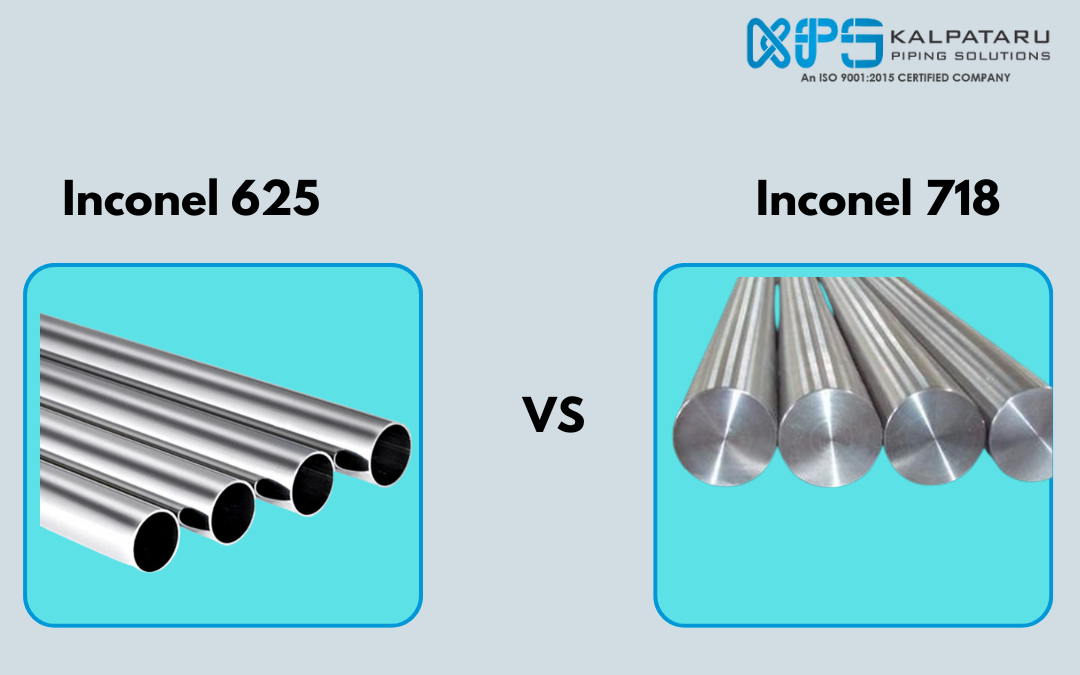
The primary difference lies in how these alloys are hardened. Inconel 625 is a solid-solution strengthened alloy (using molybdenum and niobium), whereas Inconel 718 is precipitation hardenable (using aluminum and titanium to create an “age-hardening” effect).
| Feature | Inconel 625 (UNS N06625) | Inconel 718 (UNS N07718) |
| Primary Attribute | Exceptional Corrosion Resistance | Exceptional Yield & Tensile Strength |
| Hardening Method | Solid Solution Strengthening | Precipitation (Age) Hardening |
| Weldability | Excellent; rarely requires PWHT | Good; requires careful heat control |
| Max Service Temp | Up to 1800°F (982°C) | Up to 1300°F (704°C) |
| Common Forms | Inconel 625 Round Bars | Inconel 718 Round Bars |
Chemical Composition Comparison of Inconel 625 vs 718
The addition of Titanium and Aluminum in 718 allows it to undergo age-hardening, while the higher Molybdenum content in 625 provides its superior “pitting” protection.
| Element | Inconel 625 (%) | Inconel 718 (%) |
| Nickel (Ni) | 58.0 min | 50.0 – 55.0 |
| Chromium (Cr) | 20.0 – 23.0 | 17.0 – 21.0 |
| Iron (Fe) | 5.0 max | Balance |
| Molybdenum (Mo) | 8.0 – 10.0 | 2.8 – 3.3 |
| Niobium (Nb) | 3.15 – 4.15 | 4.75 – 5.5 |
| Titanium (Ti) | 0.40 max | 0.65 – 1.15 |
| Aluminum (Al) | 0.40 max | 0.2 – 0.8 |
Mechanical Properties Comparison of Inconel 625 vs 718
When comparing Inconel 718 tensile strength vs 625, 718 is the clear winner. Its yield strength is nearly double that of 625 at room temperature, making it the preferred choice for high-stress fasteners and rotating components.
| Property | Inconel 625 | Inconel 718 (Aged) |
| Tensile Strength | 120–150 ksi (827–1034 MPa) | 180–210 ksi (1241–1448 MPa) |
| Yield Strength (0.2%) | 60–90 ksi (414–620 MPa) | 150–175 ksi (1034–1206 MPa) |
| Elongation (%) | 30–50% | 12–25% |
| Hardness (Rockwell) | B90 – C35 | C36 – C44 |
Corrosion Resistance of Inconel 625 vs 718
Inconel 625 becomes victorious in the aqueous and chemical environments. Due to the Molybdenum and Chromium content, Alloy 625 has virtually complete immunity to the effect of chloride on the development of stress corrosion cracking. It is the gold standard of seawater service, sour gas (H 2 S ) and mineral acids.
Inconel 718 also has good corrosion resistance though it is a bit pitting prone under severe chloride conditions than 625. Most commonly it is selected due to its strength in corrosive environments and not necessarily its chemical inertness.
Temperature Performance of Inconel 625 vs 718
Cryogenic Behavior: Both alloys perform exceptionally well in sub-zero temperatures, maintaining ductility where carbon steels would shatter.
High Temperature: Inconel 625 maintains its stability up to higher absolute temperatures (1800°F) for oxidation resistance. However, Inconel 718 is preferred for load-bearing applications up to 1300°F because 625 begins to lose significant mechanical strength above 1200°F.
Weldability & Fabrication of Inconel 625 vs 718
Inconel 625 is widely considered the most weldable of all nickel alloys. It does not require post-weld heat treatment (PWHT) to maintain its properties. If you are welding Inconel 625 Pipes & Tubes, the process is straightforward with the right filler wire.
Inconel 718 is designed to be weldable without spontaneous cracking (a common issue with other age-hardened alloys), but it usually requires a full solution anneal and age-hardening cycle post-welding to regain its high-strength properties.
Industry Applications of Inconel 625 vs 718
Where you find Inconel 625:
- Marine Engineering: Propulsion motors, exhaust ducts, and Inconel 625 Flanges.
- Chemical Processing: Vessels handling highly corrosive acids.
- Nuclear: Reactor core components.
Where you find Inconel 718:
- Aerospace: Jet engine components, gas turbine blades.
- Oil & Gas: High-pressure Inconel 718 Fasteners and wellhead components.
- Space Exploration: Rocket motors and cryogenic tanks.
Decision Guide: When to Choose Which?
Choose Inconel 625 if:
- Your primary concern is corrosion (seawater, acids, sour gas).
- You need excellent weldability without complex post-weld heat cycles.
- The application involves high-temperature oxidation but lower mechanical loads.
- You are sourcing Inconel 625 Pipes & Tubes.
Choose Inconel 718 if:
- Highest possible yield and tensile strength is required.
- The component must withstand high stress at temperatures up to 1300°F.
- You are manufacturing bolts, fasteners, or rotating shafts.
- You are looking for Inconel 718 Seamless Pipes & Tubes for high-pressure service.
Price Comparison of Inconel 625 vs 718
Generally, Inconel 718 is slightly more expensive than Inconel 625. This is due to the more complex alloying elements (Al, Ti, Nb) and the intensive heat-treatment processes required to achieve its final strength properties. However, for many aerospace and high-pressure applications, the strength-to-weight ratio of 718 provides a lower “total system cost.”
View Inconel 625 Pipes & Tubes | View Inconel 718 Pipes & Tubes
See how all Inconel grades compare here or contact our technical team today for a custom quote.
Frequently Asked Questions About Inconel 625 vs Inconel 718
Is Inconel 718 stronger than 625?
Yes. Due to precipitation hardening, Inconel 718 has nearly double the yield strength of Inconel 625 at room temperature.
Which is more corrosion resistant?
Inconel 625 is generally more resistant to pitting and crevice corrosion, especially in seawater and harsh chemical environments, due to its higher Molybdenum content.
Can 625 replace 718?
Only if high strength is not the primary requirement. If a part is designed to take advantage of 718’s 150 ksi yield strength, 625 will likely fail under the same load.
Which Inconel is used in aerospace?
Both are used, but Inconel 718 is the “aerospace superalloy” staple for engine parts, while 625 is more common in exhaust systems and ducting.
Whether your project demands the corrosion-fighting power of 625 or the extreme strength of 718, Kalpataru Piping provides certified materials with full MTRs.