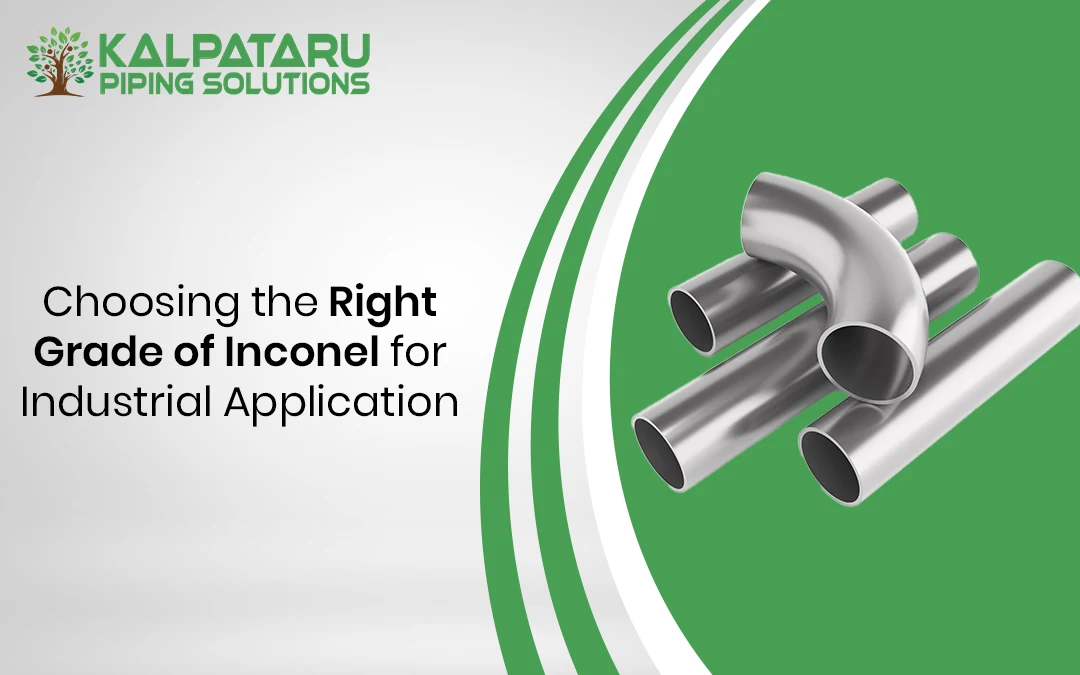
Choosing the Right Grade of Inconel for Your Industrial Application

by | Aug 14, 2025 | Blog | 0 comments

Inconel products are made from nickel-chromium superalloys, designed for use in applications where ordinary steels would fail. When exposed to high temperatures, Inconel materials creates an oxide protective layer providing an increased level of resistance to corrosion, oxidation and creep. No matter the types of Inconel when they are developed, and produced correctly, Inconel parts will continue to perform in overly extreme environments: furnaces, nuclear high-energy reactants, chemical plants, marine piping, and jet engines for example. Many different types of Inconel exist, each designed to perform in a specific operating environment or condition. By understanding many types of Inconel grades & Inconel alloy grades, you can find a grade that meets your requirements for the best cost.

What Are Inconel Grades?

Inconel grades or Inconel material grades identify a distinct chemical composition and heat-treatment condition. The various alloying elements lead to solid solution and precipitation-hardened grades such as Niobium, Molybdenum, Titanium, and Iron. This allows the design engineer a multitude of options for a given application including cryogenic service, high-temperature furnaces, hot acidic process streams, or seawater applications. The properties of Inconel can be compared by Inconel alloy grades to determine the best Inconel type for the application.

Inconel Grades & Properties

Below is a brief summary on five commonly utilized Inconel types that compare the manufacturing route, properties, and typical uses. Check manufacturer material (-spec) datasheets for additional properties by grade.

Inconel 600 (UNS N06600)

Inconel 600 is melted in vacuum as well as hot or cold surroundings before a final anneal. Inconel 600 has excellent resistance to oxidation and corrosion at elevated temperatures, in many media; maintains strength at cryogenic temperatures up to about 1 100 °C (2 000 °F); and has a high nickel content which provides resistance to chloride stress and corrosion cracking. Inconel 600 is used for many items, including furnace fixtures, retorts, nitriding boxes, heat exchanger tubing, nuclear reactor water systems and general chemical processing. With its versatility, Inconel 600 is often touted as one of the best all-around grades of material for moderate-high temperature applications.

Inconel 625 (UNS N06625)

Inconel 625 is an alloy strengthened by molybdenum & niobium. It is typically produced by vacuum induction melting followed by hot working & annealing. The alloy combines high tensile strength with excellent resistance to pitting, crevice corrosion and chloride induced stress cracking. It performs well at temperatures up to roughly 980 °C (1 800 °F) and in acidic and seawater environments. Typical applications include seawater piping, marine hardware, pollution control systems, chemical processing equipment and bellows. It is also used in aerospace exhaust systems where corrosion resistance is essential.

Inconel 718 (UNS N07718)

Inconel 718 is a nickel chromium, precipitation hardenable superalloy that develops strength from a two-step age treatment in which gamma prime (γ′) and gamma double-prime (γ″) precipitate. It provides excellent tensile and yield strength from about −250 °C (−423 °F) to 705 °C (1 300 °F) and has very good weldability relative to many superalloys. These properties make it the default material of choice for gas-turbine engine disks, casings, and fasteners, rocket motor components, cryogenic tankage & high-pressure valve bodies. Among the types of Inconel, it provides the best combination of strength and corrosion resistance for high-stress applications.

Inconel 800 (UNS N08800)

It is referred to as Incoloy 800. The hot working process occurs at roughly 870–1 230 °C (1 600–2 250 °F) & annealing occurs at approximately 980 °C (1 800 °F). Iron gives the alloy structural stability at elevated temperatures while chromium gives the alloy oxidation resistance. Inconel 800 has austenitic metallurgy and has high creep-rupture strength for long periods of time at temperatures above 600 °C (1 100 °F). Furthermore, Inconel 800 also has good carburization resistance and oxidation resistance, allowing for turbine applications for petrochemical heaters, heat exchangers sheathing, nitric acid condensers & nuclear steam generator tubing.

Inconel 825 (UNS N08825)

Incoloy 825 consists with molybdenum and copper materials for improved resistance to pitting, crevice corrosion & reducing acids. It is made by conventional hot or cold working, followed by annealing, and has good weldability. It will withstand numerous oxidizing and reducing acids, but has the greatest utility in sulfuric and phosphoric acids, sustaining useful strength to about 540 °C (1 000 °F). Typical applications are sulfuric-acid evaporators, pollution control scrubbers, seawater heat exchangers & components for nuclear fuel reprocessing. Because of its utility in aggressive, oxidizing & reducing environments, Incoloy 825 is normally selected for marine and acid-processing service.
Let’s explore the key properties and applications of Inconel grades 600, 625, 718, 800, and 825 in detail.
Grade Key properties Typical applications
600 Solid‑solution alloy; resistant to oxidation; non‑magnetic; works from cryogenic to 1 100 °C Heat‑treating fixtures, nitriding containers, furnace parts, chemical‑processing equipment, nuclear reactor water systems
625 Solid‑solution; strengthened by molybdenum and niobium; resists pitting and crevice corrosion; useful to ~980 °C Seawater piping, marine hardware, “pollution‑control scrubbers, chemical plant equipment, aerospace exhaust systems
718 Age‑hardenable; very high tensile and yield strength; service range −250 °C to 705 °C; good weldability Gas‑turbine engines, rocket motors, liquid‑fuelled rockets, cryogenic tanks, high‑pressure valves, aerospace fasteners
800 Nickel–iron–chromium alloy; good structural stability and creep strength; resists carburization and oxidation Petrochemical heaters, heat exchangers, carburizing equipment, nuclear steam generator tubes
825 Contains molybdenum and copper; improved resistance to pitting and reducing acids; strong to 540 °C Acid‑production equipment, pickling hooks, seawater heat exchangers, pollution control, nuclear reprocessing

How to Choose the Right Inconel Grade?

Selecting the best grade of Inconel depends on matching material capabilities to service conditions. Consider these factors:
  • Temperature: Grades 600 and 625 handle roughly 2 000 °F and 1 800 °F; the precipitation‑hardened 718 offers strength around 1 300 °F.
  • Corrosion environment: For oxidizing or chloride media, choose 600; for seawater or acidic service, 625 resists pitting and crevice corrosion; 825 handles a wide range of oxidizing and reducing acids.
  • Mechanical load: High‑stress applications like turbine disks call for 718, whereas moderate stresses in corrosive environments suit 600, 625 or 825.
  • Fabrication and codes: Grades 718 and 825 weld readily. Check applicable codes: nuclear steam generators often specify 800 and aerospace standards commonly require 718.
By considering these factors, you can identify the optimum Inconel grade rather than simply selecting the most exotic alloy. Comparing Inconel properties by grade gives a practical basis for choosing a material that balances performance and cost.

Why choose Kalpataru Piping Solutions for Inconel Products?

Kalpataru Piping Solution is an Inconel manufacturer and inconel supplier stocking material grades 600 to 825. Its metallurgists work with clients to compare grades and choose the best material. Certified pipes, tubes, plates and forged parts can be supplied with test documentation and service offerings can include cutting, machining and threading to ensure parts are ready for installation. A combination of product variety, educated expertise and on-time delivery makes Kalpataru a good choice for complex projects.

Conclusion

Inconel superalloys allow designers to stretch their limits related to temperature, pressure and corrosion. No one alloy is perfect for every application, so it is necessary to understand the types of Inconel and compare each properties of each Inconel grade. Grades 600 and 625 provides relative corrosion resistance and high-temperature stability; 718 provides unparalleled strength; 800 and 825 expand the family with iron or copper additions for specific corrosion resistant or a specific corrosive environment. You can choose the best quality Inconel grade if you consider temperature, corrosion type, mechanical stress and demands of fabrication to avoid unnecessary expense or failure. If you need support, or a trusted source of raw material, Kalpataru Piping Solution offers the technical knowledge and the right products to help you be successful.

Frequently Asked Questions About Inconel Grades

What are the different types of Inconel?

The Inconel family includes a wide range of alloy grades, including 600, 601, 617, 625, 686, 690, 718, 725, 738, 751, X‑750 and others. Each of these Inconel alloy grades is tailored to specific combinations of temperature, strength and corrosion requirements.

Which Inconel grade is best for high temperatures?

For continuous service near 1 100 °C, Inconel 600 or its derivative 601 are excellent because they resist oxidation and carburization. Where high mechanical strength is also required, Inconel 718 retains very high tensile and yield strength up to about 705 °C.

How do Inconel 625 and 718 differ?

Inconel 625 is a solid‑solution alloy strengthened by molybdenum and niobium, giving it outstanding corrosion resistance in seawater and acidic environments but more moderate strength. Inconel 718, by contrast, is age‑hardenable; it offers much higher tensile and yield strength, making it suitable for gas turbines and rocket motors but slightly less resistant to certain acids.

Are Inconel grades suitable for marine environments?

Yes. Grades such as Inconel 625 and Incoloy 825 contain alloying elements that resist pitting, crevice corrosion and stress‑corrosion cracking in seawater. They are commonly used in seawater piping, desalination plants and marine exhaust systems.

Can Kalpataru supply custom Inconel products?

As both an Inconel manufacturer and supplier, Kalpataru offers custom‑sized pipes, plates, fittings and forged components in most Inconel grades. Technical experts can help you select the appropriate alloy and see that it meets the required specifications for your project.
Contact Us

    Fill the below form and get in touch with us, we’ll call you back.

    Fill the Captcha:

    Recent Blogs

    Inconel 600 Chemical Composition — Complete Guide

    Inconel 600 Chemical Composition — Complete Guide

    Inconel 600 or UNS N06600 is a common engineering material, which is applied in the field when the material is required to be resistant to corrosion and heat.UNS N06600 chemical composition is essential in industries that work in highly extreme environments.It is an...

    read more
    WhatsApp chat