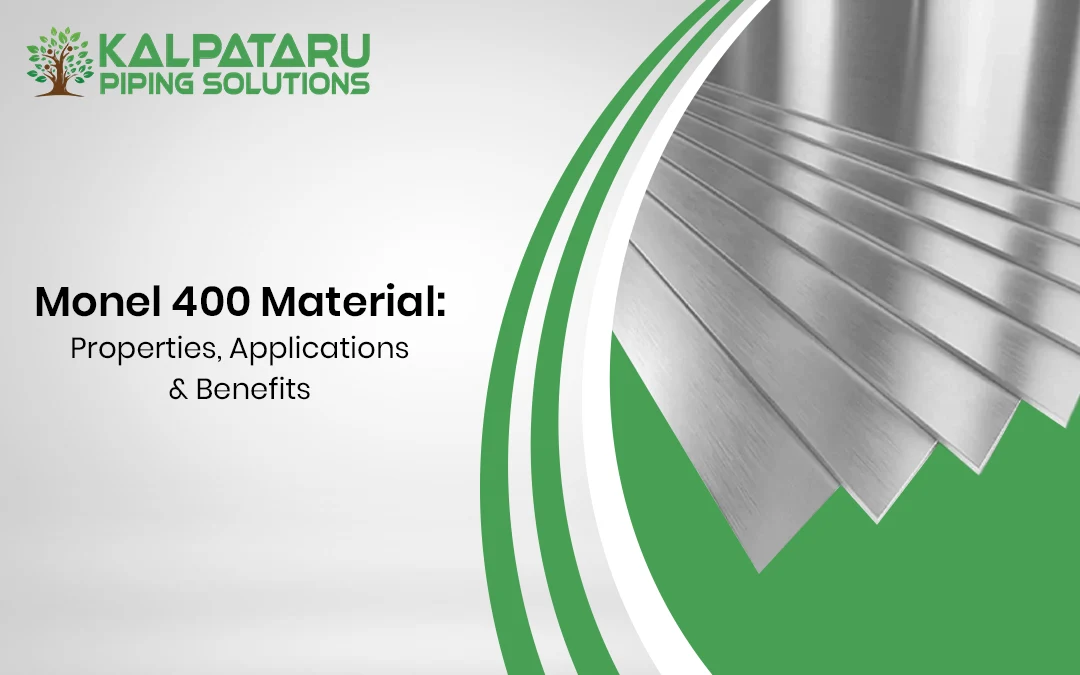
Since its commercial introduction in 1905, Monel 400 (UNS N04400, DIN 2.4360) is a nickel-copper binary alloy which has found applications in the most demanding industrial environments. Its nearly 70 percent nickel content and about 30 percent copper content provides an incredible combination of corrosion resistance, mechanical strength and thermal stability, which few engineering alloys can offer. Marine, oil and gas, chemical processing and aerospace engineers, fabricators, and other procurement departments continually request Monel 400 when exposure to aggressive media, high temperature or exposure to seawater (or other hostile environments) would quickly degrade stainless steels or even carbon steel grades.
Browse our complete Monel Products range to find the right product form for your application.
What Is Monel 400?
Monel 400 is a single-phase nickel-copper alloy, a solid-solution-strengthened, single-phase, alloy registered as UNS N04400 and DIN 2.4360. It is part of the larger family of nickel alloys that the International Nickel Company (INCO) developed, and is named after one of its inventors, Ambrose Monell, who was the president of the International Nickel Company when the alloy was commercialised in 1905. Monel 400, unlike such precipitation-hardened grades as Monel K-500, is completely strengthened by solid-solution strengthening and cold-working, so it can be easily welded and used in a broad variety of fabrication operations.
Key standard designations for Monel 400 include:
- UNS N04400
- DIN 2.4360
- ASTM B164 (Round bars), ASTM B127 (Plates/sheets), ASTM B165 (Seamless pipe/tube)
- AMS 4574, AMS 4675
Monel 400 Chemical Composition
Monel 400 is a binary-dominant alloy. The table below shows the nominal chemical composition per ASTM B164 / UNS N04400:
| Element | Min (%) | Max (%) |
| Nickel (Ni) | 63.0 | — |
| Copper (Cu) | 28.0 | 34.0 |
| Iron (Fe) | — | 2.5 |
| Manganese (Mn) | — | 2.0 |
| Carbon (C) | — | 0.30 |
| Silicon (Si) | — | 0.50 |
| Sulfur (S) | — | 0.024 |
The excellent resistance of the alloy to reducing acids, alkalis, and seawater is due to the high nickel content (minimum 63 percentage). Copper improves the non-oxidising acid resistance, as well as the overall resistance to hydrofluoric acid, inherent to the alloy. Minor alloying additions of iron and manganese are added to enhance strength and fabricability (also used as nickel copper alloy 400 or DIN 2.4360 in European supply chains).
Monel 400 Physical Properties
| Property | Value |
| Density | 8.80 g/cm³ (0.318 lb/in³) |
| Melting Range | 1300–1350°C (2372–2462°F) |
| Specific Heat Capacity | 427 J/kg·K (0.102 BTU/lb·°F) |
| Thermal Conductivity | 21.8 W/m·K at 20°C |
| Electrical Resistivity | 0.547 μΩ·m at 20°C |
| Modulus of Elasticity | 179 GPa (26 × 10⁶ psi) |
| Magnetic Permeability | Slightly magnetic in annealed condition |
Monel 400 Mechanical Properties
The values below represent typical annealed (hot-finished) condition per ASTM B164:
| Property | Value (Annealed) | Value (Cold-Drawn) |
| Ultimate Tensile Strength | 550 MPa (80 ksi) | 620–760 MPa (90–110 ksi) |
| 0.2% Yield Strength | 240 MPa (35 ksi) | 415–550 MPa (60–80 ksi) |
| Elongation (2 in / 50 mm) | 40% | 20–30% |
| Hardness | 65 HRB | 75–95 HRB |
| Impact Toughness (Charpy) | Excellent at cryogenic temperatures | — |
Cold-working significantly increases tensile and yield strength at the expense of ductility. For most pressure-retaining applications, annealed material is specified to retain maximum corrosion resistance and toughness. Refer to the current edition of ASTM B164 (round bar) or ASTM B127 (plate) for minimum specified values applicable to your purchase order.
Monel 400 Corrosion Resistance
Monel 400 is one of the few engineering alloys with outstanding resistance to hydrofluoric (HF) acid across all concentrations at temperatures up to the boiling point — a property that no common stainless steel can match. Its corrosion performance in key environments:
| Environment | Corrosion Performance |
| Hydrofluoric Acid (all concentrations) | Excellent — industry-preferred alloy |
| Seawater & Brackish Water | Excellent — low uniform corrosion; resistant to biofouling |
| Sulfuric Acid (dilute, de-aerated) | Good — resistant in reducing conditions |
| Hydrochloric Acid (dilute, de-aerated) | Acceptable — requires de-aeration |
| Caustic Alkalis (NaOH, KOH) | Good up to moderate concentrations and temperatures |
| Oxidising Acids (nitric, chromic) | Poor — not recommended |
| Dry Chlorine / Fluorine Gas | Good at temperatures below 150°C |
| Neutral Salt Solutions | Excellent |
Monel 400 is susceptible to stress corrosion cracking (SCC) in moist aerated hydrofluoric acid and mercury. Always consult your corrosion engineer when these media are present.
Monel 400 Temperature Performance
Monel 400 retains useful mechanical properties over a wide temperature range:
- Cryogenic service: Excellent toughness at temperatures as low as −196°C (−321°F); no ductile-to-brittle transition, making it suitable for LNG and liquid nitrogen service.
- Elevated temperature: Useful continuous service up to approximately 538°C (1000°F). Above this temperature, oxidation and sulphidation resistance become limiting factors.
- Steam service: Excellent resistance to steam and mixtures of steam and water up to 480°C (900°F).
Monel 400 should not be used in strongly oxidising atmospheres above 480°C without detailed corrosion evaluation.
Monel 400 Weldability and Machinability
Weldability
Monel 400 is readily weldable by TIG (GTAW), MIG (GMAW), and SMAW processes. Recommended filler metals:
- ERNiCu-7 (Monel Filler Metal 60) for TIG and MIG welding
- ENiCu-7 (Monel Electrode 190) for stick (SMAW) welding
Key welding precautions:
- Clean the base metal thoroughly with acetone before welding; surface contamination causes porosity.
- Use stainless steel wire brushes only — carbon steel contamination causes iron-rich weld defects.
- Back purge pipe welds with argon to prevent internal oxidation.
- Post-weld heat treatment is generally not required for standard service conditions.
Machinability
Monel 400 has a machinability rating of approximately 44% relative to AISI B1112 free-machining steel (rated at 100%). It work-hardens rapidly, so sharp tools, rigid setups, heavy feeds, and low speeds are essential. Sulfurised cutting oils improve tool life and surface finish significantly.
Monel 400 vs Monel K-500
Monel K-500 (UNS N05500) is a precipitation-hardening variant of Monel 400. Here is how the two grades compare:
| Property | Monel 400 | Monel K-500 |
| UNS Designation | N04400 | N05500 |
| Tensile Strength (annealed) | 550 MPa | 900–1100 MPa (aged) |
| Yield Strength (annealed) | 240 MPa | 620–690 MPa (aged) |
| Hardness | 65 HRB | 25–35 HRC (aged) |
| Magnetic Properties | Slightly magnetic | Non-magnetic (aged) |
| Weldability | Readily weldable | More complex; age-hardening required post-weld |
| Corrosion Resistance | Excellent | Equivalent to Monel 400 |
| Typical Applications | Piping, valves, heat exchangers | Shafts, fasteners, springs, pump impellers |
| Cost | Lower | Higher (additional processing) |
For applications requiring higher strength with corrosion resistance equivalent to Monel 400, see our Monel K500 Pipes & Tubes product range.
Monel 400 Industry Applications
Marine and Offshore
The outstanding ability of the Monel 400 to resist seawater means that the material is recommended to be used in propeller shafts, pump shafts, valve stems, sea water pipes, heat exchangers, and parts of a desalination plant. It does not biofoul or pit in stagnant or slow-moving sea water where the stainless grades can be attacked by crevices.
Chemical Processing
Monel 400 is indicated in case of HF acid units, equipment to produce hydrofluoric acids and working with sulfuric, hydrochloric acids in the conditions of reducing environments. Commonly used items are reaction vessels, reboilers, overhead condensers, heat exchanger tubing and valves.
Oil and Gas
Commonly used in downhole tooling, wellhead components and sour service piping where hydrogen sulfide (H 2 S ) and CO 2 exist. It has high resistance to chloride stress corrosion cracking compared to austenitic stainless steel in these conditions.
Aerospace and Defence
Monel 400 is an aircraft engine component, fuel system, and hydraulic fittings in which high strength-to-weight ratio and resistance against corrosion in aviation fluids are needed.
Desalination
Multi-stage flash (MSF) and multi-effect distillation (MED) desalination plants use Monel 400 as the heat exchanger tubes, tube sheets, and ingredients of a brine heater that are required to resist corrosion and erosion-corrosion in hot saline media.
Power Generation
The applications of Monel 400 in nuclear power plants and conventional power plants include feed water heaters, condenser tubing and turbine parts that are exposed to steam and treated water.
Medical and Food Processing
Monel 400 does not create any toxicity when in contact with food and the material is allowed to be used in specific food processing equipment. It is also applicable in dental tools and an operation where there is need in corrosion resistance and strength.
Pulp and Paper
Digesters, bleach plant equipments and chlorine dioxide handling systems list Monel 400 as being resistant to chlorine-carrying media and alkali pulping chemicals.
Monel 400 Available Product Forms
Kalpataru Piping supplies Monel 400 in all standard wrought product forms. All product forms are stocked to ASTM / ASME specifications and supplied with full Mill Test Reports (MTRs) and third-party inspection documentation:
- Monel 400 Pipes & Tubes — Seamless and welded, per ASTM B165 / B725
- Monel 400 Flanges — ASME B16.5 / B16.47, all pressure classes
- Monel 400 Round Bars & Wires — Per ASTM B164, hot-finished and cold-drawn
- Monel 400 Plates & Sheets — Per ASTM B127, hot-rolled and cold-rolled
- Monel 400 Buttweld Fittings — Elbows, tees, reducers per ASME B16.9
- Monel 400 Fasteners — Bolts, studs, nuts, washers per ASTM F467 / F468
View all Nickel Alloy Products available from Kalpataru Piping.
The Bottom Line
Monel 400 (UNS N04400) is still one of the most universal and widely specified nickel-copper alloys that are used in industrial service. Its unparalleled resistance to hydrofluoric acid, excellent seawater corrosion behavior, and consistent mechanical characteristics over a broad temperature range- cryogenic to 538o C -are what makes it the automatic choice in challenging marine, chemical, oil and gas applications.
In sourcing Monel 400, it is always important to make sure that the material is provided with complete Mill Test Reports (MTRs) that show that the material meets the required standard in ASTM or ASME. Kalpataru Piping sells Monel 400 in pipes, tubes, flanges, round bars, plates, fittings, and fasteners to the fabricators and EPC contractors in 40 or more countries, having full traceability records.
Frequently Asked Questions About Monel 400
What is Monel 400 used for?
Monel 400 is found in marine hardware, chemical processing equipment, HF acid handling, oil and gas downhole equipment, desalination plant equipment and power generation heat exchangers. It is the only engineering alloy with the combination of seawater resistance and HF acid resistance.
Is Monel 400 magnetic?
A small amount of iron and compositional variation makes monel 400 a little ferromagnetic in the annealed state. It is, however, much less magnetic than carbon or ferritic stainless steels. The leftover ferromagnetism is reduced with cold-working. In fully non-magnetic applications, Monel K-500 in the aged form is more suited.
What is Monel 400 and Monel K-500?
Monel K-500 also includes minor proportions of aluminium and titanium that enable it to be precipitation hardened (aged) to approximately twice the tensile strength of Monel 400. The alloys are similar in their corrosion resistance. Monel 400 is used in situations where the weldability and ductility are important; K-500 is used in high-strength shaft, fastener, and spring applications.
Can Monel 400 be welded?
Yes. Monel 400 can be easily welded with TIG (GTAW), MIG (GMAW), and SMAW processes with equal filler metal of ERNiCu-7 or ENiCu-7. Precautions are to pre-clean, argon back purging of pipe welds, and to clean up with stainless steel. Normal service does not normally require post-weld heat treatment.
What is the maximum temperature of Monel 400?
Monel 400 offers useful service from cryogenic temperatures down to −196°C (−321°F) through to approximately 538°C (1000°F) in continuous service. It is particularly noted for maintaining excellent toughness at cryogenic temperatures with no ductile-to-brittle transition, making it suitable for LNG applications.