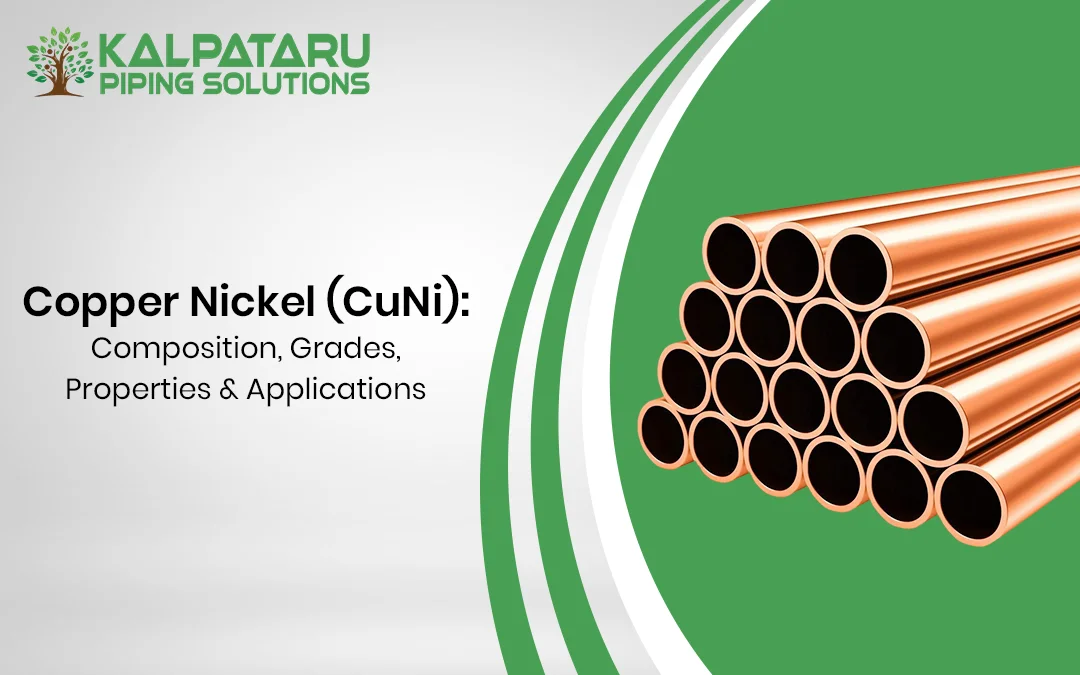
Copper Nickel (CuNi) alloys are binary or modified alloys of copper and nickel that form a complete solid solution across the full composition range. Two grades dominate industrial use: Copper Nickel 90/10 (UNS C70600) and Copper Nickel 70/30 (UNS C71500). Both are prized for outstanding seawater corrosion resistance, natural biofouling resistance, excellent weldability, and proven performance in marine, desalination, offshore oil and gas, and heat exchanger applications, service environments where carbon steel and standard stainless steels routinely fail.
This guide covers CuNi chemical composition, mechanical properties, physical properties, corrosion resistance, and a side-by-side grade comparison, so engineers and procurement teams can specify the correct alloy with confidence. For the full product range, Browse our complete Copper Nickel Products range.
What is Copper Nickel (CuNi)?
Copper Nickel is a binary alloy in which copper is the base metal and nickel is the principal alloying element, with small controlled additions of iron and manganese. Because copper and nickel are completely miscible in the solid state, the alloy forms a single-phase face-centred cubic (FCC) solid solution, the same crystal structure that underpins its excellent ductility, formability, and weldability.
The alloy has a documented history stretching back over 2,000 years, cupronickel coins were minted in the Hellenistic kingdoms of Bactria around 200 BCE. In modern industrial service, CuNi alloys first replaced admiralty brass in Royal Navy condenser tubing in the 1950s and have remained the material of choice for marine heat exchangers, desalination plant tubing, offshore platform piping, and shipbuilding ever since.
The key performance difference between 90/10 copper nickel and 70/30 copper nickel is straightforward: increasing the nickel content raises strength, improves corrosion resistance in aggressive seawater, and increases maximum service temperature, but also raises material cost. Selecting the right grade is therefore a trade-off between performance requirement and total installed cost.
Copper Nickel Grades — 90/10 (UNS C70600) vs 70/30 (UNS C71500)
Copper Nickel 90/10 — UNS C70600 / DIN CuNi10Fe1Mn
Copper Nickel 90/10 contains approximately 90% copper and 10% nickel, with controlled iron (1.0–1.8%) and manganese (up to 1.0%) additions. The iron addition is critical — it enhances seawater corrosion resistance by stabilising the protective oxide film that forms on the alloy surface. UNS C70600 is the most widely specified cupronickel grade due to its excellent cost-to-performance ratio, ease of fabrication, and broad ASTM and ASME coverage.
- Primary ASTM standards: ASTM B466 (seamless pipe and tube), ASTM B111 (heat exchanger tube), ASTM B608 (welded pipe)
- DIN / EN designation: CuNi10Fe1Mn
- Max continuous service temperature: 300°C
- Biofouling resistance: Good — copper ion release suppresses marine organism attachment
- Preferred for: condenser tubes, hull sheathing, firewater systems, general marine piping
Copper Nickel 70/30 — UNS C71500 / DIN CuNi30Mn1Fe
Copper Nickel 70/30 contains approximately 70% copper and 30% nickel, giving it significantly higher strength, superior corrosion resistance in aggressive seawater, and a higher maximum service temperature of 350°C compared with the 90/10 grade. The UNS C71500 designation covers seamless pipe and tube to ASTM B466 and heat exchanger tube to ASTM B111.
- Primary ASTM standards: ASTM B466 (seamless pipe and tube), ASTM B111 (heat exchanger tube), ASTM B369 (continuous cast rod and bar)
- DIN / EN designation: CuNi30Mn1Fe
- Max continuous service temperature: 350°C
- Biofouling resistance: Superior — higher nickel content improves resistance to marine biological fouling
- Preferred for: desalination plant evaporator tubing, offshore platform firewater and seawater lift systems, high-pressure heat exchangers, naval condenser applications
Copper Nickel Chemical Composition Table — ASTM Specification Limits
The table below lists the chemical composition limits for CuNi 90/10 and CuNi 70/30 per ASTM B466 and related standards. All values are in weight percent (wt%). Individual heats are certified to these limits on the Material Test Report (MTR).
|
Element |
CuNi 90/10 — UNS C70600 |
CuNi 70/30 — UNS C71500 |
|
Copper (Cu) |
Remainder (~88–91%) |
Remainder (~65–71%) |
|
Nickel + Cobalt (Ni+Co) |
9.0–11.0% |
29.0–33.0% |
|
Iron (Fe) |
1.0–1.8% |
0.40–1.0% |
|
Manganese (Mn) |
1.0% max |
1.0% max |
|
Lead (Pb) |
0.02% max |
0.02% max |
|
Carbon (C) |
0.05% max |
0.05% max |
|
Sulfur (S) |
0.02% max |
0.02% max |
|
Zinc (Zn) |
1.0% max |
1.0% max |
|
ASTM Standard (Pipe) |
ASTM B466 |
ASTM B466 |
Notes: “Remainder” for copper means the balance after all specified elements. Cobalt content is counted as part of the Ni+Co total. For procurement, always cross-reference the project specification (NACE MR0175, ASME B31.3) for any additional chemistry or testing requirements.
Copper Nickel Mechanical Properties
Mechanical property values depend on alloy grade and temper condition. Annealed (soft) temper is standard for piping, heat exchanger tubing, and pressure vessels. As-drawn (hard) temper applies to drawn tube and bar stock. The table below provides typical values — always verify against the certified mill test report for design purposes.
|
Property |
CuNi 90/10 — Annealed |
CuNi 90/10 — As-Drawn |
CuNi 70/30 — Annealed |
CuNi 70/30 — As-Drawn |
|
Tensile Strength (MPa) |
275–380 |
340–480 |
370–480 |
480–620 |
|
Yield Strength 0.2% (MPa) |
100–140 |
280–380 |
150–200 |
380–480 |
|
Elongation (%) |
30–42 |
10–20 |
35–45 |
8–18 |
|
Hardness (HRB) |
45–65 |
65–80 |
55–75 |
75–90 |
|
Shear Modulus (GPa) |
~50 |
~50 |
~54 |
~54 |
Copper Nickel Physical Properties
Physical properties that govern heat exchanger design, pressure system calculations, and thermal analysis are tabulated below. Copper nickel density of 8.9 g/cm³ is consistent across both grades, making weight calculations straightforward for piping system design.
|
Physical Property |
CuNi 90/10 — UNS C70600 |
CuNi 70/30 — UNS C71500 |
|
Density (g/cm³) |
8.9 |
8.95 |
|
Melting Point (°C) |
1100–1145 |
1170–1240 |
|
Thermal Conductivity (W/m·K) |
40 |
29 |
|
Electrical Resistivity (μΩ·cm) |
19 |
34 |
|
Coefficient of Thermal Expansion (μm/m·°C) |
17.1 |
16.2 |
|
Modulus of Elasticity (GPa) |
135 |
152 |
|
Magnetic Permeability |
Non-magnetic |
Non-magnetic |
|
Max Service Temperature (°C) |
300 |
350 |
Copper Nickel Corrosion Resistance
Seawater Corrosion Resistance
CuNi alloys owe their outstanding seawater corrosion resistance to a thin, self-healing cuprous oxide / nickel oxide protective film that forms immediately on first seawater exposure. This film suppresses the underlying metal dissolution rate to very low levels and repairs itself if mechanically disrupted, provided fluid velocity stays within acceptable limits.
- General corrosion rate in seawater: typically 0.025 mm/year or less for 90/10; lower still for 70/30
- Maximum recommended seawater velocity: 90/10 — 3.0 m/s; 70/30 — 4.5 m/s (above these limits, impingement erosion can destabilise the oxide film)
- Chloride stress corrosion cracking: CuNi alloys are essentially immune, unlike austenitic stainless steels which are highly susceptible
- Crevice corrosion resistance: Good in flowing seawater; stagnant seawater conditions should be avoided at start-up and shutdown
Biofouling Resistance
Biofouling resistance is one of the most commercially important properties of copper nickel marine piping. Copper ions released from the alloy surface are toxic to barnacles, mussels, algae, and microbial biofilms that colonise seawater piping systems. CuNi 70/30 releases copper ions at a slightly higher and more sustained rate than 90/10, delivering superior biofouling suppression in tropical seawater environments where biological growth rates are highest.
This property eliminates the chlorination systems, mechanical cleaning schedules, and flow-restriction losses associated with biofouled carbon steel or stainless steel piping — a significant operating cost advantage over the service life of an offshore platform or desalination plant.
Impingement Erosion & Velocity Limits
Impingement erosion — the combined mechanical and electrochemical attack at local high-velocity zones such as inlet tube ends, bends, and joints — is the principal failure mode for copper nickel heat exchanger tubing. Both grades are significantly more resistant to impingement than admiralty brass. Velocity limits must be respected; installing inlet tube inserts (ferrules) in heat exchanger tubesheets is good engineering practice for systems that experience transient high-flow conditions.
Copper Nickel 90/10 vs 70/30 — Grade Comparison Table
Use the table below for first-pass grade selection. CuNi 90/10 covers the majority of marine and industrial applications at the lowest cost. Specify CuNi 70/30 when higher strength, elevated temperature capability above 300°C, or superior biofouling resistance in tropical seawater is required.
|
Criteria |
CuNi 90/10 — C70600 |
CuNi 70/30 — C71500 |
|
Nickel Content |
9–11% |
29–33% |
|
Tensile Strength |
275–380 MPa (annealed) |
370–480 MPa (annealed) |
|
Seawater Corrosion Resistance |
Very Good |
Excellent |
|
Biofouling Resistance |
Good |
Superior |
|
Max Service Temperature |
300°C |
350°C |
|
Thermal Conductivity |
Higher (40 W/m·K) |
Lower (29 W/m·K) |
|
Cost |
Lower |
Higher |
|
Typical Application |
Condenser tubes, hull sheathing, general marine piping |
Desalination, offshore platforms, high-pressure heat exchangers |
|
Weldability |
Good (GTAW/GMAW) |
Good (GTAW/GMAW) |
|
ASTM Standard (Pipe/Tube) |
ASTM B466 / B111 |
ASTM B466 / B111 |
Temperature Performance
Copper Nickel 90/10 is rated for continuous service up to 300°C. Above this temperature, strength falls significantly and oxidation rate increases. For seawater and process fluid service below 300°C, 90/10 is fully adequate for the vast majority of offshore, marine, and desalination applications.
Copper Nickel 70/30 extends the maximum continuous service temperature to 350°C, with superior strength retention at elevated temperatures. It is preferred for high-pressure steam-heated heat exchangers and applications where process side temperatures can transiently approach 300–350°C.
Both CuNi grades retain excellent ductility and toughness at cryogenic temperatures, making them suitable for LNG-related seawater systems and cold-climate offshore installations.
Weldability and Machinability
Weldability
Copper nickel weldability is generally good for both 90/10 and 70/30 grades using Gas Tungsten Arc Welding (GTAW/TIG) and Gas Metal Arc Welding (GMAW/MIG) processes. The recommended filler metals are ERCuNi (for both grades) per AWS A5.7.
- Preheat is not required for wall thicknesses up to 10 mm; light preheat of 50–100°C is recommended for heavier sections
- Post-weld heat treatment is not required — a significant fabrication advantage over many stainless and nickel alloys
- Joint preparation should be thoroughly cleaned; contamination with iron from grinding or carbon steel tooling can compromise corrosion resistance in the heat affected zone
- Shielding gas: pure argon or argon-helium mix; avoid argon-CO₂ mixes that can cause porosity
- Weld passes should be kept short to limit heat input and maintain low interpass temperatures (max 150°C)
Machinability
Both copper nickel grades have a machinability rating of approximately 20% relative to free-cutting brass (C36000 = 100%). They produce long, stringy chips that require appropriate chip-breaking tool geometry. Carbide tooling with positive rake angles, high cutting speeds with generous coolant flow, and dedicated tooling (avoiding contamination from ferrous materials) produce the best results.
Copper Nickel vs Stainless Steel — Marine Service Comparison
Engineers specifying marine piping frequently evaluate copper nickel vs stainless steel. The table below summarises the key differentiators for seawater service:
- Chloride stress corrosion cracking: CuNi is essentially immune; 316L stainless is susceptible above 60°C in chloride-bearing media
- Biofouling resistance: CuNi has inherent biocidal activity; stainless steel requires biocide dosing or mechanical cleaning
- Crevice corrosion: CuNi is more resistant in seawater crevice conditions; 316L stainless can pit severely
- Weldability: Both weld well but CuNi does not require PWHT or the strict precautions needed to avoid sensitisation of stainless
- Cost: CuNi 90/10 is generally cost-competitive with 316L stainless in marine piping applications; 70/30 carries a cost premium
Copper Nickel Industry Applications
Marine & Shipbuilding
The marine sector is the largest end-use market for copper nickel piping and tubing. Applications include ship condenser and cooler tubing, hull sheathing on high-value vessels, seawater intake and overboard discharge piping, bow thruster piping, and firewater systems. The biofouling resistance of CuNi eliminates hull-side fouling accumulation in static berthing conditions, reducing drydock frequency.
Desalination Plants
Multi-Stage Flash (MSF) and Multi-Effect Distillation (MED) desalination plants specify CuNi 70/30 for evaporator heat transfer tubes and CuNi 90/10 for seawater intake, reject brine, and auxiliary piping. Both grades resist the concentrated brine environments and elevated temperatures characteristic of thermal desalination service.
Offshore Oil & Gas
Offshore platforms specify copper nickel for seawater lift, firewater deluge, cooling water, and bilge systems where seawater is the process fluid. CuNi 90/10 pipes and tubes are the standard specification for FPSO and fixed-platform seawater piping. The biofouling resistance avoids the flow restriction problems that affect unprotected carbon steel piping over a 20–25-year platform life.
Power Generation
Coastal and nuclear power stations use copper nickel heat exchangers for once-through seawater cooling of turbine condensers. CuNi 70/30 is preferred in nuclear service (where purity requirements are most stringent) and CuNi 90/10 covers the majority of coastal gas and coal-fired plant condenser applications.
Heat Exchangers
Copper nickel heat exchanger tubing combines high thermal conductivity (relative to titanium), resistance to erosion-corrosion at rated velocities, and freedom from biofouling, making it the preferred tube material for shell-and-tube heat exchangers in seawater-cooled service across marine, offshore, and onshore coastal process plants.
Available Product Forms — Copper Nickel Supply Range
Kalpataru Piping manufactures and supplies the complete range of CuNi product forms to ASTM, ASME, and EN standards:
- Copper Nickel Pipes & Tubes — ASTM B466 seamless and welded pipe, ASTM B111 heat exchanger tube
- Copper Nickel 90/10 Pipes & Tubes — UNS C70600 / DIN CuNi10Fe1Mn, full dimensional range
- Copper Nickel 70/30 Pipes & Tubes — UNS C71500 / DIN CuNi30Mn1Fe, full dimensional range
- Copper Nickel Plates & Sheets — ASTM B171 clad plate, B122 sheet
- Copper Nickel Flanges — ASME B16.5 and MSS SP-44 flanges, all ratings
- Copper Nickel Fittings — ASME B16.9 butt-weld fittings, elbows, tees, reducers
- Copper Nickel Round Bars & Fasteners — ASTM B151 rod and bar
Browse our complete Copper Nickel Products range for full specifications, dimensional data, and chemical/mechanical property tables.
Frequently Asked Questions (FAQs)
What is the difference between Copper Nickel 90/10 and 70/30?
CuNi 90/10 (UNS C70600) contains 9–11% nickel and is the more economical grade, suited to the majority of marine piping, condenser tube, and seawater service up to 300°C. CuNi 70/30 (UNS C71500) contains 29–33% nickel, offering higher tensile strength (370–480 MPa annealed vs 275–380 MPa for 90/10), better corrosion resistance in aggressive seawater, superior biofouling resistance, and a higher service temperature limit of 350°C. Specify 70/30 where higher strength or more aggressive service conditions justify the cost premium.
Does Copper Nickel resist seawater corrosion better than stainless steel?
For seawater service, copper nickel alloys have several advantages over austenitic stainless steels: CuNi is essentially immune to chloride stress corrosion cracking (a common failure mode for 304 and 316L stainless in warm seawater), has inherent biofouling resistance that stainless lacks, and is more resistant to pitting and crevice corrosion in stagnant or low-flow seawater conditions. Super duplex stainless (UNS S32760) can match or exceed CuNi corrosion performance but at significantly higher cost.
What ASTM standards apply to Copper Nickel pipe and tube?
The primary ASTM standards for CuNi pipe and tube are: ASTM B466 (seamless copper-nickel pipe and tube, covering both 90/10 and 70/30), ASTM B111 (copper and copper-alloy seamless condenser tubes and ferrule stock), ASTM B608 (welded copper-nickel pipe), and ASTM B369 (copper-nickel alloy castings). The ASME equivalents (SB-466, SB-111) are accepted under ASME B31.3 piping code.
Can Copper Nickel pipe be welded without post-weld heat treatment?
Yes. A key fabrication advantage of copper nickel alloys is that neither 90/10 nor 70/30 requires post-weld heat treatment (PWHT). Welding is performed using GTAW (TIG) or GMAW (MIG) with ERCuNi filler wire per AWS A5.7. Joint areas must be thoroughly cleaned to remove iron contamination before welding. Shielding with pure argon or argon-helium is recommended.
What is the biofouling resistance mechanism in Copper Nickel?
Copper nickel biofouling resistance is a natural property arising from the slow release of cupric and cuprous ions from the alloy surface. These ions are toxic to marine organisms — barnacles, mussels, tube worms, algae, and microbial biofilms — at concentrations well below the threshold harmful to larger marine life. The ion release rate is high enough to prevent settlement and growth but low enough not to damage the alloy. CuNi 70/30 sustains slightly higher ion release rates than 90/10, providing superior biofouling suppression in tropical seawater environments.
Need Help Selecting the Right Copper Nickel Grade for Your Project?
Submit a specification enquiry to the Kalpataru Piping technical team to review your operating conditions — service temperature, fluid chemistry, flow velocity, design pressure, and applicable code — and receive a grade recommendation, dimensional schedule, and certification options.
Browse our complete Copper Nickel Products range | Copper Nickel Pipes & Tubes | Copper Nickel 90/10 Pipes | Copper Nickel 70/30 Pipes