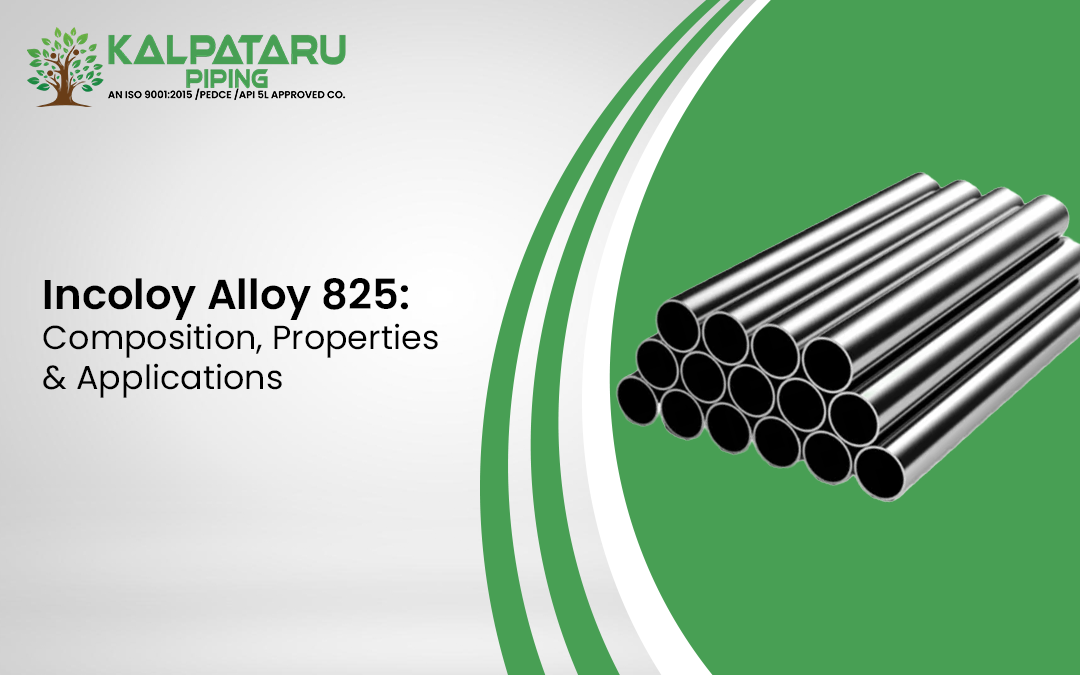
Incoloy 825 or Alloy 825 (UNS N08825) is a high performance nickel-iron-chromium alloy designed to provide exceptional durability in very demanding industrial applications. It has a wide range of applications in chemical processing, pollution control, oil and gas sectors, and is highly regarded for its resistance to corrosion, high strength, and durability. The key feature of Incoloy 825 is the controlled addition of titanium to the material, which gives the alloy a stable metallurgical structure that maintains performance stability even after welding and/or extended service at high temperatures. This combination of properties renders Incoloy 825 pipes, tubes and fittings the material of choice for engineers and designers for corrosion critical applications.
In this blog, we will discuss Incoloy 825 in great detail, its chemical composition, important properties, corrosion resistance, applications in various industries and advantages of the 825 material, which makes this alloy a must use in design or performance critical applications.
What is Incoloy 825?
Incoloy 825 is a high-performance nickel-iron-chromium alloy; it contains immense quantities of molybdenum, copper and titanium elements which make it stronger and capable of enduring oxidation. The chlorides make the alloy especially resistant to stress corrosion cracking due to high amounts of nickel that makes the austenitic structure of the alloy constant. The Incoloy 825 is impervious to reducing agents and acids with molybdenum and copper and oxidizing circumstances with chromium; nitric acid, nitrates, and oxidizing salts. The titanium content makes sure that pitting and intergranular corrosion of the alloy will not occur after fabrication and welding, even in the extreme sensitization temperatures (650°C–760°C).
Alloy 825 is especially efficient in the use of sulfuric and phosphoric acid, therefore a very cost effective and reliable alternative in the chemical processing and the various other fields where corrosion resistance and longevity is a major priority. To understand how Incoloy 825 compares with other superalloys, see our guide on Inconel vs Incoloy.
Incoloy 825 Chemical Composition & Key Elements
The Incoloy 825 is a nickel-iron-chromium alloy that is created to offer not only great resistance against corrosion but also high levels of mechanical stability. The balanced chemical structure, makes it also very efficient in the highly industrialized setting like chemical processing, oil and gas, and pollution control. It has a simple structure and is divided into components as outlined below:
- Nickel (Ni) – 38.0–46.0%: The first one is the nickel that makes the alloy more resistant to stress corrosion cracking by chloride and enhances the structural integrity of the alloy in severe conditions.
- Iron (Fe) – 22.0% minimum: The backbone of the alloy is comprised of iron and it provides it with structural integrity.
- Chromium (Cr) – 19.5–23.5%: Chromium is used to cover the alloy surface in order to prevent oxidation and corrosion particularly in an acidic environment by forming a protective layer of passive oxide.
- Molybdenum (Mo) – 2.5–3.5%: Molybdenum also increases pitting and crevice corrosion resistance, especially in reducing conditions such as sulfuric and phosphoric acid solutions.
- Copper (Cu) – 1.5–3.0%: The copper also enhances the ability of the reducing agents to resist and increases the alloy to work in sulfuric acid applications.
- Titanium (Ti) – 0.6–1.2%: The alloy is rendered stable by titanium so that it does not corrode intergranularly during welding or any other high-temperature exposure.
- Trace Elements (Mn, C, Si, S, Al): Manganese, carbon, silicon, sulphur and aluminium are strictly controlled so that the stability of manufacture, mechanical, and corrosion resistance are maintained.
These factors in combination have given Incoloy 825 its synergistic chemical, mechanical and thermal performance that has made it a popular alloy in critical industrial processes that require longer durability, reliable performance and long-term corrosion protection.
Incoloy 825 Material Properties
One of the industrial applications, which is comprised of Incoloy 825, is attributed to the excellent mechanical, thermal, and corrosion-resistant properties. Its material properties, which are of importance, have been discussed below.
Incoloy 825 physical properties are highly applicable in the extreme environmental conditions in the industrial industry due to the following physical properties.
- The melting point of this material is within 1350°C and 1400°C and this is suitable to be used when temperatures are high.
- The density of Incoloy 825 is 8.14 g/cm³, which ensures the structural integrity and stability.
- The importance of Thermal Conductivity of 12.5 W/m·K, contributes to effective transfer of heat in the industrial processes.
- Its Electrical Resistivity of 0.75 µ ohm·m makes it reliable in electrical use.
These features make Incoloy 825 a worthwhile substitute when it comes to heat transfer operations and where thermal stability is highly significant. You can explore our range of Incoloy 825 plates and sheets for applications requiring flat-rolled product forms.
Incoloy 825 Mechanical Properties
The tensile, yield strengths and elongation of Incoloy 825 (UNS N08825) are high and hence make it strong and dependable even in severe working conditions.
Tensile Strength and Yield Strength
The tensile strength of Incoloy 825 ranges between 80–120 ksi and yield strength ranging between 30–50 ksi at room temperature. The values are maintained at high temperature indicating that the alloy is an excellent thermal stable material. Strongness and moderate elongation are attributes that ensure that there is high performance in the forming and shaping processes.
Typical Room Temperature Tensile Properties:
| Form | Condition | 0.2% Proof Stress (MPa) | Tensile Strength (MPa) | Elongation (%) |
| Tube | Annealed | 440 | 770 | 35 |
| Tube | Cold Drawn | 880 | 1000 | 15 |
| Bar | Annealed | 325 | 690 | 45 |
| Plate | Annealed | 340 | 660 | 45 |
| Sheet | Annealed | 420 | 760 | 39 |
Corrosion Resistance of Incoloy 825
Incoloy 825 is a perfect corrosion-resistant material due to the high degree of corrosion resistance, and thus it is applicable in the rough industrial conditions. It is the high-performance alloy, which is very resistant to general corrosion, pitting, and crevice and intergranular stress-corrosion cracking. Incoloy 825 is another material that is desirable to work in the industries dealing with hard chemicals, oil and gas and even marine as they can withstand the extreme conditions of chemicals. For a detailed comparison of how Incoloy 825 stacks up against other high-performance alloys, refer to our blog on Incoloy 825 vs Inconel 625.
Fabrication and Welding of Incoloy 825 Alloy
Incoloy 825 (Alloy 825, UNS N08825) is a very flexible alloy in terms of manufacturing and welding, which has made it suitable for a wide range of industrial production processes that involve resistance to corrosion and high mechanical capabilities.
Fabrication of Alloy 825
The alloy is readily hot or cold worked giving flexibility in forming:
- Hot Working: The suggested range is 870–1180°C, and the finishing is 870–980°C. To ensure maximum corrosion resistance, it is advisable that the components of hot work be subjected to stabilizing annealing.
- Cold Working: Incoloy 825 is less difficult to cold form than most stainless steels, and components can be shaped accurately.
Welding of Incoloy 825
Incoloy 825 is readily weldable using standard processes, including:
- GTAW (TIG) – Gas Tungsten Arc Welding
- GMAW (MIG) – Gas Metal Arc Welding
- SMAW – Shielded Metal Arc Welding
- SAW – Submerged Arc Welding
In order to achieve a high quality welding of Incoloy 825, clean joints are required to ensure that the weld pool is not contaminated. They can preheat and do post-weld heat treatment to reduce the chances of cracking, especially in the areas of heat. Welding devices including MIG liners should be well maintained to prevent some of the most obvious problems like burnbacks, unstable arcs and irregular feeding of wire. Moreover, the duty-cycle rating of monitoring equipment provides control of heat, and eliminates overheating to make the welding process smooth and reliable. For welding consumable requirements, our Incoloy 825 filler wire page provides full specification details.
Recommended Welding Consumables
| Service Condition | Welding Electrode | Filler Metal | Flux-Cored Wire |
| Normal Service | Inconel WE 112 | Inconel FM 625 | Inco Cored 625DH |
| Higher Strength | Inconel WE 112 | Inconel FM 625 | Inco Cored 625DH |
| Best Corrosion Resistance | Inconel WE 112 | Inconel FM 625 | Inco Cored 625DH |
Using the appropriate welding consumables and fabrication practices ensures that Incoloy 825 maintains its corrosion resistance, mechanical integrity, and durability in demanding industrial applications.
Industrial Applications of Incoloy 825
Incoloy 825 is a high-performance nickel-iron-chromium alloy that is superior in harsh industrial applications. Its outstanding qualities render its use perfect in:
Chemical Processing Plants: The plants that undergo chemical corrosion are heat exchangers, piping systems and reactors.
Oil and Gas: Components of the extraction, refinery and transportation systems. Our Incoloy 825 pipe spools are widely used across these installations.
Marine Applications: Marine equipment is exposed to sea water and subjected to corrosive marine air. Incoloy 825 instrumentation valves are a preferred choice here.
Power Production: Turbines, high temperature pressure vessels etc.
Its versatility and durability can help to make a different application in other industries such as the automotive, aerospace and building industries.
Why Incoloy 825 is the Material of Choice?
Industries that need a material that could withstand extreme conditions than Incoloy 825 come in a light. Because it has high corrosion resistance, strength and stability at high temperatures. The chemical composition is one of the reasons why it has been quite useful in the shield against oxidation and acidic environments and is composed of nickel, chromium, molybdenum and copper. The physical and mechanical properties of the alloy also aid effective heat conduction and sustainability of the alloy in operations with elevated temperatures, but on the other hand, its fabrication offers it diverse applications, which can easily fit into the industrial systems. Incoloy 825, is an economical, high performance, low-cost alloy in the industrial application of chemical process, marine, oil and gas and high-temperature industries and has high durability and reliability.
Enhance the full line of high-performance metals by including all the Incoloy 825 round bars, Incoloy 825 pipes, Incoloy 825 flanges and Incoloy 825 fasteners into your projects in the industry to make them better and finer. Request a quote, and find the correct product to use.
Frequently Asked Questions
What is Incoloy 825?
Incoloy 825 (UNS N08825/W.Nr. 2.4858) is a nickel-iron-chromium alloy with added molybdenum, copper, and titanium. Its carefully engineered chemical composition provides excellent resistance to a wide range of corrosive environments, making it ideal for chemical, marine, and industrial applications.
How is Incoloy 825 different from Inconel 625?
Incoloy 825 is primarily valued for its corrosion resistance, particularly in acidic and reducing environments. In contrast, Inconel 625 is recognized for its high strength and toughness, while also offering good corrosion and oxidation resistance. For a full side-by-side analysis, see our guide on Incoloy 825 vs Inconel 625.
Is Incoloy 825 magnetic?
No, Incoloy 825 is generally non-magnetic. Its nickel-iron-chromium composition, along with molybdenum, copper, and titanium, ensures excellent corrosion resistance while maintaining its non-magnetic nature.
What is the difference between Incoloy 825 and Incoloy 925?
Incoloy 825 and 925 are similar in composition and offer comparable corrosion resistance. However, Incoloy 925 gains higher strength due to precipitation strengthening, making it suitable for applications requiring additional mechanical performance.
How does Incoloy 825 compare to SS316?
Incoloy 825 excels in highly corrosive and reducing environments, whereas SS316 performs better in marine and standard chemical processing environments. Both alloys are stainless steel-based but serve different industrial needs based on corrosion exposure.
Is Incoloy 825 better than Incoloy 800?
Incoloy 800 is more cost-effective and suitable for high-temperature but moderately corrosive environments. Incoloy 825, with higher molybdenum and copper content, is more resistant to highly corrosive environments, making it the preferred choice for chemical processing, oil & gas, and marine applications. For a broader comparison of Incoloy grades, read our guide on Inconel vs Incoloy.
Looking for Incoloy 825 pipes and tubes?
View our complete product range, specifications, and pricing View Incoloy 825 Pipes & Tubes.