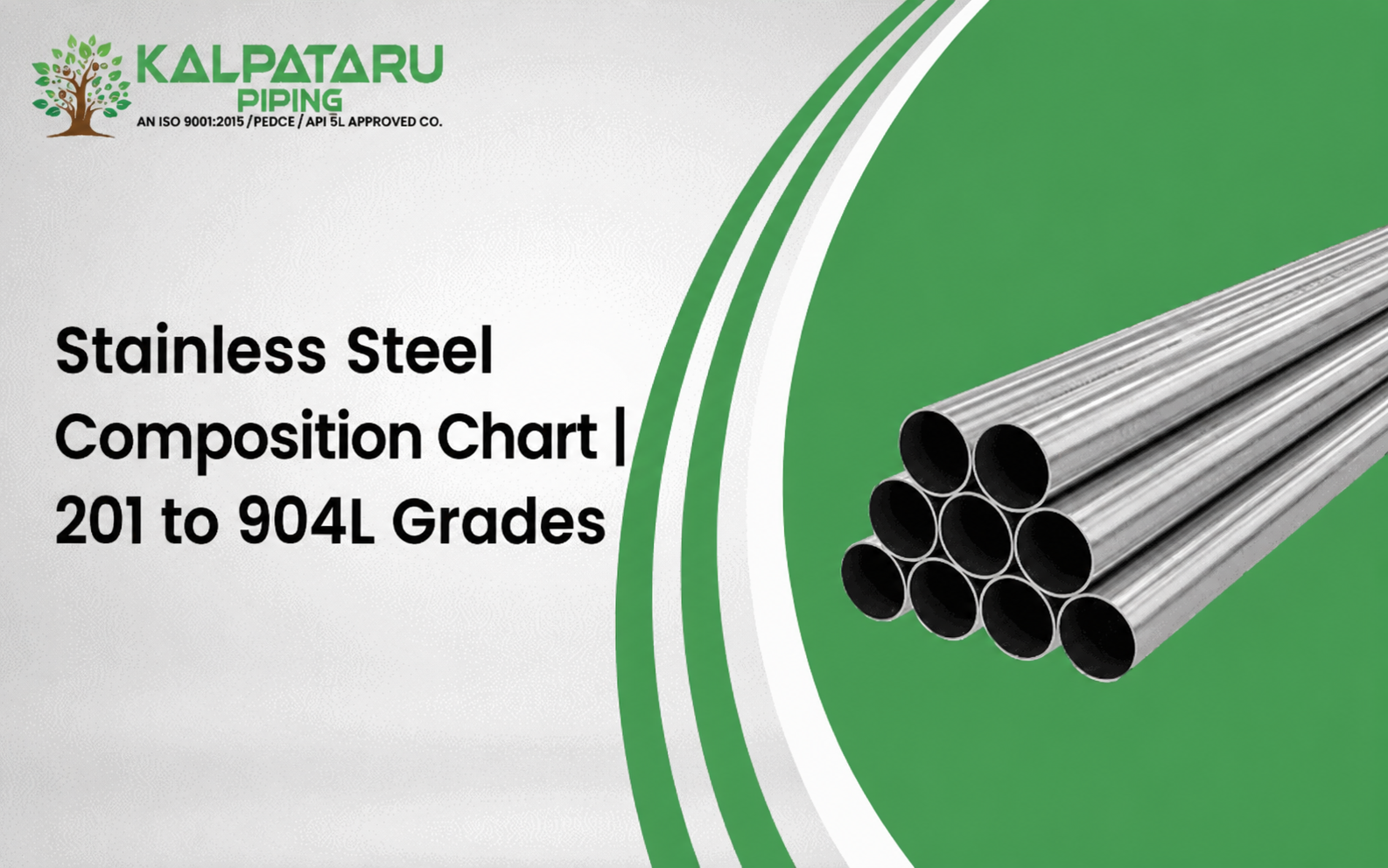
Selection of the right stainless steel grade begins with knowing its chemical composition. Different stainless steel grades have varying amounts of chromium, nickel, molybdenum, carbon, and other alloying elements that contribute to the material’s corrosive resistance, strength, and suitability to be welded in different applications. Even small variations in chemical composition could make one material fit for particular use while others do not. The Stainless Steel Composition Chart provides the standard chemical composition of the more popular stainless steel types such as 201, 304, 304L, 316, 316L, 310, 321, and 904L. This will facilitate comparison of materials and checking mill test certificates (MTCs). Kalpataru Piping is a supplier of high quality stainless steel pipe, tubes, fittings and flanges available in these grades of stainless steels.
Reading the Composition Chart Before You Order
Check the chemical composition of the selected stainless steel grade against the applicable specification, such as ASTM A240, before making the selection to determine if the material is suitable for the project. The range of values is used to express the composition of a material. The material is deemed to be compliant if it is within the range. Also note the UNS designation which is unique to each alloy, while the names 304, 18-8, and 316 are common terms used in the industry. To read the chart, first compare chromium and nickel levels -chromium and nickel are the factors that determine corrosion resistance and ductility. Check for molybdenum, which is included in the 316 series and the 904L, which offers greater chloride resistance. Lastly, check carbon for weldability and titanium for stabilized Grade 321 for high-temperature applications.
Stainless Steel Composition Chart: 201, 304, 304L, 316, 316L, 310, 321 & 904L
| Grade | UNS No | C max | Mn max | Si max | P max | S max | Cr | Ni | Mo | Others |
| 201 | S20100 | 0.15 | 5.5–7.5 | 1.00 | 0.060 | 0.030 | 16.0–18.0 | 3.5–5.5 | — | N 0.25 |
| 304 | S30400 | 0.08 | 2.00 | 0.75 | 0.045 | 0.030 | 18.0–20.0 | 8.0–10.5 | — | N 0.10 |
| 304L | S30403 | 0.030 | 2.00 | 0.75 | 0.045 | 0.030 | 18.0–20.0 | 8.0–12.0 | — | N 0.10 |
| 316 | S31600 | 0.08 | 2.00 | 0.75 | 0.045 | 0.030 | 16.0–18.0 | 10.0–14.0 | 2.00–3.00 | N 0.10 |
| 316L | S31603 | 0.030 | 2.00 | 0.75 | 0.045 | 0.030 | 16.0–18.0 | 10.0–14.0 | 2.00–3.00 | N 0.10 |
| 310 | S31000 | 0.25 | 2.00 | 1.50 | 0.045 | 0.030 | 24.0–26.0 | 19.0–22.0 | — | — |
| 321 | S32100 | 0.08 | 2.00 | 0.75 | 0.045 | 0.030 | 17.0–19.0 | 9.0–12.0 | — | Ti 5xC min–0.70; N 0.10 |
| 904L | N08904 | 0.020 | 2.00 | 1.00 | 0.045 | 0.035 | 19.0–23.0 | 23.0–28.0 | 4.00–5.00 | Cu 1.00–2.00; N 0.10 |
Grade by Grade: What Each Composition Means in Practice
201 Stainless Steel
Grade 201 (UNS S20100) is a cost-effective alternative to 304 stainless steel, developed by reducing nickel and increasing manganese and nitrogen. It contains 16.0–18.0% chromium, 3.5–5.5% nickel, and 5.5–7.5% manganese, providing good strength, formability, and moderate corrosion resistance. However, its lower nickel content makes it less resistant to chlorides and acidic environments than 304 or 316. Grade 201 is commonly used in kitchen equipment, decorative trim, appliances, and light structural stainless steel applications, where high corrosion resistance is not the primary requirement.
304 Stainless Steel
Grade 304 (UNS S30400) is the most widely used austenitic stainless steel due to its excellent balance of corrosion resistance, strength, and weldability. It contains 18.0–20.0% chromium and 8.0–10.5% nickel, making it suitable for a wide range of industrial and commercial applications. Carbon is limited to 0.08%, although prolonged welding can increase the risk of sensitization. Grade 304 is widely used for pipes, tubes, tanks, flanges & fittings, food processing equipment, and architectural structures exposed to mild or moderately corrosive environments.
304L Stainless Steel
Grade 304L (UNS S30403) is the low-carbon version of 304 stainless steel, with a maximum carbon content of 0.03%. This lower carbon level minimizes carbide precipitation during welding, reducing the risk of intergranular corrosion. Its chromium and nickel content remains nearly identical to standard 304, so corrosion resistance is maintained. Although its strength is slightly lower, 304L is the preferred choice for pressure vessels, storage tanks, welded piping systems, and fabricated equipment where extensive welding and long-term corrosion resistance are essential.
316 Stainless Steel
Grade 316 (UNS S31600) offers improved corrosion resistance over 304 by adding 2.0–3.0% molybdenum and increasing nickel to 10.0–14.0%. Chromium ranges from 16.0–18.0%, providing excellent resistance to pitting and crevice corrosion in chloride-rich environments. This makes 316 suitable for marine, offshore, pharmaceutical, food processing, and chemical industries. Its superior resistance to seawater, process chemicals, and de-icing salts makes it the preferred grade whenever standard 304 may not provide sufficient corrosion protection.
316L Stainless Steel
Grade 316L (UNS S31603) combines the corrosion resistance of 316 with a reduced carbon content of 0.03% maximum, improving weldability and preventing sensitization in welded areas. Chromium, nickel, and molybdenum levels remain almost the same as standard 316, ensuring excellent resistance to chlorides and aggressive chemicals. Because of its reliable performance after welding, 316L is commonly specified for marine structures, offshore equipment, pharmaceutical plants, 316L compared against 904L is typically specified by default rather than treated as an optional upgrade over standard 316 chemistry.
310 Stainless Steel
Grade 310 (UNS S31000) is designed for high-temperature service rather than chloride resistance. It contains 24.0–26.0% chromium and 19.0–22.0% nickel, giving outstanding resistance to oxidation and scaling at temperatures exceeding 1000°C. Higher silicon content further improves heat resistance, while carbon is maintained at about 0.25% to enhance creep strength. Grade 310 is widely used in industrial furnaces, heat treatment equipment, kilns, combustion chambers, and high-temperature processing systems, where conventional grades such as 304 or 316 cannot withstand prolonged heat exposure.
321 Stainless Steel
Grade 321 (UNS S32100) is a titanium-stabilized version of 304 stainless steel developed for high-temperature welded applications. It contains approximately 17.0–19.0% chromium, 9.0–12.0% nickel, and titanium, which prevents chromium carbide formation during welding. Unlike 304L, stabilization is achieved without significantly reducing carbon content. Grade 321 provides excellent resistance to intergranular corrosion after welding and performs well at elevated temperatures. It is commonly used in exhaust systems, aerospace components, heat exchangers, and process equipment operating between 425°C and 900°C.
904L Stainless Steel
Grade 904L (UNS N08904) is a high-alloy austenitic stainless steel developed for extremely corrosive environments. It contains 19.0–23.0% chromium, 23.0–28.0% nickel, 4.0–5.0% molybdenum, and 1.0–2.0% copper, providing outstanding resistance to chlorides, sulfuric acid, and phosphoric acid. Carbon is limited to 0.02%, further improving corrosion resistance after welding. Grade 904L is widely used in chemical processing plants, flue gas desulfurization systems, fertilizer production, seawater equipment, and offshore applications, where even 316L may not provide adequate long-term performance.
Common Mistakes to Avoid When Comparing Stainless Steel Grades
- Don’t assume 316 is always better than 304
Grade 316 offers better corrosion resistance only in chloride and marine environments. For general-purpose applications, 304 is often the more economical and suitable choice. - Don’t treat the “L” grades as weaker materials
The “L” suffix (304L, 316L) indicates low carbon content, which improves weldability and reduces the risk of intergranular corrosion after welding. - Don’t ignore the alloying elements
Elements listed under “Others” are important. For example, titanium gives 321 excellent high-temperature weld stability, while copper improves 904L resistance to strong acids. - Don’t choose only based on corrosion resistance
If your application requires higher strength along with corrosion resistance, a duplex stainless steel grade may be a better choice see our duplex stainless steel composition guide.
Final Thoughts
A composition chart is only useful if it changes what you actually order, so treat every percentage in this table as a decision point, not a reference to skim past. Chromium and nickel set the corrosion and ductility baseline, molybdenum decides whether chlorides will be a problem, carbon decides whether heavy welding will be safe, and elements like titanium or copper mark a grade built for a specific service condition. Whether the application calls for the economy of 201, the reliability of 304, the chloride resistance of 316 or 316L, the heat tolerance of 310, the weld stability of 321, or the acid resistance of 904L, matching chemistry to service environment against a proper dimension and composition reference is what keeps stainless steel living up to its name for the full design life of the equipment.
Frequently Asked Questions
What is the main chemical difference between 304 and 316 stainless steel?
A: The defining difference is molybdenum, present at 2.00 to 3.00 percent in 316 but absent from 304. This addition gives 316 meaningfully better resistance to pitting and crevice corrosion in chloride environments, while chromium and nickel levels remain broadly similar between the two grades.
Why does 904L contain copper when other austenitic grades do not?
A: Copper, added at roughly 1.00 to 2.00 percent in 904L, specifically improves resistance to sulfuric and phosphoric acid attack. Combined with high chromium, nickel, and molybdenum content, it makes 904L suited to acidic chemical processing environments that would corrode standard 316L unacceptably fast.
Is 316L stronger or weaker than standard 316?
A: 316L has a marginally lower minimum tensile and yield strength than standard 316 because of its reduced carbon content. In practice this difference rarely affects design, since 316L is chosen specifically for its superior weld zone corrosion resistance rather than for raw mechanical strength.
What does the "L" suffix mean in grades like 304L and 316L?
A: The “L” stands for low carbon, capped at 0.030 percent maximum instead of the standard 0.08 percent. Lower carbon slows chromium carbide precipitation at grain boundaries during welding, reducing the risk of intergranular corrosion in heavily welded assemblies.
Why is 201 cheaper than 304, and what is the tradeoff?
A: 201 substitutes manganese and nitrogen for a portion of the nickel used in 304, since nickel is the more expensive element. The tradeoff is weaker corrosion resistance in chloride or acidic conditions, which limits 201 to less demanding applications than 304 or 316.
Can 321 be substituted for 304L in welded applications?
A: Both address weld zone sensitization but through different mechanisms. 321 uses titanium stabilization, better suited to prolonged high temperature service, while 304L uses low carbon, better suited to room temperature or moderate temperature chloride free environments without sustained heat exposure.