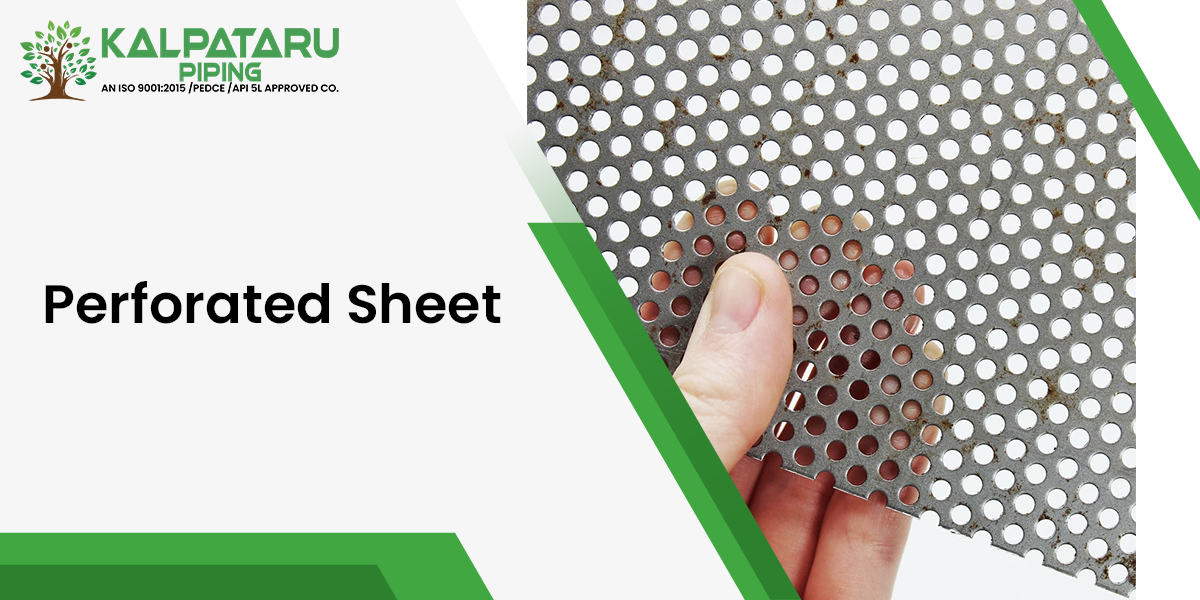
Perforated Sheet Manufacturer, Supplier & Exporter
A perforated sheet is a flat metal sheet that has been mechanically punched or stamped with a regular pattern of holes, slots, or decorative openings using CNC punching machines or press tooling. The resulting sheet combines structural integrity with controlled open area, enabling simultaneous passage of air, light, liquid, or sound while maintaining load-bearing strength. Perforated metal sheets differ from wire mesh and expanded metal in that each hole is precisely defined, making them ideal where consistent flow rates, acoustic performance, or visual aesthetics are required.
Kalpataru Piping manufactures and supplies perforated sheets in a wide range of materials, hole patterns, thicknesses, and open area percentages. Our carbon steel perforated sheets are suited for general industrial and filtration use, while our stainless steel perforated sheets provide corrosion resistance for food-grade, pharmaceutical, and marine environments. We also stock aluminium perforated sheets for lightweight architectural and HVAC applications, along with specialty alloy perforated sheets in Inconel 625, Hastelloy C-276, Monel, Incoloy 825, and Super Duplex Steel for demanding chemical and process plant applications.
Table of Contents
- Copper vs Brass Perforated Sheet
- Types of Perforated Sheets by Hole Pattern
- Types of Perforated Sheets by Material
- Specifications
- Hole Pattern Comparison Table
- Perforated Sheet Applications
- Sheet Thickness & Hole Size Reference
Copper vs Brass Perforated Sheet
These two get compared a lot, since they’re both copper-based and often used interchangeably on decorative work:
| Parameter | Copper Perforated Sheet | Brass Perforated Sheet |
| Composition | Pure copper (or copper alloy with minor additions) | Copper-zinc alloy |
| Conductivity | Higher thermal and electrical conductivity | Lower than pure copper |
| Colour / Finish | Warm red-gold, ages to green-brown patina | Bright yellow-gold, ages more slowly |
| Typical Use | Electrical screening, filtration, architectural cladding | Decorative panels, hardware, musical instruments |
| Cost | Generally higher | Generally lower |
Types of Perforated Sheets by Hole Pattern
|
Hole Pattern |
Shape |
Key Feature |
Typical Open Area |
Best Applications |
|---|---|---|---|---|
|
Round Hole |
Circular |
Most common; maximum open area achievable |
25-65% |
Filtration, sieving, ventilation, general industrial |
|
Square Hole |
Square |
Uniform coverage; clean aesthetic |
25-49% |
Screening, grain sorting, architectural panels |
|
Slotted Hole |
Elongated rectangle |
High flow in one direction |
30-55% |
Conveyors, drainage, coal & mineral screening |
|
Hexagonal Hole |
Six-sided |
Honeycomb structure; excellent strength-to-weight |
40-83% |
Acoustic panels, decorative facades, filtration |
|
Capsule / Oblong |
Rounded rectangle |
Smooth edge; reduces clogging |
30-50% |
Food processing, pharmaceutical, grain handling |
|
Decorative / Custom |
Various (stars, diamonds, logos) |
Aesthetic appeal; bespoke shapes |
Variable |
Architectural cladding, interior design, signage |
|
Micro Perforated |
Very small round holes (<1 mm) |
Sound absorption; precision filtration |
5-25% |
Acoustic ceilings, speaker grilles, HVAC silencers |
Pitch / Orientation Options:
- Triangular pitch (60 staggered): highest open area, best airflow and drainage
- Square pitch (90 straight): clean uniform pattern, good for screening and aesthetics
- 45 degree staggered: balanced open area and structural stiffness
- Straight line: easiest to clean; preferred for food and pharma applications
Types of Perforated Sheets by Material
|
Material |
Grade / Standard |
Thickness Range |
Key Property |
Industries |
|---|---|---|---|---|
|
Mild Steel (MS) |
IS 2062, ASTM A36, HR/CR |
0.8 – 12 mm |
Cost-effective; easy to weld and cut |
General engineering, construction, automotive |
|
Stainless Steel (SS) |
SS 304, 316, 316L, 321, 310S |
0.3 – 6 mm |
Corrosion resistant; hygienic surface |
Food, pharma, chemical, marine, architecture |
|
Aluminium |
AA 1050, 3003, 5052, 6061 |
0.5 – 6 mm |
Lightweight; non-magnetic; weather resistant |
HVAC, facades, transport, electrical enclosures |
|
Copper |
C11000, C12200 |
0.5 – 3 mm |
Antimicrobial; excellent conductivity |
EMI shielding, decorative, electrical |
|
Brass |
CW614N, C26000 |
0.5 – 3 mm |
Attractive golden finish; corrosion resistant |
Decorative panels, musical instruments, filtration |
|
Galvanised Iron (GI) |
IS 277, ASTM A653 |
0.5 – 4 mm |
Zinc-coated for outdoor use |
Construction, agriculture, poultry enclosures |
|
Inconel / Hastelloy / Monel |
625, C-276, 400 |
0.5 – 6 mm |
High-temp & chemical resistance |
Petrochemical, aerospace, deep-sea applications |
Perforated Sheet Technical Specification
|
Parameter |
Specification |
|---|---|
|
Hole Diameter |
0.5 mm to 50 mm (custom sizes available) |
|
Sheet Thickness |
0.3 mm to 12 mm |
|
Sheet Width |
Up to 2,500 mm |
|
Sheet Length |
Up to 6,000 mm (custom lengths on request) |
|
Pitch (Centre-to-Centre) |
1.0 mm to 100 mm (triangular or square) |
|
Open Area |
5% to 83% (depending on hole size, pitch, and pattern) |
|
Hole Orientation |
Straight (90 deg), 45 deg staggered, 60 deg staggered |
|
Standard Sheet Sizes |
1,000 x 2,000 mm; 1,220 x 2,440 mm; 1,500 x 3,000 mm |
|
Surface Finish |
Mill finish, galvanised, powder coated, anodised (aluminium), pickled & oiled |
|
Manufacturing Process |
CNC punching, hydraulic press punching |
|
Available Forms |
Flat sheets, cut-to-size panels, formed / bent sections |
|
Mill Test Certificate |
EN 10204 Type 3.1 (third-party 3.2 on request) |
|
Applicable Standards |
ASTM, IS 2062, DIN, BS, JIS |
|
Delivery Port |
Mumbai, Kandla, JNPT (India) |
Open Area Formula:
For round holes on triangular pitch: Open Area (%) = 90.7 x (D / P)^2
Where D = hole diameter (mm), P = pitch / centre-to-centre distance (mm)
Hole Pattern Comparison Table
|
Hole Pattern |
Pitch Type |
Max Open Area |
Flow Efficiency |
Structural Strength |
Best For |
|---|---|---|---|---|---|
|
Round – Triangular pitch |
60 deg staggered |
Up to 83% |
Excellent |
Good |
Filtration, drainage, ventilation |
|
Round – Square pitch |
90 deg straight |
Up to 65% |
Good |
Better |
Screening, acoustic panels |
|
Square – Square pitch |
90 deg straight |
Up to 49% |
Moderate |
Excellent |
Heavy screening, architecture |
|
Hexagonal – Triangular |
60 deg staggered |
Up to 83% |
Excellent |
Very Good |
Acoustic, decorative, lightweight screens |
|
Slotted – Straight line |
0 deg straight |
Up to 55% |
High (directional) |
Good |
Conveyors, grain handling, drainage |
|
Capsule – Staggered |
60 deg staggered |
Up to 50% |
Good |
Good |
Food, pharma, cleanable surfaces |
|
Micro Round – Triangular |
60 deg staggered |
5 – 25% |
Moderate |
Very Good |
Sound absorption, precision filtration |
Perforated Sheet Applications
|
Industry |
Application |
Recommended Pattern |
Material |
|---|---|---|---|
|
Filtration & Separation |
Liquid / gas filters, strainer baskets, basket strainers |
Round – triangular pitch |
SS 316L, Hastelloy C-276 |
|
Chemical & Petrochemical |
Reactor internals, catalyst support trays, column packing supports |
Round / slotted |
SS 316L, Inconel 625, Monel |
|
Food Processing & Pharma |
Sieves, conveyor belts, washing drums, tablet coating drums |
Capsule / round |
SS 304, SS 316L |
|
Architecture & Interior Design |
Facade cladding, sunscreens, balustrades, ceiling tiles |
Round / hexagonal / decorative |
Aluminium, SS 304 |
|
HVAC & Acoustics |
Return air grilles, silencer baffles, acoustic ceiling panels |
Round / micro perforated |
Aluminium, GI, MS |
|
Automotive & Transport |
Engine guards, speaker grilles, cabin air filters, body panels |
Round / slotted |
Aluminium, MS |
|
Mining & Aggregate |
Vibrating screens, coal preparation, quarry sieving |
Slotted / square – heavy gauge |
MS, Wear-resistant steel |
|
Agriculture & Aquaculture |
Grain separators, seed sorters, fish cage panels |
Round / square |
GI, SS 304 |
|
Construction & Infrastructure |
Safety fencing, anti-slip walkway gratings, soil erosion control |
Square / slotted |
MS, GI |
|
Power & Energy |
Turbine inlet screens, cooling tower fills, boiler internals |
Round / slotted |
SS 316, Inconel 601 |
Sheet Thickness & Hole Size Reference
A rough guide to matching thickness and hole size to the application:
|
Application |
Typical Thickness |
Typical Hole Size |
|
Acoustic panels / sound control |
0.5mm – 1.5mm |
1mm – 5mm |
|
Architectural cladding / screens |
1mm – 3mm |
5mm – 20mm |
|
Filtration / sieving |
0.4mm – 2mm |
0.4mm – 5mm |
|
Electrical / RF screening |
0.5mm – 2mm |
1mm – 10mm |
|
Heavy-duty guards / grilles |
3mm – 10mm |
10mm – 100mm |
Manufacturing Process & Quality Control
Kalpataru Piping manufactures perforated sheets through a tightly controlled six-stage CNC punching process:
- Raw Material Procurement & Incoming Inspection: Parent coils and flat sheets are sourced from certified mills and inspected for thickness, hardness, surface condition, and chemical composition before entering production. Every heat is documented and traceable to its mill test certificate.
- Sheet Levelling & Preparation: Coil material passes through a precision roller leveller to remove coil set and achieve flatness within ASTM A480 tolerances. Flat sheets are de-stacked, checked for surface defects, and staged for punching.
- CNC Turret Punching: Sheets are loaded onto CNC turret punch presses programmed with the exact hole pattern, diameter, pitch, and orientation specified by the customer. Servo-controlled axes deliver hole position accuracy of +/- 0.1 mm and consistent punch-to-die clearance for burr-free holes.
- Deburring & Edge Treatment: After punching, sheets pass through a rotary deburring machine to remove any micro-burrs from hole edges. Sheet edges are sheared square and deburred to eliminate sharp corners and ensure safe handling.
- Surface Treatment (as specified): Sheets requiring a finish are sent through the relevant process – hot-dip galvanising, powder coating, anodising (aluminium), electro-polishing (SS), or pickling and passivation. Each finish is applied after punching to preserve hole geometry.
- Dimensional Inspection & Documentation: A final quality check verifies hole diameter (sample gauging), pitch, open area, sheet flatness, and surface finish against the purchase order and drawings. An EN 10204 Type 3.1 mill test certificate is generated for every shipment, confirming chemical composition, mechanical properties, and dimensional compliance.
Certifications & Documentation
Kalpataru Piping operates under a robust quality management system and supplies perforated sheets with complete material traceability documentation:
|
Certification / Standard |
Scope |
|---|---|
|
ISO 9001:2015 |
Quality management system for manufacturing and supply |
|
EN 10204 Type 3.1 MTC |
Material test certificate with chemical & mechanical data per heat |
|
ASTM A480 |
General requirements for flat-rolled stainless and heat-resisting steel |
|
ASTM A36 / A283 / A1011 |
Carbon and low-alloy steel flat sheet standards |
|
IS 2062 |
Indian standard for hot-rolled medium and high tensile structural steel |
|
IS 277 |
Indian standard for galvanised steel sheets and coils |
|
DIN 24041 / ISO 9044 |
Perforated plate / perforated sheet dimensional standards |
|
NACE MR0175 / ISO 15156 |
Sour service compliance for H2S environments (on request) |
|
PED 2014/68/EU |
Pressure Equipment Directive compliance for pressure boundary applications |
Documentation Package (supplied with every order):
- EN 10204 Type 3.1 Mill Test Certificate
- Dimensional Inspection Report
- Hole gauge and open area verification sheet
- Packing list and country of origin certificate
- Third-party inspection reports (SGS, Bureau Veritas, TUV – on request)
FAQ’s About Perforated Sheet
What are the uses of perforated sheets?
Perforated sheets are widely used for filtration, screening, ventilation, acoustic panels, machine guards, partitions, ceilings, and architectural applications. They are available in different materials, hole sizes, and patterns.
What is the thickness of a perforated sheet?
Perforated sheets are commonly available in thicknesses from 0.5 mm to 12 mm, depending on the material and application. Custom thicknesses can also be supplied as per requirements.
What are the standard sizes of perforated sheets?
Common sizes include 1000 × 2000 mm, 1220 × 2440 mm, 1250 × 2500 mm, and 1500 × 3000 mm. Custom sizes can be manufactured according to project requirements.
What is the weight of perforated sheets?
The weight depends on the material, thickness, dimensions, hole diameter, pitch, and open area. Perforated sheets generally weigh less than solid sheets of the same size and thickness.
What is the difference between perforated and non-perforated sheets?
Perforated sheets contain regularly spaced holes that allow air, light, liquids, or sound to pass through. Non-perforated sheets have a solid surface and provide continuous coverage and containment.