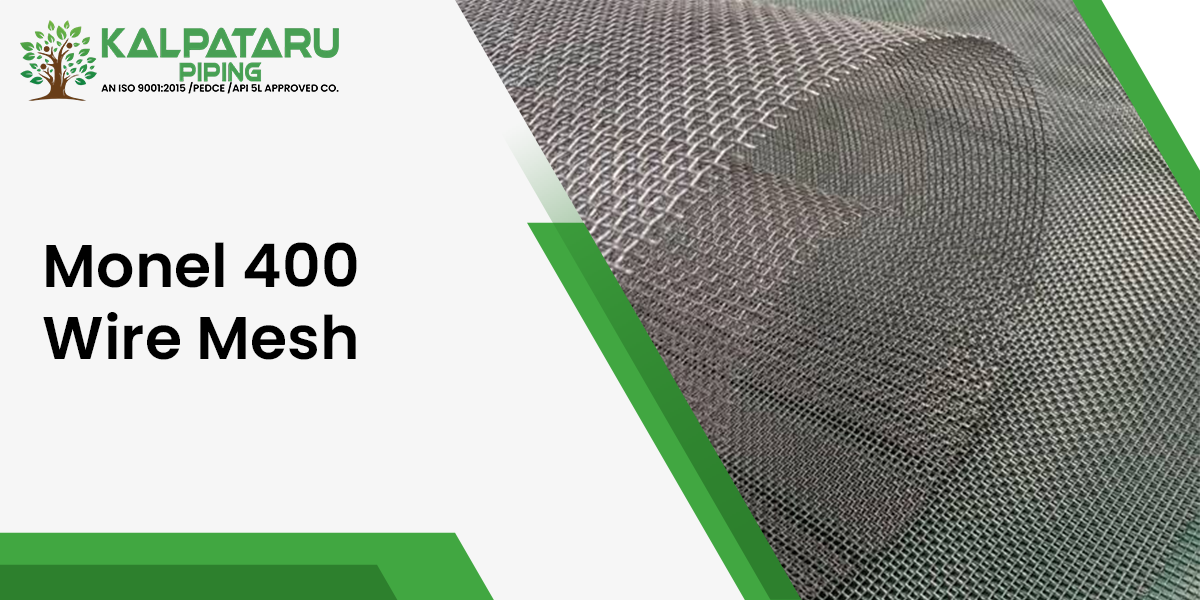
We get asked about Monel 400 wire mesh constantly, usually by someone who’s already had a stainless mesh fail on them in a chloride or acid environment. Monel 400 (UNS N04400, WNR 2.4360) is a nickel-copper alloy that keeps working where standard 300-series stainless can’t — seawater, hydrofluoric acid, alkaline solutions, the works. At Kalpataru Piping, we weave and weld this mesh in-house, in counts from a coarse 3 mesh down to a very fine 400 mesh, with wire diameters between 0.05 mm and 15 mm. You can order it in Plain, Twill, Dutch, Twilled Dutch, Five Heddle, or Herringbone weave, depending on what you’re screening or filtering. Every roll leaves our facility with an EN 10204 3.1/3.2 mill test certificate, and most orders go through flexure, compression, and bubble point testing before they’re packed. And if you’re already sourcing Monel 400 pipes and tubes or fittings from us for the rest of the system, this mesh is built to the same UNS N04400 spec, so it slots in without any grade-mismatch headaches.
What Is Monel 400 Wire Mesh?
Monel is technically a trade name — Special Metals originally registered it — but in practice “Monel 400” and “Alloy 400” get used interchangeably, and that’s the material this mesh is woven or welded from. It’s a solid-solution alloy, meaning the nickel and copper are fully dissolved into one another rather than layered or plated on, which is a big part of why it doesn’t lose its corrosion resistance after cutting, welding, or years of abrasion. Compared with stainless mesh, it simply keeps performing in reducing acids, seawater, and hydrofluoric acid service — the exact conditions that chew through 304 or 316 stainless within months.
If your project also needs the wire itself in bar or filler form, our Monel 400 round bars & wires and Monel 400 filler wire pages cover the same UNS N04400 grade
- Specifications
- Chemical Composition (%)
- Available Weave Types
- Sample Mesh Count vs Wire Diameter (Plain Weave)
Monel 400 Wire Mesh Technical Specifications
| Property | Details |
|---|---|
| Material | Monel 400 (Alloy 400 / Nickel Alloy 400) |
| Standard | ASTM E2016-11, ASME SB164 / SB127, UNS N04400, WNR 2.4360 |
| Mesh Count | 3 to 400 mesh |
| Wire Diameter | 0.05 mm – 15 mm |
| Opening Size | 0.05 mm – 30 mm |
| Construction | Woven / Welded |
| Weave Types | Plain, Twill, Dutch, Twilled Dutch, Five Heddle, Herringbone, Reverse Dutch |
| Crimp Style | Lock Crimp, Double Crimp, Intercrimp, Flat Top |
| Finish | Mill Finish / PTFE Coating (on request) |
| Roll Width | Up to 2 metres (custom widths on request) |
| Density | 8.80 g/cm³ |
| Melting Range | 2370 – 2460°F (1300 – 1350°C) |
| Max Operating Temperature | Up to 1000°F |
| Testing | Flexure, Compressive & Bubble Point Tests |
| Certification | EN 10204 3.1 / 3.2 Mill Test Certificate |
| Origin of Raw Material | Indian, Japanese, European |
| Packaging | Wooden Box / HDPE Bag / Paper Tube |
Chemical Composition of Monel 400 Wire Mesh
|
Element |
Content (%) |
|
Nickel (Ni) |
63.00 min |
|
Copper (Cu) |
28.00 – 34.00 |
|
Iron (Fe) |
2.50 max |
|
Manganese (Mn) |
2.00 max |
|
Silicon (Si) |
0.50 max |
|
Carbon (C) |
0.30 max |
|
Sulphur (S) |
0.024 max |
Available Weave Types
|
Weave Type |
Best Suited For |
|---|---|
|
Plain Weave |
General filtration, screening, and industrial straining |
|
Twill Weave |
Fine filtration where wire diameter exceeds opening size |
|
Dutch Weave |
High-precision liquid/gas filtration with directional flow control |
|
Twilled Dutch Weave |
Ultra-fine filtration in high-pressure, high-particulate service |
|
Five Heddle Weave |
Heavy-duty vibrating screens and mining/aggregate screening |
|
Herringbone Weave |
Wide-opening, high-strength screening for coarse material separation |
|
Reverse Dutch Weave |
Maximum mechanical strength combined with fine retention |
Sample Mesh Count vs Wire Diameter (Plain Weave)
|
Mesh |
Opening (mm) |
Wire Diameter (mm) |
|---|---|---|
|
4 |
5.15 |
1.20 |
|
10 |
2.03 |
0.51 |
|
20 |
0.96 |
0.32 |
|
40 |
0.44 |
0.19 |
|
80 |
0.20 |
0.12 |
|
150 |
0.10 |
0.066 |
|
250 |
0.061 |
0.041 |
|
400 |
0.039 |
0.025 |
Note: full mesh-to-wire-diameter charts (3–400 mesh) should be published as a downloadable PDF/CSV to also capture ‘monel 400 mesh size chart’ long-tail searches without bloating on-page load time.
Monel 400 Wire Mesh Applications & Industries
Where this mesh actually ends up varies a lot, but a few industries account for most of our orders:
- Chemical & Petrochemical Processing: filtration baskets, reactor internals, and strainers that spend their working life in acids and solvents that would eat through stainless in months. Pair it with our Monel 400 buttweld fittings and Monel compression tube fittings for a fully matched system.
- Marine & Shipbuilding: demisters, seawater strainers, and underwater hardware that sits in salt water permanently — this is the classic Monel 400 use case.
- Oil & Gas / Hydrocarbon Processing: crude distillation and refining towers that see corrosive sour gas and hydrocarbon streams day in, day out.
- Boiler Feedwater & Power Plants: feedwater screens and fuel-tank filtration in hot condensate and steam service. Our Monel instrumentation valves and Monel pipe spools are commonly specified alongside this mesh in boiler rooms.
- Aerospace Engineering: components where thermal stability and corrosion resistance both matter, and there’s no room for a material that only does one of the two.
- Pulp, Paper & Mining: vibrating screens and pulp washers that need to survive constant abrasion on top of chloride exposure.
- Industrial Heat Exchangers: support grids, screens, and internals exposed to hot, corrosive process fluid.
Monel 400 vs Stainless Steel vs Hastelloy Wire Mesh
If you’re trying to decide between Monel 400 and something else, it usually comes down to this: stainless mesh is cheaper and fine for general-purpose work, Monel 400 earns its cost the moment chlorides or acids enter the picture, and Hastelloy takes over once you’re dealing with something even Monel can’t handle. Here’s how they stack up side by side.
|
Parameter |
Monel 400 Wire Mesh |
Stainless Steel 316 Wire Mesh |
Hastelloy C276 Wire Mesh |
|---|---|---|---|
|
Base Composition |
Ni-Cu alloy (63% Ni min) |
Fe-Cr-Ni alloy |
Ni-Mo-Cr alloy |
|
Seawater / Chloride Resistance |
Excellent |
Moderate (pitting risk) |
Excellent |
|
Acid Resistance |
Very good (HF acid, alkalis) |
Limited in reducing acids |
Excellent (oxidizing & reducing) |
|
Max Service Temperature |
~1000°F |
~1500°F (oxidizing only) |
~2000°F |
|
Relative Cost |
Moderate-High |
Low |
Very High |
|
Typical Use Case |
Marine, HF acid, chemical processing |
General industrial filtration |
Extreme chemical/high-temp corrosion |
For a straight stainless option, see our stainless steel wire mesh range; for extreme chemical service beyond what Monel can handle, our Hastelloy wire mesh page has the full spec.
Manufacturing Process & Quality Control
Nothing about this mesh is generic. We start with certified Monel 400 wire rod from mills in India, Japan, and Europe, then draw it down to the exact diameter your mesh count calls for — there’s no shortcut here, since wire diameter is what actually determines opening size and mesh strength. From there it’s either woven on our looms or welded into panels, depending on the construction you need, and crimped — lock, double, intercrimp, or flat-top — to hold its shape under load.
Before anything gets packed, it goes through flexure, compressive, and bubble point testing, and we issue EN 10204 3.1/3.2 certificates along with NABL test reports and a quality assurance plan for every order. For export, that means wooden box packaging; for domestic delivery, HDPE bags or paper tube. Either way, it’s built to arrive exactly the way it left our facility.
Standards & Certifications
Here’s what we build to, so you can check it against your own spec sheet before you order:
|
Standard / Certificate |
Applicability |
|---|---|
|
ASTM E2016-11 |
Standard specification for industrial woven wire cloth |
|
ASME SB164 / SB127 |
Nickel-copper alloy rod, bar & plate feedstock standards |
|
UNS N04400 |
Unified Numbering System designation for Monel 400 |
|
WNR 2.4360 / DIN |
Werkstoff (material) number used in European specifications |
|
EN 10204 3.1 / 3.2 |
Mill test certificate / third-party inspection certification |
|
ISO 9001:2015 |
Quality management system certification |
Related Products
FAQ’s About ASTM A106 Grade B Pipes
What is ASTM A106 Grade B pipe?
ASTM A106/A106M Grade B is a seamless carbon steel pipe specification intended for high-temperature service. The exact project suitability depends on the governing piping code, design conditions and purchase specification.
What is the difference between ASTM A106 Grade B and ASTM A53 Grade B?
ASTM A106 Grade B is a seamless high-temperature-service pipe specification. ASTM A53 Grade B covers welded and seamless pipe for mechanical and pressure applications and ordinary steam, water, gas and air service. Select the specification required by the project and design code.
What sizes does Kalpataru supply?
The current brief lists a Kalpataru supply range of 1/2 to 36 in NPS and Schedule 10 to XXS, subject to size and availability. ASTM A106/A106M itself has a wider standard scope.
What is the maximum temperature of ASTM A106 Grade B pipe?
Do not use one universal maximum temperature from the ASTM material specification. Allowable service depends on the design code, pressure, wall thickness, allowable stress and project conditions.
Is ASTM A106 Grade B seamless or welded?
ASTM A106/A106M is a seamless carbon steel pipe specification. Do not describe ERW, LSAW or other welded pipe as ASTM A106 product construction.
What tests are required for ASTM A106 Grade B pipe?
The specification includes mechanical testing and bend/flattening testing as applicable, together with hydrostatic and/or nondestructive electric testing requirements. The exact inspection package should match the current ASTM edition and purchase order.
What documents can be supplied?
Orders can be supplied with EN 10204 3.1 MTC and, where applicable and agreed, IBR documentation, third-party inspection and project-specific test reports.
How is ASTM A106 Grade B pipe priced?
Price depends on NPS, schedule or wall thickness, length, quantity, origin/mill, testing/certification, coating/end preparation and delivery destination. Send the full requirement for a size-wise quotation.
Need Monel 400 Wire Mesh You Can Actually Rely On?
Tell us your mesh count, weave, and quantity, and we'll get you a quote with a real lead time — not a generic price list. Specifying a full system? Run the numbers first with our pipe & tube weight calculator or plates & sheets weight calculator.