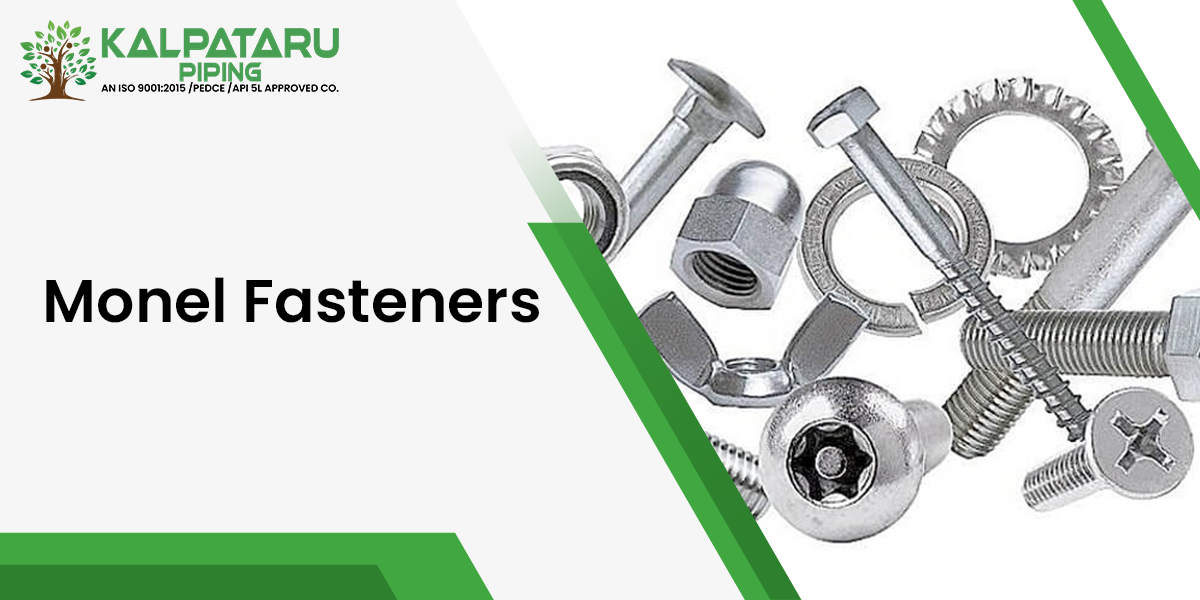
“Monel fasteners” almost always means one of two things in practice: standard Monel 400, or the age-hardened Monel K500. Both are nickel-copper alloys that keep their strength and corrosion resistance in seawater, brine, and acidic environments that would eat through a stainless bolt within a few years — which is exactly why they show up so often in marine, chemical, and offshore equipment. At Kalpataru Piping, we manufacture both grades in-house as bolts, nuts, studs, washers, and screws, to ASTM F467/F468 and equivalent DIN 2.4360 standards, with zero MOQ and most common sizes ex-stock in Mumbai. If you already know which grade you need, head straight to our Monel 400 fasteners or Monel K500 fasteners page for full specifications, dimensions, and pricing. If you’re not sure yet, the grade guide below will get you there in under a minute.
Which Monel Grade Do You Need? (Grade Selector)
This is the most important block on the page — it’s what turns a generic visitor into someone on the right spoke page. Most people land here without knowing there are two grades, so answer it plainly:
| Property | Monel 400 (UNS N04400) | Monel K500 (UNS N05500) |
|---|---|---|
| Tensile Strength | 517 – 620 MPa | 900 – 1100 MPa (age-hardened) |
| Relative Cost | Lower | 30–50% higher |
| Best For | General corrosion resistance — chemical, marine, acid service, flanged joints | High-load and wear applications — marine shafting, pump components, valve stems |
| Learn More | See full Monel 400 Fasteners specs | See full Monel K500 Fasteners specs |
Full dimensional charts, chemical composition, mechanical properties, and pricing for each grade live on their dedicated pages: Monel 400 Fasteners and Monel K500 Fasteners. If you’re still not sure which one your application needs, tell our technical team the service conditions and load requirements and we’ll tell you honestly which grade fits.
What Are Monel Fasteners?
Monel is a family of nickel-copper alloys — Monel 400 is the workhorse grade, and Monel K500 is the same base chemistry with aluminum and titanium additions that let it be age-hardened for roughly double the tensile strength. Both are difficult to machine compared to steel, since the alloy work-hardens quickly, which is why they need to be cut and turned at slower speeds with the right tooling — it’s part of why these fasteners cost more than stainless, and part of why a manufacturer who’s actually set up for nickel alloys (rather than treating them like steel with a different name) makes a real difference to the finished part.
Monel Fasteners Technical Specifications
All Monel fasteners supplied by Kalpataru Piping Solutions conform to ASTM B865-04 / ASME SB865-04 (Monel K500 rod, bar, wire) and ASTM B164 / ASME SB164 (Monel 400 rod, bar, wire) as the base material standards, with final dimensional tolerances to the relevant ASME B18 / DIN / ISO standards listed below.
| Parameter | Monel 400 Fasteners | Monel K500 Fasteners |
|---|---|---|
| UNS Number | N04400 | N05500 |
| Werkstoff Nr. | 2.4360 | 2.4375 |
| Applicable ASTM | B164 / ASME SB164 | B865 / ASME SB865 |
| Density | 8.80 g/cm³ | 8.44 g/cm³ |
| Melting Range | 1300–1350 °C (2372–2462 °F) | 1315–1350 °C (2399–2462 °F) |
| Max Service Temp. | 482 °C (900 °F) continuous | 482 °C (900 °F) continuous |
| Magnetic Permeability | Slightly ferromagnetic | Non-magnetic (age-hardened) |
| Thread Forms | UNC, UNF, METRIC, BSW, BSF | UNC, UNF, METRIC, BSW, BSF |
| Size Range (inch) | 1/4″ to 3″ | 1/4″ to 2″ |
| Size Range (metric) | M6 to M64 | M6 to M52 |
| Length Range | 3 mm to 500 mm | 3 mm to 500 mm |
| Tolerance Class | 6g (external) / 6H (internal) | 6g (external) / 6H (internal) |
| Surface Finish | Bright, black oxide, passivated | Bright, black oxide, passivated |
| Head Marking | “M400” / “MK500” | “M400” / “MK500” |
| Test Certificate | EN 10204 Type 3.1 MTC | EN 10204 Type 3.1 MTC |
Dimensional Standards Reference
| Standard | Covers |
|---|---|
| ASME B18.2.1 | Heavy hex bolts, square bolts (inch series) |
| ASME B18.2.2 | Heavy hex nuts (inch series) |
| ASME B18.31.2 | Stud bolts for pressure piping flanges |
| DIN 931 / DIN 933 | Hex bolts partial-thread / full-thread (metric) |
| DIN 934 | Hex nuts (metric) |
| ISO 4014 / ISO 4017 | Hex bolts partial / full thread |
| ISO 4032 / ISO 4033 | Hex nuts style 1 / style 2 |
| BS 1768 | Unified precision hex bolts and nuts |
Our Monel flanges and Monel wire mesh are also available for complete system supply.
Typical Chemical Composition (Monel Family)
| Element | Content (%) |
|---|---|
| Nickel (Ni) + Cobalt | 63.00 min |
| Copper (Cu) | 28.00 – 34.00 |
| Iron (Fe) | 2.50 max |
| Manganese (Mn) | 2.00 max |
| Silicon (Si) | 0.50 max |
| Carbon (C) | 0.30 max |
| Sulphur (S) | 0.024 max |
Monel K500 carries the same base composition plus small, controlled additions of aluminum and titanium for age hardening — see the K500 page for the exact figures.
Mechanical Properties of Monel Fasteners
Monel 400 fasteners are supplied in the annealed condition; Monel K500 fasteners are available in both annealed and age-hardened (precipitation-hardened) conditions. Age-hardening significantly raises yield and tensile strength, making K500 the preferred choice for high-stress applications such as pump shafts, propeller shafts, and subsea fasteners.
|
Property |
Monel 400 (Annealed) |
Monel K500 (Annealed) |
Monel K500 (Age-Hardened) |
|---|---|---|---|
|
Tensile Strength |
517–620 MPa (75–90 ksi) |
689–827 MPa (100–120 ksi) |
965–1035 MPa (140–150 ksi) |
|
0.2% Yield Strength |
172–345 MPa (25–50 ksi) |
276–414 MPa (40–60 ksi) |
690–790 MPa (100–115 ksi) |
|
Elongation (in 50 mm) |
35–45% |
30–40% |
20–25% |
|
Hardness (Brinell) |
100–160 HB |
130–180 HB |
270–330 HB |
|
Modulus of Elasticity |
179 GPa (26 × 10³ ksi) |
179 GPa (26 × 10³ ksi) |
179 GPa (26 × 10³ ksi) |
|
Poisson’s Ratio |
0.32 |
0.32 |
0.32 |
|
Impact Strength (Charpy) |
≥60 J at −40 °C |
≥45 J at −40 °C |
≥30 J at −40 °C |
|
Proof Load (bolt class) |
Per ASTM F468 |
Per ASTM F468 |
Per ASTM F468 |
Cryogenic and Elevated Temperature Performance
Monel 400 retains good toughness down to −196 °C (liquid nitrogen temperature), making it suitable for LNG and cryogenic service without the need for post-weld heat treatment. At elevated temperatures, both grades maintain useful mechanical properties up to approximately 482 °C, beyond which Inconel grades such as those used in our Inconel 625 fasteners and Inconel 601 fasteners are recommended.
Monel Fasteners Equivalent Grades & Cross-Reference
Different national and international standards designate the same Monel alloy under different names. The table below helps engineers, procurement teams, and inspection agencies confirm material equivalence across specifications.
|
Standard Body |
Monel 400 Designation |
Monel K500 Designation |
|---|---|---|
|
UNS (USA) |
N04400 |
N05500 |
|
ASTM / ASME |
B164 / SB164 |
B865 / SB865 |
|
DIN / EN (Europe) |
2.4360 |
2.4375 |
|
BS (UK) |
NA 13 |
NA 18 |
|
AFNOR (France) |
NW 4400 |
NW 5500 |
|
JIS (Japan) |
NW 4400 |
NW 5500 |
|
GOST (Russia) |
МН䅬28-2.5 |
МН䅬28-2.5 Al |
|
ISO |
NW4400 |
NW5500 |
|
Trade Name |
Monel 400® |
Monel K500® |
Note: “Monel” is a registered trademark of Special Metals Corporation. Equivalent alloys from other producers may carry names such as Nicrofer 4228, Alloy 400, or Alloy K500.
Types of Monel Fasteners
Fastener Types We Manufacture
Across both grades, we produce the full standard range plus custom and coated options:
- Bolts — hex bolts, heavy hex bolts, stud bolts
- Nuts — hex nuts, heavy hex nuts, lock nuts, nyloc nuts, wing nuts, coupling nuts
- Screws — machine screws, socket head cap screws, self-tapping and self-drilling screws
- Washers — flat washers, spring/lock washers, structural washers
- Threaded rods and U-bolts
- Custom and coated fasteners — special head marking, thread locking, or surface finish on request
For exact sizes, ASME B16.5 stud bolt dimension charts, and DIN/ISO cross-reference tables, see the Monel 400 Fasteners specification tables — the dimensional standards are the same across both grades.
Applications & Industries
- Chemical & Petrochemical Processing: bolting and hardware for equipment handling acids and solvents that would degrade stainless fasteners within a few years.
- Oil & Gas: wellhead, subsea, and topside fastening that needs to meet NACE MR0175 / ISO 15156 sour-service requirements.
- Marine & Shipbuilding: the classic Monel use case — seawater piping, deck hardware, and propulsion system fasteners that stay in salt water permanently.
- Defense & Aerospace: corrosion-critical fastening where failure isn’t an option and stainless doesn’t meet spec.
- Building & Construction (specialty use): architectural and structural hardware in coastal or high-corrosion environments, where standard fasteners won’t last the design life of the structure.
Packaging, Payment & Delivery
The practical questions procurement teams actually ask before placing an order:
| Detail | Information |
|---|---|
| Payment Modes | LC (Letter of Credit), TT (Telegraphic Transfer / Wire Transfer), Cheque, and other terms on request |
| Packaging | Export-grade packaging appropriate to order size and destination; packaging charges quoted separately where applicable |
| Port of Dispatch | Mumbai or Kalamboli ports, Maharashtra, India |
| Documentation | EN 10204 3.1 mill test certificate standard with every order; PMI, TPI, and NABL lab reports on request |
| Taxes | GST applicable per current Indian tax regulations for domestic orders |
Why Choose Kalpataru Piping
Plenty of suppliers list Monel fasteners on a catalog page without actually machining nickel alloys in-house — and it usually shows up as longer lead times or inconsistent quality. We forge and CNC machine both grades ourselves, keep common sizes ex-stock in Mumbai, and hold ISO 9001:2015, PED 2014/68/EU, and EIL approval. For the full picture of how we operate, see our About Us page.
- Zero MOQ across both grades — single pieces to bulk export
- In-house forging and CNC machining, not outsourced
- Complete documentation — EN 10204 3.1 MTC, PMI, TPI, and NABL reports
- Export experience across the Middle East, Europe, Africa, and Southeast Asia
- A technical team that helps you pick the right grade, not just process the order
Certifications & Approvals
|
Certification |
What It Covers |
|---|---|
|
ISO 9001:2015 |
Quality management system across manufacturing, inspection, and dispatch |
|
PED 2014/68/EU |
Pressure Equipment Directive compliance for EU pressure-system supply |
|
EIL Approved Manufacturer |
Pre-qualification for refinery and petrochemical project procurement in India |
|
NACE MR0175 / ISO 15156 |
Sour-service qualification for oil & gas, wellhead, and subsea applications |
|
EN 10204 3.1 MTC |
Third-party witnessed material test certificate, standard with every shipment |
Related Products
FAQ’s About ASTM A106 Grade B Pipes
What is ASTM A106 Grade B pipe?
ASTM A106/A106M Grade B is a seamless carbon steel pipe specification intended for high-temperature service. The exact project suitability depends on the governing piping code, design conditions and purchase specification.
What is the difference between ASTM A106 Grade B and ASTM A53 Grade B?
ASTM A106 Grade B is a seamless high-temperature-service pipe specification. ASTM A53 Grade B covers welded and seamless pipe for mechanical and pressure applications and ordinary steam, water, gas and air service. Select the specification required by the project and design code.
What sizes does Kalpataru supply?
The current brief lists a Kalpataru supply range of 1/2 to 36 in NPS and Schedule 10 to XXS, subject to size and availability. ASTM A106/A106M itself has a wider standard scope.
What is the maximum temperature of ASTM A106 Grade B pipe?
Do not use one universal maximum temperature from the ASTM material specification. Allowable service depends on the design code, pressure, wall thickness, allowable stress and project conditions.
Is ASTM A106 Grade B seamless or welded?
ASTM A106/A106M is a seamless carbon steel pipe specification. Do not describe ERW, LSAW or other welded pipe as ASTM A106 product construction.
What tests are required for ASTM A106 Grade B pipe?
The specification includes mechanical testing and bend/flattening testing as applicable, together with hydrostatic and/or nondestructive electric testing requirements. The exact inspection package should match the current ASTM edition and purchase order.
What documents can be supplied?
Orders can be supplied with EN 10204 3.1 MTC and, where applicable and agreed, IBR documentation, third-party inspection and project-specific test reports.
How is ASTM A106 Grade B pipe priced?
Price depends on NPS, schedule or wall thickness, length, quantity, origin/mill, testing/certification, coating/end preparation and delivery destination. Send the full requirement for a size-wise quotation.
Need Monel 400 Wire Mesh You Can Actually Rely On?
Tell us your mesh count, weave, and quantity, and we'll get you a quote with a real lead time — not a generic price list. Specifying a full system? Run the numbers first with our pipe & tube weight calculator or plates & sheets weight calculator.