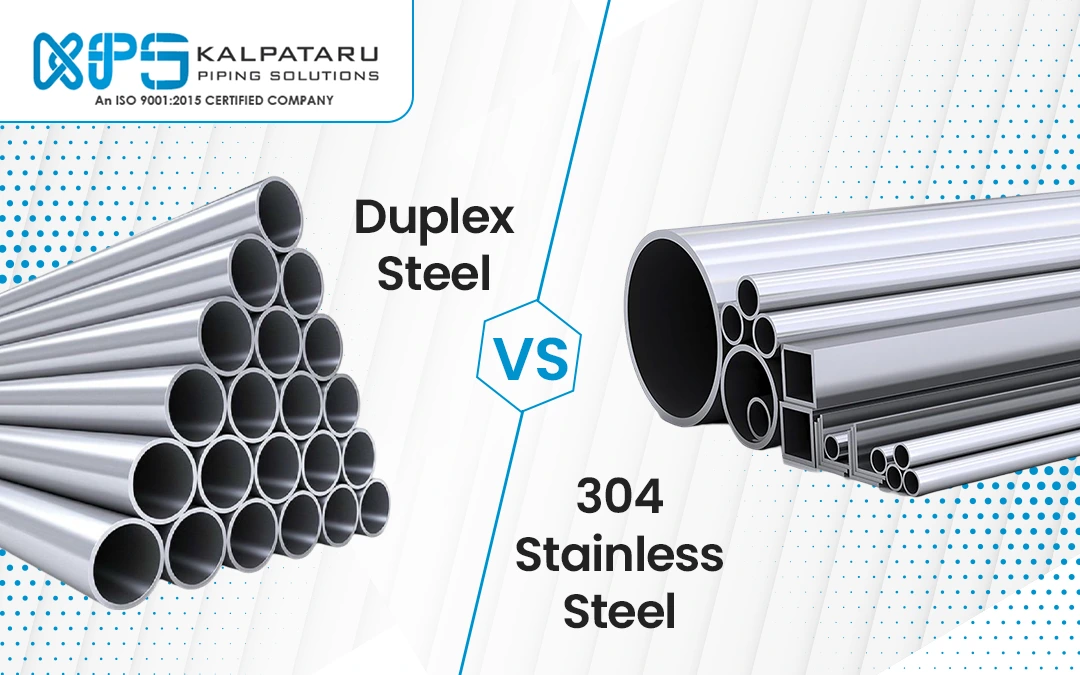
Duplex Steel  Vs 304 Stainless Steel

Duplex Steel  Vs 304 Stainless Steel

At Kalpataru Piping Solutions, we offer a diverse range of high-quality stainless steel products, including duplex stainless steel and 304 stainless steel. These materials are used in various industrial applications, but each is suited to unique needs depending on their composition and properties. In this guide, we will compare duplex stainless steel with 304 stainless steel to help you choose the right material for your specific requirements.

What is Duplex Stainless Steel?

Duplex stainless steel is a combination of austenitic and ferritic stainless steels, providing enhanced strength, toughness, and superior corrosion resistance, especially in highly corrosive environments. With higher levels of chromium and molybdenum, duplex steel is highly resistant to pitting, crevice corrosion, and stress corrosion cracking. Kalpataru Piping Solutions is a trusted duplex Stainless Steel Supplier, offering products to industries requiring exceptional mechanical properties and resistance to harsh conditions. Common applications include the oil and gas industry, marine environments, chemical processing plants, and power plants.

What is 304 Stainless Steel?

304 stainless steel, also known as SS 304, is an austenitic stainless steel containing approximately 18% chromium and 8% nickel. This material is known for its excellent corrosion resistance, making it suitable for mild to moderate conditions. 304 Stainless Steel Suppliers often used in food processing, automotive, and chemical processing. While SS 304 performs well in standard conditions, it is less suited for highly corrosive environments when compared to duplex stainless steel, making it more cost-effective for applications where moderate corrosion resistance is sufficient.

Differences Between Duplex Stainless Steel and 304 Stainless Steel

Corrosion Resistance

  • Duplex stainless steel excels in high pressure applications, such as exposure to seawater or chemicals, offering superior resistance to stress corrosion cracking, pitting, and crevice corrosion.
  • 304 stainless steel offers good corrosion resistance in milder environments but may not withstand highly acidic or salty conditions.

Strength and Durability

  • Duplex stainless steel has higher mechanical strength and toughness than 304 stainless steel, making it more durable and resistant to high mechanical stresses.
  • 304 Stainless Steel performs well in moderate stress conditions but lacks the strength and toughness of Duplex Steel.

Cost

  • 304 stainless steel is more affordable and widely available, making it an excellent choice for applications with less mechanical requirements.
  • Duplex stainless steel is more expensive due to its complex manufacturing process and higher raw material costs.

Why Choose Duplex Stainless Steel from Kalpataru Piping Solutions?

  • Superior Corrosion Resistance: Duplex Stainless Steel is ideal for industries facing corrosive conditions, ensuring extended performance and minimal maintenance.
  • High Strength and Durability: With its dual-phase structure, Duplex Steel provides exceptional strength, toughness, and resistance to deformation.
  • Industrial Applications: Whether it’s chemical processing, marine environments, or oil and gas, Duplex Stainless Steel ensures reliable performance in demanding industries.

For more information on Duplex Stainless Steel, 304 Stainless Steel, and to request a quote for your next project, contact Kalpataru Piping Solutions today! We specialize in providing stainless steel solutions as per your unique needs.

    FAQs

    Does 304 stainless steel rust?

    304 stainless steel is resistant to rust in normal atmospheric conditions but can corrode under certain circumstances, such as exposure to chloride environments.

    What are the disadvantages of 304 stainless steel?

    304 stainless steel can experience pitting and crevice corrosion in warm chloride environments and stress corrosion cracking above 60°C (140°F).

    Is duplex stainless steel expensive?

    Yes, duplex stainless steel is generally more costly than regular stainless steels, with grades like 904L being particularly expensive.

    Duplex Pipe Manufacturing Process

    Duplex Pipe Manufacturing Process

    In today’s demanding industrial landscape, the need for robust and reliable piping systems is paramount. Duplex pipes – a class of stainless steel piping that is rapidly gaining traction due to its exceptional performance characteristics. Duplex pipes represent a significant advancement in piping technology. Their exceptional strength, corrosion resistance, and versatility make them a preferred choice for numerous industrial applications. By understanding the manufacturing process and properties of these advanced materials, engineers and designers can leverage their benefits to create more efficient, durable, and cost-effective piping systems.

    What is a Duplex Pipe?

    Duplex pipes are a specialized type of stainless steel pipe known for their exceptional strength and corrosion resistance. They derive their name from their unique microstructure, which consists of two distinct types of stainless steel: ferritic and austenitic.

    • Ferritic Layer: This inner layer is rich in chromium, providing excellent resistance to corrosion, particularly in harsh environments like those containing chloride ions.
    • Austenitic Layer: The outer layer, with its finer grain structure and higher carbon content, contributes to the pipe’s exceptional strength and durability.

    Duplex Pipe Manufacturing Process

    Duplex pipes are manufactured through a multi-stage process involving steelmaking, forming, and heat treatment. The process typically begins with the melting of scrap steel and alloying elements in an electric arc furnace. The molten steel is then transferred to an argon-oxygen decarburization (AOD) converter, where impurities are removed and the desired chemical composition is achieved. The duplex pipe price is higher due to the complexities of their manufacturing process, particularly cold forming and heat treatment.

    Cold Forming Challenges:

    • High Forming Forces: Duplex stainless steels exhibit significantly higher strength than austenitic grades, necessitating significantly greater forming forces. This translates to:
      • Increased equipment demands: More powerful machinery is required for bending, drawing, and other forming operations.
      • Higher energy consumption: Increased force translates to higher energy consumption during the manufacturing process.
    • Work Hardening: Duplex steels exhibit pronounced work hardening during deformation, leading to a rapid increase in strength. This necessitates careful consideration of forming limits to prevent equipment overload and ensure consistent product quality.
    • Lower Ductility: Compared to austenitic stainless steels, duplex grades have lower ductility. This necessitates:
      • Larger bending radii: To avoid cracking and ensure successful forming.
      • Intermediate annealing: Frequent heat treatments are required during complex forming operations to prevent work hardening and maintain formability.

    Heat Treatment Considerations:

    • Solution Annealing: After each cold forming operation, a complete solution annealing treatment is crucial to:
      • Restore the optimum microstructure.
      • Ensure optimal mechanical properties and corrosion resistance.
    • Temperature and Time: Solution annealing requires precise temperature control and sufficient holding times to fully dissolve intermetallic phases.
    • Rapid Quenching: Rapid water quenching is essential after solution annealing to stabilize the desired microstructure.

    Applications of Duplex Pipes

    • Oil and Gas Industry: Duplex pipes are extensively used in offshore and onshore oil and gas pipelines, particularly in corrosive environments.
    • Chemical Processing: The excellent corrosion resistance makes them suitable for handling various chemicals and acids in process plants.
    • Desalination Plants: Duplex pipes are used in seawater desalination plants due to their resistance to chloride-induced corrosion.
    • Marine Applications: The combination of strength and corrosion resistance makes them ideal for shipbuilding and marine structures.
    • Pulp and Paper Industry: Duplex pipes are used in the pulp and paper industry to handle corrosive chemicals and slurries.

    Conclusion

    Duplex SS pipes have emerged as a game-changer in various industries, offering great features of strength, corrosion resistance, and cost-effectiveness. Duplex stainless steel boasts a unique microstructure, combining austenitic and ferritic phases. This synergistic interplay provides exceptional resistance to a wide range of corrosive environments. 

    Kalpataru Piping Solutions is a leading manufacturer of high-quality duplex steel pipes in India and South Africa. We offer a diverse range of duplex steel products in various grades and sizes, catering to diverse industry needs. Our expertise extends to custom manufacturing, ensuring we can deliver best solutions to meet your specific requirements. Contact us today to explore our product range and discuss your project needs.

    FAQs

    What is a Duplex Pipe?

    A duplex pipe is a type of stainless steel pipe that possesses a unique microstructure. It is composed of two distinct phases: austenite and ferrite, existing in roughly equal proportions within the metal.

    How thick is a duplex pipe?

    The thickness of a duplex pipe can vary significantly depending on the specific application and required strength. Round duplex pipes can have outer diameters ranging from 6 mm to 630 mm, with wall thicknesses ranging from 0.5 mm to 30 mm.

    What is the pressure rating of a duplex pipe?

    The pressure rating of a duplex pipe is influenced by several factors, including pipe diameter, wall thickness, the specific grade of duplex steel, and the operating temperature. To determine the precise pressure rating should consult relevant industry standards with these factors.

    Types of Stainless Steel

    Types of Stainless Steel

    Stainless steel is a widely used material across various industries, including construction, healthcare, automotive, and medical sectors. Understanding the different types of stainless steel and their properties is essential for selecting the right grade for your specific needs. 

    This guide will delve into the common types of stainless steel, highlighting their properties and practical applications. Discover why stainless steel is a preferred choice across industries and how its unique features can be used to enhance durability, performance, and efficiency in your projects.

    What is Stainless Steel?

    Stainless steel is a family of iron-based alloys known for their exceptional corrosion resistance, heat resistance, and durability. These alloys are primarily made from iron and carbon, with a maximum carbon content of 2.1%. Stainless steels are further enhanced by alloying elements such as chromium, nickel, molybdenum, and manganese. Each stainless steel alloy formulation offers unique characteristics, such as tensile strength, corrosion resistance, oxidation resistance, and melting point. The key to stainless steel’s superior corrosion resistance lies in its chromium content, which forms a protective oxide layer on the surface, preventing rust and degradation. This property makes stainless steel stand out from other steel types, making it ideal for applications where durability and resistance to harsh environments are essential.

    Different Types of Stainless Steel

    With thousands of stainless steel alloys, most of them fall into three main categories:

    1. Austenitic Stainless Steel

    Austenitic stainless steel is the most commonly used type of stainless steel alloy. Its defining features are its high chromium content and excellent corrosion resistance. This type of stainless steel is generally non-magnetic, but it can develop magnetic properties when subjected to a cold-forming process. Due to its versatility and strength, austenitic stainless steel is widely used in applications such as kitchen equipment, architectural structures, and chemical processing.

    2. Ferritic Stainless Steel

    Ferritic stainless steel is the second most common type of alloy. It contains less nickel compared to austenitic stainless steel, making it more cost-effective. It is also magnetic and can be hardened through cold working processes. Ferritic stainless steel is often used in automotive components, industrial equipment, and household appliances due to its durability and affordability.

    3. Martensitic Stainless Steel

    Martensitic stainless steel is less common but highly valued for its strength and impact resistance. It is often used in applications requiring high tensile strength, such as cutting tools, aerospace parts, and medical instruments. To enhance its corrosion resistance, martensitic stainless steel is sometimes combined with a protective polymer coating.

    4. Duplex (Ferritic-Austenitic) Stainless Steels

    Duplex stainless steels are a unique mixture of austenite and ferrite, offering superior corrosion resistance, especially against chloride pitting. Their exceptional resistance to corrosion and mechanical properties make them commonly used in industries such as oil and gas for pipelines, pressure vessels, and pipework systems.

    5. Precipitation Hardening (PH) Stainless Steels

    Precipitation hardening stainless steels are known for their remarkable strength and durability. These alloys can be heat-treated to achieve yield strengths several times greater than that of standard austenitic stainless steels. With excellent corrosion resistance, PH steels are extensively utilized in aerospace, nuclear, and oil and gas industries. Their ability to provide high-strength performance in high temperature conditions.

    Exploring the Different Grades of Stainless Steel

    Stainless steel is categorized into three primary types: austenitic, ferritic, and martensitic. Within these categories, different grades offer specific properties suited for various applications. Here, we look into the most common types of stainless steel grades and their unique attributes.

    Austenitic Stainless Steel Grades

    Austenitic stainless steel is the most commonly used type due to its excellent corrosion resistance and versatility. Two popular grades in this category are:

    Stainless Steel 304 Grade

    Known for its impressive tensile strength of approximately 621 MPa (90 ksi), Grade 304 is a reliable choice for a wide range of applications. Its maximum operating temperature is 870°C (1598°F), making it suitable for high-temperature environments.

    Stainless Steel 316 Grade

    With a tensile strength of 579 MPa (84 ksi), Grade 316 offers a similar performance to Grade 304. However, it stands out for its superior resistance to chlorides, such as salt, making it the preferred choice for maritime and coastal applications. Its maximum operating temperature is slightly lower at 800°C (1472°F).

    Ferritic Stainless Steel Grades

    Ferritic stainless steel is valued for its affordability and specific resistance properties. Two notable grades in this category are:

    Grade 430

    Although not as strong as austenitic grades, Grade 430 provides excellent resistance to nitric acid. It is suitable for heavy-duty applications where high strength is not the primary requirement.

    Grade 434

    Grade 434 offers higher tensile strength and better resistance to pitting compared to Grade 430. Its toughness makes it suitable for demanding industrial environments.

    Martensitic Stainless Steel Grades

    Martensitic stainless steel is known for its strength and impact resistance. The primary grade in this category is:

    Grade 420

    This grade provides good resistance to alkalis, mild acids, water, and food compounds. Its high tensile strength and impact resistance make it an excellent choice for products like cutlery, surgical instruments, and tools.

    Duplex (Ferritic-Austenitic) Stainless Steels Grades

    Grade 2205 Stainless Steel

    Grade 2205 offers superior corrosion resistance, especially against stress corrosion cracking, pitting, and crevice corrosion. Its enhanced properties make it ideal for the oil and gas, petrochemical, marine, and pulp industries.

    Grade 2304 Stainless Steel

    Grade 2304 provides the same corrosion resistance as grade 316 but with nearly twice the yield strength. It performs well in temperatures ranging from -58°F to 572°F, making it suitable for a variety of applications.

    Grade 2507 Stainless Steel

    Known for its high thermal conductivity and exceptional chloride stress corrosion resistance, grade 2507 is perfect for marine, petrochemical, and offshore oil platform applications, offering both strong corrosion resistance and tensile strength.

    Precipitation Hardening (PH) Stainless Steels Grades

    Grade 17-4 Stainless Steel

    Grade 17-4 delivers exceptional strength and fair corrosion resistance, with properties adjustable through heat treatment. It is widely used in aerospace, petroleum, and chemical industries.

    Grade 15-5 Stainless Steel

    Grade 15-5 excels in strength, corrosion resistance, toughness, and hardness. While not ideal for cold working, it is commonly used in high-pressure and corrosive environments, particularly in aerospace components.

    How to Choose the Right Stainless Steel for Your Project?

    1. Industrial Application
    For high pressure conditions like marine environments, choose alloys with molybdenum (e.g., grade 316) for chloride resistance.

    2. Formability and Weldability
    For better formability, select austenitic or ferritic steels like grades 304 or 430. If welding is required, ensure good weldability to avoid issues like cracking (common with martensitic steels like grade 410).

    3. Corrosion Resistance
    Austenitic steels, especially grade 316, offer the best corrosion resistance for harsh environments. Martensitic and ferritic steels are less resistant but more cost-effective.

    4. Strength, Ductility, and Toughness
    Choose alloys with a balance of strength, ductility, and toughness, such as those with chromium and nickel, based on your load-bearing and shape-changing requirements.

    5. Cost and Availability
    While austenitic stainless steels are more expensive, they offer long-term savings in maintenance. Weigh the initial cost against durability.

    6. Magnetic Response
    If magnetism is a factor, opt for non-magnetic alloys like grade 316 or 310. Grades in the 400 series are more magnetic due to higher chromium content.If magnetism is a factor, opt for non-magnetic alloys like grade 316 or 310. Grades in the 400 series are more magnetic due to higher chromium content.

    Conclusion

    Choosing the right type of stainless steel is important to make sure your project works as planned. Austenitic stainless steel is great for resisting rust, ferritic steel offers an affordable option, and martensitic steel is known for its strength. Each type is designed for specific uses, like construction, healthcare, manufacturing, or marine environments. Knowing the differences can help you pick the best option for your needs.

    At Kalpataru Piping Solutions, we provide high-quality stainless steel products to suit a range of industries. Our team can help you select the right material for your requirements, giving you reliable and long-lasting results.

    Visit Kalpataru Piping Solutions to explore our stainless steel products and get expert guidance on finding the best solution for your projects.

    FAQs

    How is stainless steel made?

    Stainless steel is made primarily from iron and carbon in a two-step process. What makes stainless steel different is the addition of chromium (Cr) and other alloying elements such as nickel (Ni) to create a corrosion-resistant product.

    Which is better, 304 or 316 stainless steel?

    316 contains a minimum of 2.0% molybdenum which makes it much more corrosion-resistant than 304 however, as it is a more expensive element, generally makes 316 a more expensive grade of metal.

    How to Choose the Right Material for Different Stainless Steel Applications?

    Choosing the right stainless steel depends on the environment, strength, corrosion resistance, and formability. For marine settings, grade 316 with molybdenum offers excellent corrosion resistance. Austenitic and ferritic steels are ideal for high strength and toughness, while martensitic steels are best for strength-focused applications, though they are more prone to cracking.

    What are the different types of Stainless Steel?

    Stainless steels are classified into four main groups:

    • Austenitic: Known for excellent corrosion resistance and formability, commonly used in food processing and medical equipment.
    • Ferritic: Offers good corrosion resistance and is magnetic, typically used in automotive and industrial applications.
    • Duplex: A blend of austenitic and ferritic steels, offering high strength and corrosion resistance, ideal for harsh environments like oil and gas.
    • Martensitic: Known for high strength and hardness, but less corrosion resistant, typically used in tools.
    Stainless Steel Uses

    Stainless Steel Uses

    Stainless steel is a versatile and durable alloy known for its strength, corrosion resistance, and low maintenance requirements. These qualities make it ideal for use across various industries, from construction to automotive etc. Stainless steel is available in forms such as sheets, plates, bars, coils, and tubing, etc to both industrial and domestic applications, having a long life span and being 100% recyclable. Its unique properties, such as corrosion resistance and ease of sterilization, make it indispensable in applications requiring durability and hygiene.

    What is Stainless Steel?

    Stainless steel is a corrosion-resistant, iron-based alloy that has high durability, aesthetic appeal, and ability to withstand extreme environments. Its defining feature is the addition of chromium, which enhances its resistance to rust and corrosion. Containing a minimum of 10.5% chromium, stainless steel forms a passive oxide layer when exposed to air, acting as a protective shield against further oxidation.

    Composition of Stainless Steel

    The composition of stainless steel varies depending on its application but typically includes iron, chromium (10-30%), and other elements such as nickel, molybdenum, nitrogen, and titanium. Chromium provides corrosion resistance, while nickel and molybdenum enhance strength and resistance to extreme conditions. Stainless steel has a chromium oxide layer that forms on its surface upon exposure to oxygen.

    Stainless Steel Uses

    Stainless steel material is mainly known for its strength, durability, and resistance to corrosion, making it indispensable across various industries. Here are list of stainless steel applications:

    Architecture and Construction

    Stainless steel is used in modern architecture and construction, due to its strength, flexibility, and resistance to corrosion. Stainless steel is widely used for exterior cladding on high-impact buildings and interior applications such as handrails, countertops, and backsplashes. Its aesthetic appeal, low maintenance, and sustainable properties—being up to 90% recycled—make it ideal for contemporary and eco-friendly designs.

    Automotive and Transportation

    Stainless steel plays a vital role in the automotive and transportation sectors, offering durability, strength, and corrosion resistance. It has become integral in car exhaust systems, trim, grills, and structural components, aligning with emission standards. Beyond automobiles, stainless steel is widely used in ship containers, road tankers, and refuse vehicles, especially for transporting chemicals, food, and liquids. Its lightweight, fuel-saving properties, reduced maintenance costs.

    Medical Industry

    The medical industry relies heavily on stainless steel for its hygienic and corrosion-resistant properties. It is used in surgical instruments, operating tables, dental tools, and advanced medical equipment like MRI scanners and steam sterilizers. Stainless steel is also a critical component in surgical implants, artificial joints, and bone fixation devices. Its ability to withstand sterilization processes ensures safety and reliability in medical environments.

    Energy and Heavy Industries

    Stainless steel is indispensable in the energy and heavy industries due to its exceptional durability and corrosion resistance in extreme conditions. It is extensively used in storage tanks, pipelines, valves, and structural components in the chemical, oil, and gas sectors. Offshore oil rigs and renewable energy systems, including solar, hydro, and wind power, also utilize high-grade stainless steel for its ability to withstand corrosive environments.

    Food and Catering

    In the food and catering industry, stainless steel is essential for its non-reactive and corrosion-resistant nature. It is used in kitchenware, cutlery, cookware, and industrial food production equipment. Stainless steel’s easy-to-clean surface ensures hygiene, while its resistance to acidic foods preserves flavor and quality. From knife blades to ice cream production systems, it supports strong antibacterial cleaning, making it ideal for maintaining food safety and cleanliness across various culinary applications.

    Types of Stainless Steel

    Stainless steel is categorized into various types based on its microstructure and alloy composition. Each type is tailored for specific applications, offering unique properties such as corrosion resistance, strength, and durability. The main types of stainless steel are as follows:

    Austenitic Stainless Steel

    Austenitic stainless steel is the most widely used type, accounting for about 70% of all stainless steel production. Its primary microstructure is austenite, a solid solution of iron and carbon formed above 723°C. This steel contains at least 16% chromium and 6% nickel, with optional additions like nitrogen or manganese to enhance its properties. Austenitic steel is non-magnetic, corrosion-resistant, and cannot be hardened through heat treatment.

    Austenitic stainless steel uses: Chemical plants, power plants, food processing equipment, and dairy machinery.

    Ferritic Stainless Steel

    Ferritic stainless steel primarily consists of iron and chromium, with chromium content ranging between 10.5% and 18%. This type is magnetic, more cost-effective than austenitic steel, and highly resistant to stress corrosion. While it offers good formability and flexibility, it is not suitable for high-temperature applications and has average corrosion resistance.

    Ferritic stainless steel uses: Car exhausts, kitchen sinks, and industrial equipment.

    Martensitic Stainless Steel

    Martensitic stainless steel is composed of iron, carbon, and chromium. It features high strength, durability, and moderate corrosion resistance. This steel is magnetic and can be hardened by heat treatment but has poor weldability compared to other grades. Untempered martensite is brittle, while tempered martensite is tough and corrosion-resistant.

    Applications: Medical equipment, aerospace components (drive shafts, landing gear), and cutlery.

    Duplex Stainless Steel

    Duplex stainless steel combines the properties of austenitic and ferritic grades, typically consisting of a 50/50 mix. It contains high chromium and low nickel, offering superior tensile strength, good weldability, and excellent resistance to stress corrosion. Duplex stainless steel is stronger than austenitic grades and highly durable, though slightly less resistant to stress corrosion than ferritic grades.

    Applications: Piping, manifolds, pressure vessels, and pipelines in petrochemical and oil and gas industries.

    FAQs

    What are the advantages of stainless steel?

    Stainless steel offers corrosion resistance, strength, durability, heat resistance, easy maintenance, and aesthetic appeal. It is also environmentally friendly due to its recyclability.

    What type of welding is used for stainless steel?

    TIG (Tungsten Inert Gas) welding and MIG (Metal Inert Gas) welding are commonly used for stainless steel, providing precision and strong welds.

    Which metal is used in stainless steel?

    Stainless steel is made from iron, carbon, chromium (10-30%), nickel, molybdenum, titanium, and other trace elements.

    What is stainless steel used for?

    Stainless steel is used in kitchenware, medical instruments, construction, automotive parts, chemical processing, and marine environments due to its durability and corrosion resistance.

    What is the difference between steel and stainless steel?

    Steel is prone to rust and corrosion, while stainless steel resists rust due to added chromium, nickel, and other elements. Steel is magnetic; most stainless steels are not.

    Is stainless steel an alloy?

    Yes, stainless steel is an alloy made primarily of iron, carbon, and 10-30% chromium, with additional elements like nickel, molybdenum, and titanium for enhanced corrosion resistance.

    Is stainless steel corrosion-resistant?

    Yes, stainless steel is resistant to corrosion, especially in mild environments. However, exposure to strong bases like sodium hydroxide can cause etching, and it may experience galvanic corrosion in certain conditions.

    316 Stainless Steel Grades

    316 Stainless Steel Grades

    Stainless steel is an alloy containing at least 10% chromium, which provides its signature corrosion resistance. The chromium reacts with oxygen to form a protective oxide layer on the metal’s surface, safeguarding it against rust and degradation. Among the various grades, 316 stainless steel stands out for its excellent resistance to corrosion, making it ideal for industries like chemical plants, refineries, and marine. Types 1.4401 and 1.4404, also known as grades 316 and 316L, are widely used variations. 

    This blog explores the grades of 316 stainless steel in detail, covering its types, key properties, and industrial applications.

    What is 316 stainless steel?

    316 stainless steel is a premium alloy known for its exceptional corrosion resistance, durability,. It belongs to the austenitic family of stainless steels. SS 316 material contains molybdenum, which significantly enhances its resistance to pitting and crevice corrosion, especially in chloride-rich environments.

    Grades of Stainless Steel 316

    • 316L Stainless Steel (Low Carbon)
      316L is a low-carbon version of 316 stainless steel, designed to minimize carbide precipitation during welding. This property makes it ideal for heavy-gauge welded components over 6mm thick. It provides the same corrosion resistance as standard 316 while reducing the risk of sensitization.
    • 316H Stainless Steel (High Carbon)
      316H is the high-carbon variant of 316, developed for applications requiring enhanced thermal stability and resistance to creep at elevated temperatures. It is commonly used in high-temperature environments like boilers, heat exchangers, and pressure vessels.
    •  316Ti Stainless Steel (Stabilized with Titanium)
      316Ti is stabilized with a small addition of titanium (approximately 0.5%) to improve resistance to intergranular corrosion. This grade performs exceptionally well in high-temperature environments above 800°C and is widely used in heat exchangers, furnace parts, and exhaust systems.

    Corrosion Resistance of Stainless Steel 316

    Stainless steel 316 offers excellent corrosion resistance and is known as “marine grade” stainless steel, outperforming grade 304. However, it is not fully resistant to warm seawater, where chloride-rich conditions can cause pitting and crevice corrosion. It tolerates chlorides up to 1000 mg/L in potable water at ambient temperatures, reducing to 500 mg/L at 60°C. Despite susceptibility to stress corrosion cracking above 60°C and surface staining in crevices.

    Heat Resistance of 316 Stainless Steel

    316 stainless steel doesn’t harden through heat treatment but is enhanced through annealing at 1010°C to 1120°C, followed by rapid cooling. This process relieves stresses and restores corrosion resistance. For resistance to intergranular corrosion, grade 316L is used, while grade 316H, with higher carbon content, is preferred for high-strength, elevated-temperature applications. While 316 offers excellent oxidation resistance up to 925°C, prolonged use between 425°C to 860°C is not recommended for water-corrosion resistance.

    Welding of Stainless Steel 316

    SS 316 stainless steel offers excellent weldability through various fusion welding methods, both with and without filler metals. The recommended filler rods and electrodes for welding SS 316 and 316L are identical to the base metal, ensuring strong and durable joints. While welding heavy sections of SS 316 may require post-weld annealing to maintain optimal corrosion resistance, this is not necessary for SS 316L due to its low carbon content. For heavy section welds, SS 316Ti, which contains titanium for stabilization, can be used as an alternative to SS 316. However, oxyacetylene welding is not suitable for joining SS 316 stainless steel. The material is pre-qualified for welding under standards like AS 1554.6 when using appropriate rods or electrodes.

    Cold Working of 316 Stainless Steel

    Stainless steel 316 is easy to shape into different parts using brake or roll forming. It’s also good for processes like stamping, heading, and drawing. However, after these processes, annealing (heating and cooling) is recommended to reduce internal stresses in the material. Cold working, which involves shaping the steel at room temperature, makes 316 stainless steel stronger and harder.

    Hot Working of Stainless Steel 316

    Stainless steel 316 can be easily shaped using all common hot working methods. However, it should not be worked below 927°C. The best temperature range for hot working is between 1149°C and 1260°C. After hot working, it’s recommended to anneal the steel to restore its corrosion resistance.

    316 Stainless Steel Heat Treatment

    316 stainless steel cannot be hardened by heat treatment. Instead, it can undergo a process called solution annealing, where the material is heated to a temperature between 1010°C and 1120°C, then rapidly cooled to prevent the formation of chromium carbides.

    Machinability of 316 Stainless Steel

    316 stainless steel is easy to machine with the right techniques. Keep cutting tools sharp to avoid hardening the material. Make light cuts, deep enough to prevent the tool from just skimming the surface. Use chip breakers to clear debris, and always apply plenty of coolants and lubricants since the material can heat up quickly during machining.

    SS 316 Chemical Composition

    Element

    316

    316L

    316H

    316Ti

    Carbon (C)

    0.0–0.07

    0.0–0.03

    0.04–0.08

    0.0–0.08

    Manganese (Mn)

    0.0–2.0

    0.0–2.0

    0.0–2.0

    0.0–2.0

    Silicon (Si)

    0.0–1.0

    0.0–1.0

    0.0–1.0

    0.0–1.0

    Phosphorus (P)

    0.0–0.05

    0.0–0.05

    0.0–0.04

    0.0–0.05

    Sulfur (S)

    0.0–0.02

    0.0–0.02

    0.0–0.02

    0.0–0.03

    Chromium (Cr)

    16.50–18.50

    16.50–18.50

    16.50–18.50

    16.50–18.50

    Molybdenum (Mo)

    2.00–2.50

    2.00–2.50

    2.00–2.50

    2.00–2.50

    Nickel (Ni)

    10.00–13.00

    10.00–13.00

    10.00–13.00

    10.50–14.00

    Titanium (Ti)

    0.40–0.70

    Iron (Fe)

    Balance

    Balance

    Balance

    Balance

    Stainless 316 Material Properties

    Stainless steel 316 offers excellent mechanical and physical properties, including high tensile and yield strength, excellent corrosion resistance, and good machinability. These properties are primarily specified for flat-rolled products like plate, sheet, and coil under ASTM A240/A240M. Similar specifications apply to other forms, such as pipes and bars, under their respective standards, with minor variations in property details.

    Mechanical Properties

    Grade Tensile Str (MPa) min Yield Str 0.2% Proof (MPa) min Elong (% in 50 mm) min Hardness
    Rockwell B (HR B) max Brinell (HB) max
    316 515 205 40 95 217
    316L 485 170 40 95 217
    316H 515 205 40 95 217

    Physical Properties

    Property

    Value

    Density

    8.00 g/cm3

    Melting Point

    1375-1400°C 

    Modulus of Elasticity 

    193 GPa 

    Electrical Resistivity 

    0.074×10⁻⁶ Ω.m

    Thermal Conductivity  

    16.3 W/m.K at 100°C 

    Thermal Expansion

    15.9×10⁻⁶ /K at 100°C 

    Applications of 316 Stainless Steel Grades

    Grade

    Applications

    316 Stainless Steel

    – Marine: Boat fittings, underwater pipelines.

    – Chemical: Tanks, heat exchangers.

    – Food & Beverage: Processing and storage equipment.

    – Medical: Surgical tools and medical devices.

    316L Stainless Steel

    – Welding: Oil pipelines, storage tanks.

    – Pharmaceutical: Corrosion-resistant equipment.

    – Cryogenic: Vessels and piping for low-temperature applications.

    316Ti Stainless Steel

    – Heat-Intensive: Chemical reactors and kilns.

    – Exhaust Systems: Automotive and industrial exhaust components.

    – Aerospace: Heat-resistant parts for aircraft.

    Conclusion

    In conclusion, Kalpataru Piping Solutions is a trusted supplier of high-quality 316, 316L, and 316Ti stainless steel products, catering to various industrial needs. As reliable 316 stainless steel suppliers, we ensure superior materials that meet the highest standards for performance and durability. Whether you’re looking for stainless steel 316 for specific applications or require expert guidance, we are here to guide you. 

    Contact us today to learn more about our range of stainless steel 316 products to meet your requirements.

    FAQs

    What is the cost of 316 stainless steel?

    The cost of 316 stainless steel depends on various factors such as the supplier, quantity, and specific requirements like size and grade. It’s best to request a quote from suppliers for accurate pricing.

    Does grade 316 stainless steel rust?

    While highly resistant to rust due to molybdenum, grade 316 stainless steel can still show signs of corrosion in harsh marine conditions.

    Which grade is better, 304 or 316 stainless steel?

    Grade 316 is better for highly corrosive environments due to its added molybdenum, offering superior resistance compared to grade 304.

    Is 316 stainless steel worth the extra cost over 304?

    Yes, for environments with high acidity or salinity, the enhanced corrosion resistance of 316 justifies its higher cost.

    What is the grade of ASTM 316?

    ASTM A240 Type 316 is a stainless steel alloy containing chromium, nickel, molybdenum, and trace elements, designed for superior corrosion resistance.

    What is 316 stainless steel grade?

    Grade 316 is an austenitic stainless steel with molybdenum, offering better corrosion resistance than 304, especially in marine and chemical environments.

    What is the grade of 316 steel?

    316 and 316L (1.4401 and 1.4404) are austenitic stainless steels with molybdenum, providing excellent corrosion resistance, second only to 304 in commercial usage.

    Enquire Now
    close slider

      Enquire Now

      Fill the below form and get in touch with us, we’ll call you back.

      Fill the Captcha:
      WhatsApp chat