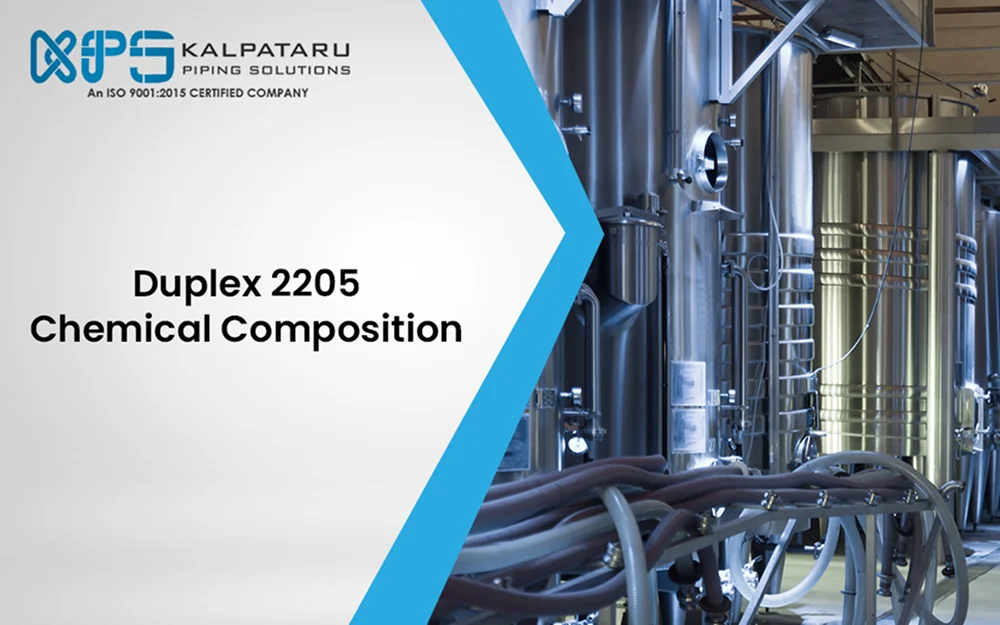
Duplex 2205 Chemical Composition

Duplex 2205 Chemical Composition

Duplex 2205 stainless steel is a strong and durable material that combines two types of steel: ferritic and austenitic. This mix gives it great resistance to corrosion and strength, making it ideal for tough environments. Duplex 2205 is an upgraded version of the earlier S31803 grade, changed to UNS S32205 in 1996. These changes improve its ability to resist corrosion even more. Stainless steel 2205 duplex is widely used in industries like oil and gas, marine, and chemicals.

 In this blog, we will explain Duplex 2205’s chemical composition and how it contributes to its impressive performance.

Understanding Duplex 2205 Chemical Composition

Duplex 2205 stainless steel is a highly corrosion-resistant material widely used in industries that require high strength and durability, such as oil and gas, marine, and chemical processing. 2205 chemical composition plays a key role in its performance and properties. It combines the best features of both ferritic and austenitic stainless steels, giving it a unique balance of strength and resistance to corrosion.

The chemical composition of Duplex 2205 typically includes:

  • Chromium (Cr): 22-23%
    Chromium is a key element in Duplex 2205, providing excellent corrosion resistance, particularly to pitting and crevice corrosion. It helps form a protective oxide layer on the steel’s surface, enhancing its durability.
  • Nickel (Ni): 4.5-6.5%
    Nickel improves the steel’s resistance to corrosion and increases its toughness, especially in low temperatures. However, the lower nickel content in Duplex 2205 compared to other austenitic steels contributes to its lower cost.
  • Molybdenum (Mo): 3-3.5%
    Molybdenum enhances steel’s resistance to chloride stress corrosion cracking and pitting. It helps improve the material’s performance in aggressive environments, such as those with high chlorides (e.g., seawater).
  • Manganese (Mn): 1.5-2%
    Manganese is an essential element that improves steel’s strength and ductility and helps stabilize its austenitic phase.
  • Nitrogen (N): 0.08-0.2%
    Nitrogen increases the strength of Duplex 2205 and helps to improve its resistance to pitting and crevice corrosion. It also enhances the material’s overall stability.
  • Iron (Fe): Balance
    Iron is the primary component of Duplex 2205, making up the majority of the alloy. It provides the basic structure and framework for the other elements.
  • Other Elements:
    • Silicon (Si): Up to 1%. Silicon contributes to the steel’s resistance to oxidation and enhances its overall strength.
    • Carbon (C): Maximum 0.03%. Carbon content is kept low in Duplex 2205 to prevent the formation of carbides that could reduce its corrosion resistance.

The combination of these elements gives Duplex 2205 its distinctive properties: high strength, good weldability, and superior corrosion resistance. The balanced composition ensures the material can withstand challenging conditions such as high pressure, high temperatures, and exposure to harsh chemicals, making it a popular choice for demanding applications.

Grade   C Mn Si P S Cr Mo Ni N
2205 (S31803) Min Max – 0.030 – 2.00 – 1.00 – 0.030 – 0.020 21.0 23.0 2.5 3.5 4.5 6.5 0.08 0.20
2205 (S32205) Min Max – 0.030 – 2.00 – 1.00 – 0.030 – 0.020 22.0 23.0 3.0 3.5 4.5 6.5 0.14 0.20

Corrosion Resistance of 2205 Duplex Stainless Steel

2205 duplex stainless steel offers a cost-effective and highly durable solution for applications where 300 series stainless steels are vulnerable to chloride stress corrosion cracking. duplex 2205 chloride resistance occurs when tensile stress is applied to stainless steel in environments containing chlorides, with susceptibility increasing as temperatures rise. The unique combination of chromium, molybdenum, and nitrogen in 2205 duplex stainless steel enhances its resistance to chloride pitting and crevice corrosion, making it suitable for challenging environments such as marine settings, brackish water systems, bleaching operations, closed-loop water systems, and specific food processing applications. Its superior composition provides greater corrosion resistance compared to commonly used stainless steels 316L and 317L, offering a reliable and long-lasting option for industries requiring high performance in corrosive conditions.

FAQs

What is the composition of 2507 material?

Alloy 2507 (UNS S32750) is a super duplex stainless steel with 25% chromium, 4% molybdenum, and 7% nickel designed for demanding applications which require exceptional strength and corrosion resistance, such as chemical process, petrochemical, and seawater equipment.

What is the difference between duplex 2205 and 2507?

Due to the difference in chemical composition, duplex steel 2507 is more resistant to corrosion than 2205, especially in environments containing chloride ions and acidic environments. Under the same conditions, 2507 is more resistant to corrosion, wear, pitting, and intergranular corrosion than 2205.

What is a 2507 duplex?

Duplex 2507 (UNS S32750) is a super duplex stainless steel with 25% chromium, 4% molybdenum, and 7% nickel designed for demanding applications that require exceptional strength and corrosion resistance, such as chemical process, petrochemical, and seawater equipment.

Related Posts

904L Stainless Steel

904L Stainless Steel – Benefits and Applications

Stainless Steel 904L vs 316L

Stainless Steel 904L vs 316L

Stainless Steel 304 Density

Stainless Steel 304 Density

Duplex Steel vs Stainless Steel

Duplex Steel vs Stainless Steel

Choosing the right steel for your project often comes down to duplex steel and stainless steel. While both are strong and resistant to corrosion, they have unique differences. Duplex steel combines austenitic and ferritic structures, offering higher strength and better resistance to stress corrosion. Stainless steel, available in many grades, is versatile and widely used across industries.

This blog will explain the key differences, helping you decide which material suits your needs best for durability and performance.

What is duplex stainless steel?

Duplex steel, also known as duplex stainless steel, is a type of stainless steel with a unique two-phase microstructure composed of austenite (face-centered cubic lattice) and ferrite (body-centered cubic lattice) in roughly equal proportions. This structure provides duplex steel with exceptional strength and superior corrosion resistance compared to standard austenitic stainless steels like Type 304 or 316. It is specifically designed to resist chloride stress corrosion and chloride pitting corrosion, making it ideal for environments with high chloride exposure. 

Duplex steel has a higher chromium content (20–28%), molybdenum (up to 5%), and nitrogen (0.05 — 0.50%) while maintaining a lower nickel content (up to 9%) compared to austenitic grades. These elements enhance its durability and reduce costs. Its high strength allows for thinner sections, further improving cost efficiency. Widely used in the offshore oil and gas industry, petrochemical pipelines, and marine applications, duplex steel combines improved corrosion resistance, higher strength, and affordability, making it a preferred choice for demanding industrial applications.

What is stainless steel?

Stainless steel, also known as inox or corrosion-resistant steel, is an iron-based alloy renowned for its resistance to rust and corrosion. This durability comes from its chromium content, which is at least 10.5%. The chromium forms a passive layer on the surface that protects the material and can self-heal when exposed to oxygen. Depending on its specific application and cost, stainless steel may also include elements like molybdenum, nickel, nitrogen, and carbon.

Duplex Steel vs Stainless Steel: A Comparison

Property Duplex Steel Stainless Steel
Strength Nearly twice the strength of stainless steel Moderate strength depends on the range
Corrosion Resistance Superior in chloride-rich environments Effective, but less resistant to chlorides
Stress Corrosion Cracking Highly resistant Prone to cracking in chloride environments
Cost More cost-effective for high-performance applications Higher cost for high-grade options like 316
Fabrication Requires expertise in welding and shaping Easier to fabricate and weld

Galvanic Corrosion Between Stainless Steel and Duplex Stainless Steel

Duplex stainless steel offers significantly better corrosion resistance compared to standard stainless steel, especially in highly corrosive environments. While austenitic stainless steel grades like 316 can handle high levels of chlorides, they are less effective against acids. Duplex stainless steel, on the other hand, provides superior resistance to chlorides, acids, reducing agents, and oxidizing agents, making it a more reliable choice for demanding conditions.

The corrosion resistance of duplex stainless steel is higher than most austenitic grades, ensuring better performance in environments with harsh chemicals. However, for extremely aggressive applications, such as in acid production plants, more specialized materials like Hastelloy are often required due to their unparalleled corrosion resistance and versatility.

Pickling and Passivation of Duplex and Stainless Steel

Passivation is a natural phenomenon that occurs in stainless steel with high chromium content. Duplex stainless steel, with chromium levels ranging from 19% to 32%, naturally forms a passivated oxide layer on its surface, which protects it from corrosion. This self-repairing layer is crucial for the durability and corrosion resistance of duplex stainless steel. In contrast, some stainless steel alloys with lower chromium content cannot form this protective layer, leaving them vulnerable to oxidation and corrosion. However, these alloys can undergo passivation treatments to enhance their corrosion resistance by artificially forming the oxide layer.

Pickling, on the other hand, is a chemical process used to remove surface scales and impurities caused by exposure to high temperatures or adjacent chromium layers. It involves the application of chemical solutions, typically containing nitric acid (HNO3) and hydrofluoric acid (HF), to clean the surface of stainless steel. Unlike mechanical methods, which can damage the metal’s surface, chemical pickling effectively removes unwanted layers without harming the material. This process not only improves the appearance of the metal but also enhances its corrosion resistance by preparing the surface for a more effective passivation layer.

Both pickling and passivation are essential treatments for maintaining the integrity and performance of duplex and stainless steel, especially in demanding applications where corrosion resistance is critical.

Advantages of Duplex and Stainless Steel

The advantages of duplex stainless steel depend on its composition and the specific application. Duplex stainless steel offers excellent corrosion resistance and high mechanical strength, outperforming many standard stainless steel grades. Its dual-phase structure combines the best properties of ferritic and austenitic stainless steels, providing superior durability and resistance to stress corrosion cracking. While its highly alloyed nature can make it more cost-effective compared to premium grades like 904L, duplex stainless steel also delivers exceptional performance in challenging environments. However, like other stainless steels, it has limitations at extreme temperatures, with reduced impact resistance below -50°C and limited usability at very high temperatures compared to nickel alloys.

Conclusion

Choosing the right steel depends on your project’s specific needs. Duplex stainless steel offers great strength, excellent corrosion resistance, and cost savings, making it a perfect fit for challenging environments. Stainless steel, on the other hand, is versatile and works well for a variety of everyday applications. At Kalpataru Piping Solutions, we understand the importance of choosing the right material and are committed to helping you find the best option for your project.

FAQs

Is duplex stainless steel better than stainless steel?

Duplex stainless steels were developed to overcome some limitations of traditional stainless steel grades, such as the popular 304 and 316 types. Compared to these conventional stainless steels, duplex stainless steels exhibit superior mechanical properties—especially regarding strength and toughness.

Is duplex stainless steel more expensive?

The price of duplex pipe fittings is more expensive than that of 316 stainless steel pipe fittings. We supply both duplex 2205 and 316 SS pipe and fittings, you are welcome to contact us if there are any requirements.

What is another name for duplex stainless steel?

Duplex stainless steels are a family of stainless steels. These are called duplex (or austenitic-ferritic) grades because their metallurgical structure consists of two phases, austenite (face-centered cubic lattice) and ferrite (body-centered cubic lattice) in roughly equal proportions.

Related Posts

904L Stainless Steel

904L Stainless Steel – Benefits and Applications

Stainless Steel 904L vs 316L

Stainless Steel 904L vs 316L

Stainless Steel 304 Density

Stainless Steel 304 Density

Duplex Stainless Steel Applications

Duplex Stainless Steel Applications

Introduction to Duplex Stainless Steel Applications

Duplex stainless steel is a strong and durable material known for its excellent corrosion resistance. It combines the best features of two types of stainless steel, making it ideal for tough environments like offshore oil rigs, chemical plants, and power stations. In this blog, we will look at the different ways duplex stainless steel is used and why it’s a popular choice for many industries.

What is Duplex Stainless Steel?

Duplex stainless steel is a special type of stainless steel that combines two phases: austenite and ferrite. This unique structure gives it superior strength and corrosion resistance compared to regular austenitic steels like 304 or 316. Duplex steels are made with higher amounts of chromium (20-28%) and molybdenum (up to 5%) while having lower nickel content (up to 9%) and a small amount of nitrogen (0.05–0.50%).

This combination of properties allows duplex stainless steel to be more resistant to corrosion, especially in environments with chloride stress or pitting. The increased strength also means thinner sections can be used, which makes it more cost-effective.

Applications of Duplex Stainless Steel in Construction

Duplex stainless steel is known for its outstanding strength and corrosion resistance, making it an ideal choice for industries that operate in harsh environments. Its versatility allows it to be used across various sectors such as water treatment, oil and gas, transportation, industrial equipment, and construction.

  1. Water Treatment and Desalination

Duplex stainless steel is perfect for desalination and water treatment because it can withstand the corrosive effects of water, salt, and other harsh chemicals. Its high strength, corrosion resistance, and long lifespan offer significant advantages, making it a cost-effective material in the long run despite the higher initial investment.

  1. Petroleum and Natural Gas

In the oil and gas industry, duplex stainless steel is favored for its strength and resistance to chloride stress corrosion cracking. It is particularly suited for offshore applications that deal with high pressure and deep depths. Duplex stainless steel is also used for onshore pipelines, transporting corrosive materials efficiently and safely, which is why it remains a top choice in the oil and gas sector.

  1. Transportation

From boats to planes, trains, and cars, duplex stainless steel is used in various forms of transportation. Its strength and resistance to corrosion make it ideal for tanks and trailers, offering better durability and lower costs than traditional carbon steel. It is also used in ship hulls, chemical tanks, and cargo containers. The rail industry benefits from duplex stainless steel’s resistance to corrosion and low maintenance, making passenger wagons safer and more durable.

  1. Industrial Equipment

Duplex stainless steel is the go-to material for industrial equipment, including food and drink storage containers, tanks, pipelines, pressure vessels, and heat exchangers. Its resistance to rust and ease of maintenance make it a durable, cost-effective choice. In industries like pulp and paper, duplex stainless steel’s strength and corrosion resistance are essential for long-lasting equipment that requires minimal upkeep.

  1. Construction & Building

Duplex stainless steel is revolutionizing construction and building designs, especially for roofs, walls, and bridges. Its combination of durability and aesthetic flexibility allows it to fit into diverse architectural styles and structures. It can be used in a wide variety of building technologies, and its long lifespan and recyclability make it an eco-friendly choice. Duplex stainless steel is also used in the construction of car and pedestrian bridges, including railings, suspension cables, and tie rods.

Duplex stainless steel continues to prove its value across multiple industries, offering strength, durability, and corrosion resistance in challenging environments.

Application Suitable Grades
Paper Production S31803, S32205
Desalination S32750, S32760
Oil and Gas S32750, S32550, S32760
Construction S31803, S32205
Food and Drink Storage S31500, S32304

Cost Benefits of Duplex Stainless Steel for Your Project at Kalpataru Piping Solutions

Duplex Stainless Steel offers significant cost benefits, especially when used in heat exchangers. Its lower nickel content compared to austenitic grades provides better thermal conductivity, meaning that less surface area is needed to achieve the same level of performance. Additionally, Duplex Stainless Steel is easier to weld than its austenitic counterparts, but it is crucial to carefully consider the weld mixture and proper handling to ensure corrosion resistance is maintained.

At Kalpataru Piping Solutions, we believe Duplex Stainless Steel is an excellent choice for many applications. With extensive experience in fabricating Duplex and Super Duplex Steel, we ensure that each product is engineered, built, and inspected to meet the highest standards.

Conclusion

Duplex stainless steel is strong, durable, and cost-effective, making it ideal for industries like water treatment, oil and gas, and construction. Its excellent corrosion resistance and strength make it a top choice for challenging environments.

At Kalpataru Piping Solutions, we offer expertise in duplex and super duplex steel fabrication, ensuring your project meets the highest standards. Contact us today to learn how duplex stainless steel can benefit your project.

FAQs

What are the uses of duplex?

They are an important component of the oil and gas exploration, transportation, and refinement business and are a cost-effective material for pollution control equipment. Duplex stainless steel is also used in pulp and paper production and is widely utilized in mining and even nuclear plants.

Is duplex stainless steel expensive?

Because duplex stainless steels are highly alloyed, the cost of using these metals may be high. However, the cost of grades like 904L is higher than some standard duplex stainless steel.

What is another name for duplex stainless steel?

Duplex stainless steels are a family of stainless steels. These are called duplex (or austenitic-ferritic) grades because their metallurgical structure consists of two phases, austenite (face-centered cubic lattice) and ferrite (body-centered cubic lattice) in roughly equal proportions

Related Posts

904L Stainless Steel

904L Stainless Steel – Benefits and Applications

Stainless Steel 904L vs 316L

Stainless Steel 904L vs 316L

Stainless Steel 304 Density

Stainless Steel 304 Density

904L Stainless Steel Chemical Composition

904L Stainless Steel Chemical Composition

904L Stainless Steel: Composition, Properties

904L stainless steel is a superaustenitic stainless steel grade, alloy 904L (UNS N08904) and contains high levels of chromium and nickel with additions of molybdenum and copper to provide superior corrosion resistance. The combination of high chromium and nickel content, coupled with additions of molybdenum and copper, assures good to excellent corrosion resistance, and moderate to high corrosion resistance in a wide range of process environments, containing dilute sulfuric acid. It also offers good resistance to other inorganic acids such as hot phosphoric acid as well as most organic acids.

With high-level alloys of 25% nickel and 4.5% molybdenum, 904L stainless steel provides good chloride stress corrosion cracking resistance, pitting and general corrosion resistance superior to 316L and 317L molybdenum enhanced stainless steels, The copper addition provides resistance to hot phosphoric acid and dilute sulfuric acid. 904L stainless steel is non-magnetic and offers excellent formability, toughness, and weldability.

904L Stainless Steel Chemical Composition

The chemical composition of stainless steel 904L contains roughly 19 to 23% chromium, 23 to 28% nickel, 4 to 5% molybdenum, and 1.0-2.0% Cu, which gives the alloy greater corrosion resistance than 316L.

Alloy 904L
Ni 23 – 28
Mo 4 – 5
Cr 19 – 23
Cu 1 – 2
C 0.02 max
Mn 2.0 max
Si 1.0 max
P 0.045 max
S 0.035 max

SS 904L Material Properties

Grade Tensile Strength (MPa) min Yield Strength 0.2% Proof (MPa) min Elongation (% in 50mm) min Hardness
Rockwell B (HR B) Brinell (HB)
904L 490 220 36 70-90 typical 150

904L Stainless Steel Physical Properties

Grade Density
(Kg/M 3 )
Elastic Modulus
(GPa)
Mean Co-Eff Of
Thermal Expansion
(Μm/M/°C) 0-100°C
Thermal Conductivity
(W/M.K) At 20°C
Specific Heat 0-100°C
(J/Kg.K)
Elec Resistivity
(NΩ.M)
904L 7900 190 15 11.5 500 952

904L Stainless Steel Specification

Standard 904L
UNS N08904
Werkstoff Nr. 1.4539

904L Stainless Steel Price

904L stainless steel price varies depending on thickness, size, and supplier, reflecting its high resistance to corrosion and acids. Known for its durability in harsh environments, 904L stainless steel is commonly used in chemical and marine applications. Its price is generally higher than other stainless steels due to its superior alloy composition. For more information about the 904L stainless steel price, please contact us—we are here to help with any questions or provide a custom quote based on your specific requirements.

904L Stainless Steel Corrosion Resistance

Stainless steel type 904L is primarily fabricated to offer resistance to the sulfuric acid and it also possesses superior resistance to the various conditions. It has outstanding resistance to the hot sea water and chloride conditions. The significant content of nickel offers outstanding resistance to stress corrosion cracking as compared to the other stainless steel alloys. The copper content enhances the resistance to sulfuric acid and other reducing acids especially in the rigorous conditions. In the various atmospheres, stainless steel 904L grade offers moderate corrosion resistance between the standard austenitic 316L alloy and highly alloyed 6% molybdenum and equivalent to super austenitic alloy types. In the presence of rigorous nitric acid, the lower resistance as compared to molybdenum-free alloys like 304L and 310L are used. To get the highest stress corrosion cracking resistance in the crucial conditions, the steel is recommended to solution treating subsequent to cold processing.

904L Cold Forming

904L is quite ductile and forms easily. The addition of molybdenum and nitrogen implies more powerful processing equipment may be necessary when compared with the standard 304/304L grades.

904L Hot Forming

Working temperatures of 1562 – 2102°F (850 –1150°C) are recommended for hot working processes. Normally hot working should be followed by a solution anneal and quench, but for 904L, if hot forming is discontinued at a temperature above 2012°F (1100°C) and the material is quenched directly thereafter, the material may be used without subsequent heat treatment. The entire workpiece must be quenched from temperatures above 2012°F (1100°C). In the event of partial heating or cooling below 2012°F (1100°C), or if the cooling has been too slow, hot working should always be followed by a solution anneal and quenching. 904L should be solution annealed at 1940 – 2084°F (1060 –1140°C).

904L Heat Resistance

Grade 904L stainless steels offer good oxidation resistance. However, the structural stability of this grade collapses at high temperatures, particularly above 400°C.

904L Fabrication

Grade 904L stainless steels are high-purity steels with low sulfur content. They can be machined using any standard methods. These grades can be readily bent to a small radius under cold conditions. Although subsequent annealing is not required in most cases, it should be carried out when the fabrication is performed under severe stress corrosion cracking conditions.

904L Heat Treatment

Grade 904L stainless steels can be solution heat-treated at 1090 to 1175°C, followed by rapid cooling. Thermal treatment is suitable for hardening these grades.

904L Welding

Alloy 904L can be readily welded by most standard processes. Solidification after welding causes the redistribution of certain elements such as molybdenum, chromium and nickel. These segregations remain in the cast structure of the weld and can impair the corrosion resistance in certain environments. Segregation is less evident in 904L, and this material is normally welded using a filler metal of the same composition as the base metal and can even be welded without filler metal.

Welding of grade 904L stainless steels can be performed using all conventional methods. This grade does not require pre-heat and post-weld heat treatments. Grade 904L can be subjected to hot cracking in constrained weldment.

Conclusion

In conclusion, 904L Stainless Steel is an excellent choice for industries requiring high-performance materials, especially in chemical processing. It provides outstanding corrosion resistance, handles high temperatures, and is easily weldable, making it suitable for applications where cleanliness and durability are essential. As industries evolve and demand resilient materials, 904L stainless steel stands out as a reliable, long-lasting solution that will support growth and efficiency well into the future.

FAQs

Which is better, 904L or 316L?

Both 904L and 316L stainless steels offer good corrosion resistance, but 904L is better for highly corrosive environments due to its higher chromium, nickel, and copper content. While 316L is more affordable for general use, 904L is ideal for demanding applications in chemical, petrochemical, and marine industries.

What is the difference between 304 and 904L?

The main difference between 304 and 904L stainless steels is their corrosion resistance. 304 is cost-effective and suitable for mild environments, while 904L offers superior resistance to harsh conditions like acids and chlorides, making it ideal for chemical and marine industries.

Contact us today to discuss your 904L stainless steel needs. Get a custom quote now!

Related Posts

904L Stainless Steel

904L Stainless Steel – Benefits and Applications

Stainless Steel 904L vs 316L

Stainless Steel 904L vs 316L

Stainless Steel 304 Density

Stainless Steel 304 Density

All You Need to Know About 904L Stainless Steel

All You Need to Know About 904L Stainless Steel

Steel is an essential part of our daily lives, and it has been for centuries. It’s used to construct buildings, bridges, cars, etc. One type of steel that has been gaining attention recently is 904L Stainless Steel. This highly corrosion-resistant metal has become popular in various industries, including construction, marine, and even fashion. This blog post will discuss all you need to know about 904L Stainless Steel.

What is 904L Stainless Steel?

904L Stainless Steel is a high-end austenitic stainless steel with low carbon content, which means it is incredibly corrosion-resistant. This steel is well-suited for environments with a higher risk of corrosion, such as industrial environments, marine environments, and chemical manufacturing.

904L stainless steel is a high-alloy austenitic stainless steel containing nickel, copper and molybdenum. It offers superior corrosion resistance when compared to conventional chromium-nickel steels such as 316L and 304L. This alloy resists chloride crevice corrosion, general pitting corrosion and stress cracking due to its high molybdenum content and low carbon content. Because of these features, 904L has become popular in applications that require maximum corrosion resistance, such as food processing, chemical processing equipment, laboratory equipment, marine exhaust systems and pollution control devices. Moreover, it maintains good weldability by adding nitrogen stabilizers like titanium or niobium alloys, making the final product highly resistant to intergranular attack in critical environments where welding may be required.

What Are the Advantages of 904L Stainless Steel?

One of the most significant advantages of 904L Stainless Steel is its remarkable corrosion resistance. 904L is more resistant to corrosion than other types of stainless steel. This metal is highly resistant to pitting and crevice corrosion, making it ideal for use in harsh environments. 904L is more expensive than other types of stainless steel, but it is worth the extra cost for its superior corrosion resistance. 904L is a high-alloy stainless steel with high chromium, nickel, and molybdenum levels.

Additionally, 904L Stainless Steel has excellent weldability, making joining easier and quicker. It also has excellent formability and machinability, which means it can be shaped and worked into various forms and shapes. 904L stainless steel is an excellent choice for applications requiring durability and long-term performance.

What Are the Applications of 904L Stainless Steel?

904L Stainless Steel is being used in numerous applications, including marine and offshore structures, chemical processing, and process industries. It is also being used to construct bridges, tanks, heat exchangers, and other equipment. In the fashion industry, it is being used in watchmaking, as it is highly resistant to wear and tear. 904L is more resistant to general and localized corrosion than conventional chromium-nickel austenitic stainless steels such as SS 304 and SS 316L. 904L is highly resistant to chloride pitting and crevice corrosion. It is highly resistant to chloride pitting and crevice corrosion.

How Does 904L Stainless Steel Compare to Other Grades of Stainless Steel?

904L Stainless Steel is known for its exceptional corrosion resistance, which sets it apart from most grades of stainless steel. However, it does come at a higher cost than other types of stainless steel. Still, the benefits justify the price, especially in harsh environments where other types of steel would fail.

How Can You Care for 904L Stainless Steel?

Caring for 904L Stainless Steel is easy! Clean any dirt or dust using warm water and a mild, non-abrasive cleanser. Dry it thoroughly afterwards to remove any moisture which can cause corrosion. Finally, check the surface frequently for signs of rust and apply a thin layer of protective wax if needed to help prevent future wear and tear. Even though 904L Stainless Steel requires minimal maintenance and care, it is still essential to take care of it to ensure its longevity. It’s recommended to avoid exposing it to harsh chemicals and to clean it regularly with mild soap and water. Additionally, it’s crucial to avoid scratching or denting the metal, as this could impact its corrosion resistance.

Conclusion

In summary, 904L Stainless Steel is a highly sought-after type of steel due to its fantastic corrosion resistance properties. Its applications are widespread, from marine and industrial environments to fashion and watchmaking. Despite its higher cost, it is well worth the investment for anyone needing a corrosion-resistant metal. With minimal care and maintenance, 904L Stainless Steel can last for years to come.

For more information about the 904L Stainless Steel Price, please contact us. We are here to help with any questions or provide a custom quote based on your specific requirements.

FAQs

What is the difference between Stainless Steel 904l vs 316l?

904L stainless steel offers better corrosion resistance and strength, making it ideal for harsh environments, but is more expensive. 316L is more affordable and works well in less aggressive conditions, like food processing and medical applications. In short, 904L is best for extreme environments, while 316L is a cost-effective option for general use.

What is 904L stainless steel made of?

904L stainless steel, also known as UNS N08904, is a super austenitic alloy designed for superior corrosion resistance in a wide range of aggressive environments. Its composition includes a high percentage of chromium and nickel, along with significant amounts of molybdenum and copper. These elements work together to deliver excellent resistance to corrosion, particularly in acidic and chloride-rich environments, making it ideal for industries like chemical processing, marine, and petrochemical applications.

What is 904L stainless steel equivalent to?

The corrosion resistance of 904L stainless steel is comparable to that of many super duplex stainless steels (SDSS) in a variety of applications, making it an excellent alternative for environments requiring high resistance to corrosion, particularly in acidic and chloride-rich conditions.


How to weld 904L stainless steel?

To weld 904L stainless steel, use TIG, MIG, SMAW, PAW, or SAW methods with nickel-based filler metals. Opt for basic electrodes and fluxes for better weld quality and corrosion resistance. Proper heat control is important to prevent defects.


Contact us today to discuss your 904L stainless steel needs. Get a custom quote now!

Related Posts

904L Stainless Steel

904L Stainless Steel – Benefits and Applications

Stainless Steel 904L vs 316L

Stainless Steel 904L vs 316L

Stainless Steel 304 Density

Stainless Steel 304 Density

Enquire Now
close slider

    Enquire Now

    Fill the below form and get in touch with us, we’ll call you back.

    Fill the Captcha:
    WhatsApp chat