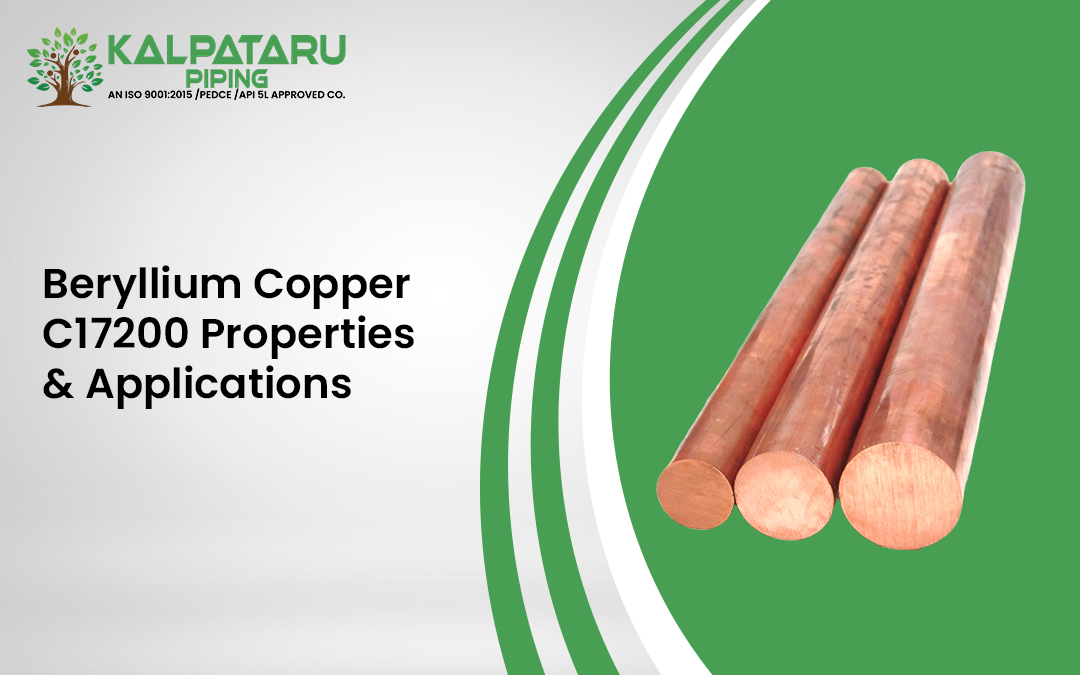
Beryllium Copper C17200 Properties & Applications
Beryllium copper C17200 is an alloy of its own, among all the commercial copper-base alloys. Also known as UNS C17200, Alloy 25, and BeCu 25, this wrought high-copper alloy is manufactured in both mill-hardened and heat-treatable tempers, and is suitable to virtually all applications which require the combination of high strength, dimensional stability, and dependable electrical operation.
At Kalpataru Piping’s dedicated C17200 product page, engineers and sourcing professionals can explore the full range of available product forms, i.e., rod, bar, plate, strip, tube, and wire at the dedicated C17200 product page of Kalpataru piping. This guide is a supplement to that resource with a data-driven and detailed examination of what is so attractive to C17200 material properties when it comes to critical engineering applications.
| Key Fact: C17200 copper in its peak-aged condition achieves an ultimate tensile strength in the 200 ksi (approximately 1,380 MPa) range and a Rockwell C hardness approaching RC 45, rivalling many grades of alloy steel while retaining the conductivity and corrosion resistance characteristic of copper alloys. |
This combination is the reason copper beryllium C17200 is specified in electronics, aerospace, precision tooling, defence ordnance, oil-and-gas downhole tools, and a wide range of industrial components where no substitute alloy can match its multi-property performance envelope.
What Makes Alloy 25 the Strongest Precipitation-Hardenable Copper?
The exceptional strength of Alloy 25, the trade name most used to refer to UNS C17200 is due to precipitation hardening, a heat treatment process that makes tiny components of beryllide compounds to develop in the copper structure. These particles hinder the motion of dislocations thus giving rise to the strength levels that cannot be matched by other copper-base alloys.
As contrasted with hardened alloys of the solid-solution type, including tin bronze or nickel silver, C17200 is strengthened by a two-step thermal treatment, first by a solution anneal that dissolves one component, beryllium, in the copper matrix, and secondly by an aging treatment that recrystallizes the solution as a fine dispersed form. What is obtained is a material that is machinable and corrosive as copper is in its soft form, but has the structural properties of a medium-carbon steel in its hardened state.
This guide includes the entire C17200 material properties profile, composition, physical properties, mechanical information of all tempers, fabrication behaviour and breadth of C17200 applications in industry sectors.
Chemical Composition of UNS C17200
The defining characteristic of beryllium copper alloy 25 is a precisely controlled beryllium content that enables precipitation hardening to unprecedented strength levels. The nominal elemental balance is set out below.
| Element | Min (%) | Max (%) | Nominal (%) | Role in Alloy |
| Copper (Cu) incl. Ag | Remainder | Remainder | ~97.9 | Base metal; conductivity matrix |
| Beryllium (Be) | 1.80 | 2.00 | 1.90 | Primary hardener via precipitation |
| Cobalt (Co) / Ni+Co | 0.20 (Ni+Co) | 0.6 (Ni+Fe+Co) | 0.20 | Grain control; elevated-temp stability |
| Aluminium (Al) | — | 0.20 | — | Residual / impurity limit |
| Silicon (Si) | — | 0.20 | — | Residual / impurity limit |
The beryllium content of 1.80–2.00% positions C17200 at the high-strength end of the BeCu family. A small addition of cobalt suppresses grain growth during solution annealing and improves performance at elevated temperatures — a critical advantage in aerospace and downhole oil-and-gas environments.
For a broader perspective on how this composition compares to other copper families, see Kalpataru Piping’s article on understanding the beryllium copper composition.
Physical Properties of C17200 Copper
Physical properties govern how copper beryllium C17200 behaves in service — from heat dissipation and thermal expansion to density and melting behaviour. These values remain essentially constant across tempers and are critical for thermal management and dimensional stability calculations.
| Property | US Customary | SI / Metric |
| Density | 0.298 lb/in³ @ 68 °F | 8.25 g/cm³ @ 20 °C |
| Specific Gravity | 8.26 | 8.26 |
| Melting Point — Solidus | 1,590 °F | 866 °C |
| Melting Point — Liquidus | 1,800 °F | 982 °C |
| Electrical Conductivity | 22 % IACS @ 68 °F | 0.129 MS/cm @ 20 °C |
| Thermal Conductivity | 62 Btu·ft/(hr·ft²·°F) @ 68 °F | 107.3 W/m·K @ 20 °C |
| Coeff. of Thermal Expansion | 9.9 × 10⁻⁶ /°F (68–572 °F) | 17.8 × 10⁻⁶ /°C (20–300 °C) |
| Specific Heat Capacity | 0.10 Btu/lb/°F @ 68 °F | 419 J/kg·K @ 293 K |
| Modulus of Elasticity (Tension) | 18,500 ksi | 128,000 MPa |
| Modulus of Rigidity (Shear) | 7,300 ksi | 50,330 MPa |
| Poisson’s Ratio | 0.300 | 0.300 |
| Electrical Resistivity | 46.2 ohms-cmil/ft @ 68 °F | 7.68 µΩ·cm @ 20 °C |
| Dimensional change on aging | Up to 2% decrease in length | Up to 6% increase in density |
|
Note on Dimensional Change During Aging Engineers designing precision tooling or mold inserts must account for the length decrease and density increase that occur when aging C17200 parts. These changes, up to 2% decrease in length and up to 6% increase in density, distinguish beryllium copper tooling practice from steel equivalents and must be factored into final machining allowances. |
The beryllium copper conductivity value of 22 % IACS applies in the precipitation-hardened condition. Aging to peak hardness simultaneously raises both strength and conductivity, a dual benefit unique among high-performance engineering alloys.
Mechanical Properties of BeCu 25 Across Tempers
The mechanical property profile of beryllium copper C17200 is highly temper-dependent. The alloy is available in solution-heat-treated condition for maximum formability, cold-worked states for balanced properties, and fully precipitation-hardened tempers for maximum strength, often designated TH04 for the hard-and-precipitation-heat-treated condition.
Flat Products — Selected Tempers
| Temper | Condition | Tensile Strength (ksi) | Yield Strength (ksi) | Elongation (%) | Hardness (Rc) | Fatigue Str. (ksi) |
| TB00 | Solution Heat Treated | 70 Typ | 32 Typ | 45 Typ | — (60 HRB) | — |
| TD04 | Solution Treated + Cold Worked Hard | 110 Typ | 104 Typ | 5 Typ | — (99 HRB) | — |
| TF00 | Precipitation Hardened | 175 Typ | 155 Typ | 6 Typ | 38 Typ | 36 Typ |
| TH02 | ½ Hard + Precipitation Hardened | 195 Typ | 175 Typ | 3 Typ | 41 Typ | 44 Typ |
| TH04 | Hard + Precipitation Hardened | 200 Typ | 180 Typ | 2 Typ | 42 Typ | 45 Typ |
| TM06 | Mill Hardened XHM | 168 Typ | 148 Typ | 7 Typ | 37 Typ | — |
| TM08 | Mill Hardened XHMS Spring | 182 Typ | 160 Typ | 6 Typ | — | — |
Rod — Peak-Aged Temper
| Section Size | Temper | Tensile Strength (ksi) | Yield Strength (ksi) | Elongation (%) | Hardness (Rc) |
| 0.375 in | TH04 | 205 Typ | 160 Typ | 2 Typ | 42 Typ |
| 3 in | TH04 | 195 Typ | 145 Typ | 4 Typ | 41 Typ |
| 3 in | TF00 | 182 Typ | 145 Typ | 4 Typ | 39 Typ |
Wire — Peak-Aged Temper
| Temper | Condition | Tensile Strength (ksi) | Yield Strength (ksi) | Elongation (%) |
| TB00 | Solution Heat Treated | 68 Typ | 28 Typ | 35 Typ |
| TD04 | Cold Worked Hard | 152 Typ | 125 Typ | 1 Typ |
| TH02 | ½ Hard + Aged | 200 Typ | 185 Typ | 1 Typ |
| TH04 | Hard + Aged | 212 Typ | 195 Typ | 1 Typ |
Among all product forms, C17200 wire in the fully hardened TH04 temper achieves the highest tensile strength at 212 ksi (1,462 MPa), making it the premier material for miniature spring wire, contact fingers, and precision coil springs where space constraints prevent the use of heavier sections.
For a direct comparison of how these values differ from standard copper grades, refer to Kalpataru Piping’s article on differences between regular copper and beryllium copper.
Beryllium Copper Hardness & Beryllium Copper Conductivity
The dual-property advantage of C17200 is most strikingly illustrated by placing its beryllium copper hardness and beryllium copper conductivity side by side across tempers.
| Property | Solution-Annealed (TB00) | Peak-Aged (TH04 / TF00) |
| Beryllium copper hardness (Rockwell) | ~60 HRB | RC 38–45 (product form dependent) |
| Vickers Hardness (approx.) | ~130 HV | ~380–420 HV |
| Beryllium copper conductivity (% IACS) | 17–20 % IACS | 22 % IACS minimum |
| Thermal Conductivity (W/m·K) | ~85 W/m·K | 107 W/m·K |
|
Why This Matters Precipitation aging does not merely increase strength, it simultaneously raises electrical and thermal conductivity by removing beryllium atoms from solid solution in the copper lattice. This is the opposite of what happens in most strengthening mechanisms, making BeCu 25 uniquely suited to applications requiring both load-carrying ability and electrical or thermal conduction. |
Explore more on this topic through Kalpataru Piping’s resource on the 5 unique properties of beryllium copper, a companion article that expands on why these characteristics make BeCu irreplaceable in critical applications.
Corrosion Resistance & Fatigue Life of Alloy 25 Copper
- Corrosion Resistance
Alloy 25 copper is an effective material in a wide variety of corrosive conditions. It has a copper-rich structure that offers inherent protection against fresh water, seawater, as well as a broad spectrum of industrial chemicals. It is resistant to corrosion in the atmosphere, and unlike steels, does not rust. This is why it has found use as an alloy in the marine instrumentation housing, oil and gas valve parts and chemical process equipment.
UNS C17200 provides superior resistance to corrosion, confirms Copper Development Association, listed as a primary selection reason when Belleville washers, connectors, fuse clips, bearings, bushings, pump components and valve seats are used, where mechanical load and chemical attack both take place. - Fatigue & Stress Relaxation Resistance
One of the distinguishing benefits of beryllium copper C17200 is fatigue strength, or the capacity to withstand crack propagation and crack initiation under repeated cyclic loads. In the hard-and-aged (TH04) state, flat products exhibit the fatigue strength of at least 45 ksi (310 MPa) at 100 times the 10-number cycles, with a measurement of the fatigue strength at 0.188 in section thickness.
Other properties of interest in electrical applications include stress relaxation resistance – the propensity of a spring element to lose its spring force permanently at operating temperature. The use of C17200 connectors and relay blades ensures that there is no loss of contact with the temperature at which phosphor bronze and brass have already started to relax and that is why it is used in high reliability electrical contacts in automotive and aerospace applications.
Fabrication & Heat Treatment of C17200 Beryllium Copper
The fabrication behaviour of copper beryllium C17200 is excellent, with good cold-working capability in the annealed state and outstanding hot-forming behaviour after solution treatment.
| Fabrication Process | Rating / Temperature |
| Cold Working | Excellent |
| Hot Forming | Excellent |
| Forgeability Rating | 40 (vs C37700 forging brass = 100) |
| Hot Working Temperature | 1,200–1,500 °F (649–816 °C) |
| Machinability Rating | 20 % (vs C36000 free-cutting brass = 100 %) |
| Solution Annealing | 1,425–1,475 °F (774–802 °C) for 0.5 min, water quench |
| Precipitation Treatment | 600 °F (316 °C) for 3 hours in air |
| Stress Relief | 400 °F (204 °C) |
Common Fabrication Processes
- Blanking, drawing, and forming (in the annealed TB00 state)
- Drilling, tapping, and turning (machinability rating: 20%)
- Forging at 1,200–1,500 °F
- CNC machining of rod, bar, and plate stock
Welding & Joining Suitability
| Joining Technique | Suitability |
| Gas Shielded Arc Welding (GTAW/GMAW) | Good |
| Coated Metal Arc Welding | Good |
| Spot Welding | Good |
| Brazing | Good |
| Soldering | Good |
| Seam Welding | Fair |
| Butt Welding | Fair |
| Oxyacetylene Welding | Not Recommended |
|
Health & Safety Note Machining, grinding, or welding beryllium copper generates beryllium-containing dust or fume. All fabrication operations must comply with OSHA beryllium standards and relevant occupational health regulations. Proper engineering controls and PPE are mandatory. |
C17200 Applications: Where Is Alloy 25 Copper Used?
The range of Alloy 25 copper applications indicates the rare set of characteristics that are presented by beryllium copper C17200. There is no other copper alloy that provides the same strength or a structural alloy that provides the same strength and conductivity. This makes C17200 the preferred choice of material in a wide range of industries.
- Electrical & Electronic
Relay blades, switch components, fuse connections, contact bridges, Belleville washers, spring connectors, and components of navigational instruments. The choice to be electrically conducting, of very high strength, creep resisting, and stress relaxation resistant – the combination that maintains contact force constant through millions of working cycles. - Springs & Fasteners
Springs with current carrying, lock washers, retaining rings, roll pins, screws, and bolts. The high fatigue and formability characteristics of the alloy enable it to be the standard spring material in the challenging working conditions where normal spring steels would be corroding or not conducting. - Industrial Components
Bearings, bushings, pump components, valve seats, valve stems, shafts, spline shafts, diaphragms, bellows, Bourdon tubes, wear plates and welding equipment. The galling resistance and wear resistance of C17200 are very high, which allows it to have a relatively high service life in highly-contacting applications. - Aerospace & Defence
Firing pins, instrument housings, non-sparking safety tools and machined parts. Its non-magnetic behaviour and high strength-to-weight ratio is of great importance in avionics, ordnance and defence electronics. - Tooling, Oil, Gas, and Hazardous Areas
Tools that have the potential to produce friction sparks are not allowed in hazardous-area classifications such as ATEX Zone 1 and NEC Class I Division 1 environments. Beryllium copper C17200 is non-sparking, due to the absence of iron which forms ignition-generating sparks on impact, this makes it the material of choice of wrenches, hammers, chisels and scrapers in and around flammable gases or vapours in upstream oil and gas, petrochemical and grain-handling plants. - Tooling & Mold Making
Injection molds, welding electrodes and part of a rolling mill. The thermal conductivity of C17200 is high, which will aid the quick cooling of molds with shorter cycle times than tool steel inserts, but provide a hardened surface that can support high production volumes per mold run.
The full range of C17200 applications is also documented across Kalpataru Piping’s broader copper products category.
Industry Specifications for UNS C17200
Beryllium copper C17200 is covered by a comprehensive set of national and international standards. Reference the appropriate standard for your product form when specifying material from Kalpataru Piping.
| Product Form | Applicable Specifications |
| Bar & Rod | ASTM B196/B196M, AMS 4650, AMS 4651, AMS 4533, AMS 4534, MIL-C-21657, SAE J461, SAE J463 |
| Plate, Sheet & Strip | ASTM B194, AMS 4530, AMS 4532, ASTM B888/B888M, SAE J461, SAE J463 |
| Tube (Seamless) | ASTM B643, AMS 4535 |
| Wire | ASTM B197/B197M, AMS 4725, SAE J461, SAE J463 |
| Forgings & Extrusions | ASTM B570, AMS 4650 |
Additional designations include RWMA CLASS IV and CuBe2 2.1247 under DIN/EN standards, used in European welding and electrical engineering specifications.
Alloy 25 vs Standard Copper: How Do They Compare?
Engineers frequently ask why C17200 is specified over standard copper grades such as C11000 (electrolytic tough pitch copper) or C12200 (phosphorus-deoxidised copper). The answer lies in orders-of-magnitude differences in mechanical performance.
| Property | Pure Copper (C11000) | Beryllium Copper C17200 (TH04) |
| Tensile Strength | ~32–38 ksi (220–260 MPa) | ~195–212 ksi (1,344–1,462 MPa) |
| Yield Strength | ~10–30 ksi (70–207 MPa) | ~145–195 ksi (1,000–1,344 MPa) |
| Hardness | ~40–90 HRF | RC 38–45 (peak aged) |
| Electrical Conductivity | ~101 % IACS | 22 % IACS (aged) |
| Fatigue Resistance | Low | Very High (45 ksi at 10⁸ cycles) |
| Corrosion Resistance | Good | Good to Excellent |
| Non-Sparking | No | Yes |
| Non-Magnetic | Yes | Yes |
Kalpataru Piping’s article on differences between regular copper and beryllium copper provides a comprehensive engineering perspective on when to choose each option.
Frequently Asked Questions: UNS C17200 & Alloy 25 Explained
What is the difference between C17200 and C17300?
UNS C17200 (Alloy 25) contains 1.80–2.00% Be with cobalt for grain control and is the higher-strength grade. C17300 is a leaded variant with a small lead addition to improve machinability but at a modest reduction in mechanical properties. For most structural and electrical applications, C17200 is preferred.
What does TH04 mean for beryllium copper?
TH04 is the temper designation for cold-worked-to-full-hard then precipitation-heat-treated. It represents the peak-strength condition of C17200 material properties and is the standard temper specified for connectors, springs, and high-performance structural parts.
Is beryllium copper C17200 magnetic?
No. Copper beryllium C17200 is non-magnetic (paramagnetic) — an essential characteristic for applications in navigational instruments, MRI-compatible components, and sensitive electronic housings where ferromagnetic materials would interfere with performance.
Can C17200 be used in food or pharmaceutical contact?
Generally, BeCu 25 is not recommended for direct food contact due to beryllium content. It is primarily an engineering structural and electrical alloy. Consult applicable regulations and safety data sheets before considering any human-contact application.
What product forms does Kalpataru Piping supply in C17200?
Kalpataru Piping supplies beryllium copper C17200 in solid bar (round, rectangular, square), plate, sheet, strip, rod, seamless tube, wire, and custom forged/machined components. Visit the C17200 product page or the copper products section for enquiries.
Is Beryllium Copper C17200 the Right Alloy for Your Application?
Beryllium copper C17200, also known as UNS C17200, Alloy 25, and BeCu 25, stands unchallenged as the highest strength available of all the most common commercially available precipitation-hardenable copper alloys. Its tensile strength up to 212 ksi in the form of wire, beryllium copper hardness of up to RC 45, beryllium copper conductivity of 22% IACS in the peak-aged condition, excellent fatigue life, and excellent corrosion resistance all add up to a material that engineers turn to when nothing else will do.
The list of applications of the C17200 is immense starting with electrical connectors, current carrying springs, non-sparking oilfield tools, precision plastic injection molds, aerospace firing pins and the list goes on and on as engineers find more ways of using this special alloy. Knowing the material property of C17200, composition to temper and fabrication practice – helps procurement teams and design engineers to confidently specify C17200 and achieve its maximum performance potential.
Sourcing C17200 from Kalpataru Piping
If this guide has helped clarify the properties and potential of Alloy 25, Kalpataru Piping’s dedicated C17200 page covers available forms, tempers, and applicable specifications in one place.
Explore the full range: Beryllium Copper C17200 — Forms & Specifications.
Further Reading from Kalpataru Piping